
Introduction

The most profitable e-commerce SEO strategy for a store in France rests on three priorities, in this order: fix technical health (Core Web Vitals and indexing), optimize category pages for buying intent, then enrich product pages with content, reviews and structured data. These three measures account for most of the gains in organic traffic and revenue in the short and medium term.
Immediate actions (weeks 1 to 4):
- Run a full crawl with Screaming Frog or ScreamingCAT to identify indexing errors, missing redirects and pages with thin content.
- Open Google Search Console and check index coverage: excluded pages, 4xx errors and canonicalization issues.
- Measure Core Web Vitals (LCP, CLS, INP) with PageSpeed Insights on priority category and product pages.
- Identify the 10 to 20 highest-volume transactional queries for which your website ranks between 5th and 20th: these are your quick wins.
- Check that every product page has Product/Offer/AggregateRating JSON-LD markup.
Estimated schedule:
- 30 days: technical fixes (redirects, canonicals, sitemap, robots.txt), initial speed improvements. Expected outcome: fewer crawl errors and improved mobile LCP.
- 90 days: enrich category pages (200–400 words of editorial text, CollectionPage schema, stronger internal linking) and optimize the 20 priority product pages. Expected outcome: improved rankings on commercial queries and higher CTR through rich results.
- 180 days: a blog content strategy (2 000–4 000-word guide articles), targeted link building, and AEO/GEO preparation for generative answers. Expected outcome: a measurable increase in organic traffic and initial citations in AI Overviews.
For a microbusiness or SME, partial outsourcing generally costs between 500 € and 2 500 € per month, depending on page volume and technical complexity. Full outsourcing (technical work + content + link building + AI monitoring) often exceeds 2 500 € a month at a specialist agency.
Table of contents
- How should you segment your e-commerce queries to prioritise your pages?
- Are your product pages really optimized for Google?
- How should you structure your website so Google prioritises your commercial pages?
- Which technical audit should you run first for your online store?
- Schema.org structured data: how do you implement it correctly?
- How do customer reviews and UGC strengthen your SEO?
- Which KPIs and tools measure your store's SEO impact?
- Which pitfalls should you avoid to protect your organic traffic?
- How much does e-commerce SEO cost in France, and how should you choose a provider?
- How does Pharelia audit an e-commerce store's visibility?
- Key takeaways
- What most e-commerce SEO guides do not tell you
- Pharelia supports e-commerce stores on Google and in AI answers
- Useful sources and resources
- Frequently asked questions
How should you segment your e-commerce queries to prioritise your pages?
Keyword research for an online store is not just about finding high-volume terms. The challenge is matching each query type with the right page, because Google assesses how well the content provided fits search intent.
The three search intents in e-commerce
E-commerce queries fall into three main groups, each corresponding to a different stage in the buying funnel:
Transactional: the user is ready to buy or very close to buying. Examples: ‘buy women's running shoes’, ‘Dyson V15 vacuum cleaner price’. These queries target product and category pages with a direct call to action.
Navigational: the user is looking for a specific brand or website. Examples: ‘Nike France store’, ‘Fnac laptop’. They mainly concern your homepage, brand pages and main category pages.
Informational: the user is researching before buying. Examples: ‘how to choose an electric bike’, ‘difference between OLED and QLED’. These queries inform blog posts and buying guides, which then act as a stepping stone to commercial pages through internal linking.
A practical keyword research method
- Use research tools — Semrush, Ahrefs and Ubersuggest let you explore search volumes, difficulty and suggested long-tail queries specific to the French market.
Prioritisation matrix
| Query | Estimated volume | Intent | Difficulty | Target page | Priority |
|---|---|---|---|---|---|
| ‘women's running shoes’ | High | Transactional | High | Category | Medium term |
| ‘best trail running shoe 2026’ | Medium | Informational | Medium | Blog post | Short term |
| ‘buy Nike Air Zoom’ | Medium | Transactional | Low | Product page | Immediate |
| ‘how to choose your shoes’ | High | Informational | Medium | Buying guide | Short term |
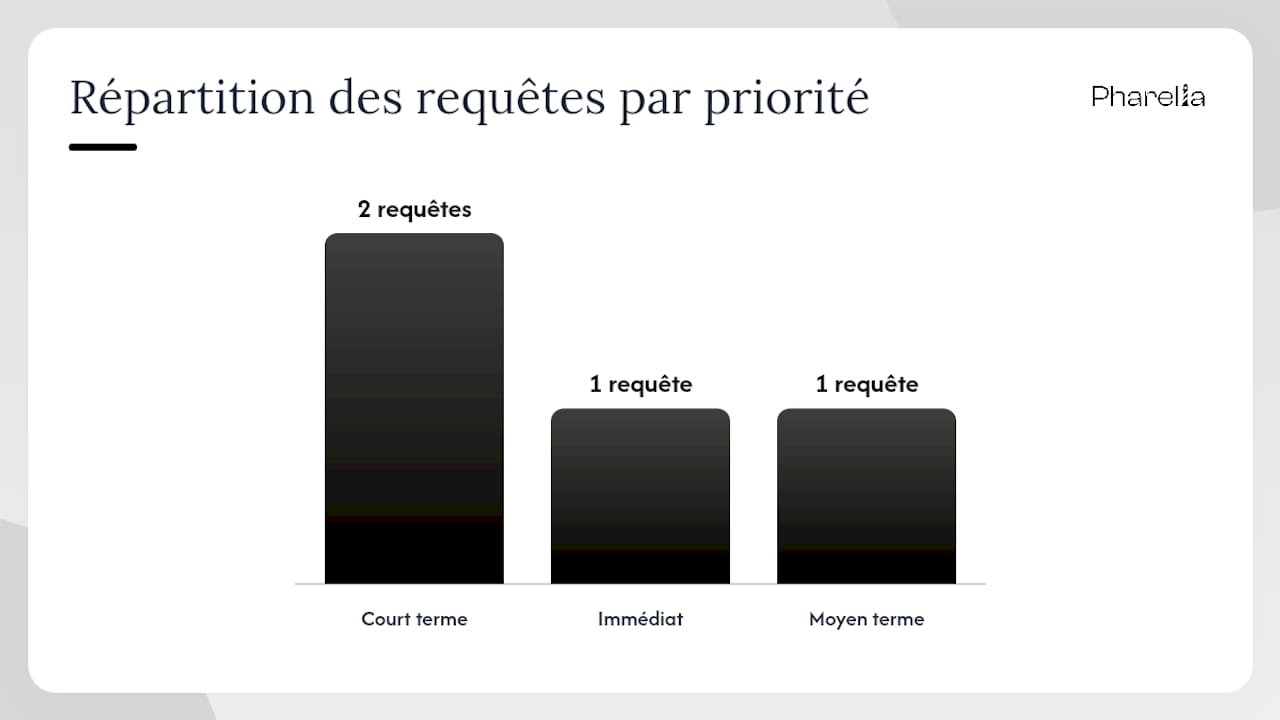
Stores that treat category pages as proper commercial content pages, with a 200 to 400-word introduction and an FAQ section, capture high-value commercial queries much better than those showing only a product grid. Practical guides and commerce-focused long-form content also help capture commercial queries and support internal linking to product pages.
Are your product pages really optimized for Google?
A product page that ranks well is not simply a page with a title and a photo. It is a structured document that answers every question a potential buyer may have, signals its relevance to indexing robots and displays stars in search results.
Product page checklist
- Long description: a description of at least 500 words, accompanied by optimized images and customer reviews, improves both visibility and conversion. For premium or technical products, aim for 800 words with detailed specifications, use cases and an integrated FAQ.
An example of minimal JSON-LD markup
{ "@context": "https://schema.org/", "@type": "Product", "name": "Chaussure Trail Runner Pro X", "image": "https://exemple.fr/images/trail-runner-pro-x.webp", "description": "Chaussure de trail légère pour terrains mixtes...", "brand": { "@type": "Brand", "name": "RunTech" }, "offers": { "@type": "Offer", "url": "https://exemple.fr/chaussures/trail-runner-pro-x", "priceCurrency": "EUR", "price": "149.00", "availability": "https://schema.org/InStock" }, "aggregateRating": { "@type": "AggregateRating", "ratingValue": "4.7", "reviewCount": "83" } }This snippet goes in the page's <head> or through a tag manager (Google Tag Manager). It lets Google display the price, availability and stars directly in search results.
Pro tip: On Shopify and PrestaShop, native or third-party extensions generate this markup automatically. Always check the output with Google's Rich Results Test before going live, because a missing field (particularly `priceCurrency` or `availability`) is enough to invalidate the entire snippet.
How should you structure your website so Google prioritises your commercial pages?
An e-commerce website's architecture determines how Google distributes authority between your pages. Poorly planned architecture dilutes this authority across hundreds of low-value pages instead of concentrating it on your priority categories and products.
Architecture principles
The basic rule: no commercial page should be more than three clicks from the homepage. The ideal path is: Home > Main category > Subcategory > Product page. Beyond four levels, crawlers visit less frequently and the authority passed through internal links weakens.

For mega menus, every link must point to a stable canonical URL. Avoid uncrawlable JavaScript links and menus that generate dozens of dynamic URL combinations.
Facets and filters: the index bloat trap
Faceted navigation (filters by colour, size, price and brand) is the main source of index bloat on e-commerce websites. Each filter combination can generate a distinct URL, multiplying the number of crawled pages by thousands without adding SEO value.
The strategy recommended by Google Search Central and confirmed by specialist technical guides is to leave filters crawlable so Google understands the structure, but prevent their indexing with a <meta name="robots" content="noindex, follow"> tag or a canonical directive pointing to the parent category. The only exceptions are combinations matching real queries with significant volume (for example, ‘red women's running shoes’ if that query generates measurable traffic).
Which technical audit should you run first for your online store?
Technical SEO is the foundation for everything else. A store with excellent product pages but indexing problems or a mobile LCP above 4 seconds loses a significant share of its potential traffic before Google has even assessed its content.
Technical audit steps
- Full crawl — run Screaming Frog or ScreamingCAT across the whole website. Identify pages with 4xx errors, redirect chains, duplicate title and meta tags, and orphan pages (without incoming internal links).
Priority fixes and expected impact
| Fix | SEO impact | Conversion impact | Difficulty |
|---|---|---|---|
| Missing 301 redirects | High | Medium | Low |
| LCP > 2,5 s on mobile | High | High | Medium |
| Pages without a canonical tag | Medium | Low | Low |
| XML sitemap not submitted | Medium | Low | Low |
| CLS > 0,1 (layout shift) | Medium | High | Medium |
| Blocking third-party scripts | High | High | Medium |
Speed and image management often deliver more conversion gains than small keyword variations. Prioritising LCP and reducing third-party scripts offers a quick return on investment, especially on mobile, where most e-commerce sessions now take place.
Pro tip: On PrestaShop, the native caching module and image compression are often disabled by default. On Shopify, third-party themes frequently load non-essential fonts and scripts: audit `theme.liquid` before any other optimization.
Schema.org structured data: how do you implement it correctly?
Structured data has become the language AI agents use to understand your products. Properly populated, it increases the likelihood of your product pages appearing in Google's rich results, shopping surfaces and generative answers from ChatGPT, Perplexity or Gemini.
Google explicitly recommends structured data suited to e-commerce, particularly the Product, Offer, AggregateRating and BreadcrumbList types. In 2026, optimization must cover traditional SEO, AEO and GEO: structured data and intent-focused content are priorities for staying visible in AI answers.
Essential fields by type
Product:
name: the exact product nameimage: the main image URL (WebP format recommended)description: an excerpt from the description (150–300 characters)brand: the brand namesku: the internal product reference
Offer:
price: the numeric price without a currency symbolpriceCurrency: ‘EUR’ for Franceavailability:InStock,OutOfStockorPreOrderurl: the product page's canonical URLpriceValidUntil: the price expiry date (recommended for promotions)
AggregateRating / Review:
ratingValue: the average rating (e.g. 4,6)reviewCount: the total number of reviewsbestRating: the scale's maximum value (usually 5)
Validation before going live
- Test every snippet with Google's Rich Results Test.
- Check for critical errors (missing required fields) and warnings (missing recommended fields).
- After deployment, monitor the ‘Enhancements’ tab in Google Search Console to detect errors across the website.
On Shopify, most themes generate Product markup automatically, but availability and reviews often require manual configuration or a third-party app. On PrestaShop, dedicated modules (such as the one from Prestashop Addons) can inject complete JSON-LD without changing the source code.
How do customer reviews and UGC strengthen your SEO?
Customer reviews are more than a trust signal for buyers: they provide fresh, unique content rich in natural keywords that Google values. A product page with 50 written reviews is structurally stronger than one with no reviews, even if both have the same written description.
Implementation and moderation
Every review must be authenticated (verified purchase) to meet Google's E-E-A-T requirements and the rules of France's DGCCRF, which has required transparency about review origins since 2022. Fake or unverified reviews expose businesses to regulatory penalties and algorithmic devaluation.
For moderation, tools such as Avis Vérifiés, Trustpilot and the native Shopify and PrestaShop systems let you collect, authenticate and display reviews while automatically generating the corresponding schema markup.
Pro tip: Send an automated review request 7 to 14 days after delivery, with a direct link to the form. [Prospect behavioural data](https://waalaxy.ai/fr/blog/avantages-donnees-comportementales-prospects) shows that the post-purchase engagement window is short: after three weeks, the response rate drops significantly. Personalise the email subject with the purchased product's name to maximise opens.
Which KPIs and tools measure your store's SEO impact?
Measuring an e-commerce website's SEO without connecting visibility data to revenue is like driving without a dashboard. Connecting Google rankings to organic revenue is possible once GA4 and Google Search Console are configured correctly.
Priority KPIs
| KPI | Tool | Frequency | Alert threshold |
|---|---|---|---|
| Organic impressions | Google Search Console | Weekly | Drop > 15 % over 7 days |
| Average CTR | Google Search Console | Weekly | < 2 % on category pages |
| Average position | Google Search Console | Weekly | Increase > 3 positions in the top 10 |
| Organic sessions | GA4 | Weekly | Drop > 10 % week on week |
| Organic conversion rate | GA4 | Monthly | < 1 % on mobile |
| Organic revenue | GA4 (e-commerce) | Monthly | Rolling monthly baseline |
| Indexed pages | Google Search Console | Monthly | Change > 5 % without explanation |
| Core Web Vitals | PageSpeed Insights | Monthly | LCP > 2,5 s or CLS > 0,1 |
Connecting SEO and revenue in GA4
To measure organic revenue, enable enhanced e-commerce tracking in GA4 and configure purchase events with the transaction_id, value and currency parameters. Add UTM parameters to your non-organic campaign links to isolate organic traffic clearly in reports.
In GA4, create a ‘Google organic traffic’ segment and apply it to the ‘Monetization > Ecommerce purchases’ report to see revenue directly attributable to organic search. Supplement this with Search Console data through the native GA4/GSC integration, which shows the queries that led to converting sessions.
The native Shopify and PrestaShop dashboards provide sales data by channel but do not distinguish organic subchannels as precisely as GA4. Use them for cross-checking, not as the main source.
Which pitfalls should you avoid to protect your organic traffic?
The most costly mistakes in e-commerce SEO are not the most complex. They often result from decisions made without measuring their impact on indexing: a platform migration without redirects, a catalogue update that deletes hundreds of pages, or activating filters without a canonicalization strategy.
Common pitfalls
- Deleting pages without redirects: deleting a product page without a 301 redirect to its parent category or a similar product destroys accumulated authority and generates 404 errors for users and robots. Consult the redirect management guide to structure this process.
Monthly maintenance checklist
- Check new crawl errors in Google Search Console.
- Check Core Web Vitals on the 10 highest-traffic pages.
- Audit newly created pages (products, articles) to ensure they are indexable and correctly marked up.
- Check for new instances of cannibalization after adding content.
- Check the number of indexed pages: a sudden change of more than 5 % warrants immediate investigation.
Pro tip: Set up an email alert in Google Search Console to be notified when a crawl error exceeds a defined threshold. On websites with large catalogues (more than 10 000 product references), a weekly automated crawl with ScreamingCAT or scheduled Screaming Frog detects regressions before they affect rankings.
How much does e-commerce SEO cost in France, and how should you choose a provider?
The SEO agency market in France is varied. Prices depend on catalogue size, technical complexity, the volume of content to produce and the level of integration with existing tools. Here are practical benchmarks to set your budget and select the right partner.
Questions to ask during an initial discussion
- Which tools do you use for crawling and rank tracking?
- How do you manage cannibalization and facets in a large catalogue?
- What is your approach to AI Overviews and generative answers?
- Who produces the content: in-house writers or subcontractors?
- What contractual commitments do you make if traffic drops without explanation?
For microbusinesses and SMEs, producing content in-house (with an agency-provided brief) and outsourcing technical work and link building often offers the best balance of cost and effectiveness. Pharelia's SEO guide for microbusinesses and SMEs explains this division of responsibilities.
How does Pharelia audit an e-commerce store's visibility?
The visibility audit is the starting point for every Pharelia engagement. It is not an automated report generated in five minutes: it combines crawl, SERP, Search Console and AI mention data to produce a list of actions prioritised by estimated impact.
Deliverables from the free audit
- A list of actions prioritised by estimated impact (high/medium/low) and the effort required.
- A qualitative estimate of potential gains over the first 90 days.
- A 90-day action plan with milestones and responsibilities.
The published client case studies illustrate what this method delivers in practice: Applewood recorded +300 % organic traffic and +500 % citations in AI answers after a complete engagement. M2A improved by +86 % in one month on its priority queries.
The free audit covers the diagnosis and action plan. Technical fixes, content production, link building and monthly monitoring are part of paid support, structured into three packages according to the project's volume and complexity.
Key takeaways
Effective e-commerce SEO relies on three measures applied together: sound technical foundations, category pages treated as commercial content, and product pages enriched with schema, reviews and long descriptions.
| Point | Details |
|---|---|
| Immediate technical priority | Fix Core Web Vitals (LCP < 2,5 s), missing redirects and indexing errors before any other work. |
| Underused category pages | Add suitable editorial text and CollectionPage schema to every priority category to capture commercial queries. |
| Product pages and schema | A 500+ word description, reviews marked up with AggregateRating, and complete Product/Offer JSON-LD are the three conditions for a rich result. |
| Facets and index bloat | Canonicalize or noindex non-priority filter combinations to preserve crawl budget for commercially valuable pages. |
| Pharelia for e-commerce | Pharelia audits stores' organic and AI visibility free of charge, then handles technical work, content and link building under one monthly contract. |
What most e-commerce SEO guides do not tell you
The debate over e-commerce SEO priorities often revolves around the same topics: keywords, backlinks and speed. This framework is not wrong, but it obscures a more nuanced reality that I regularly observe on the websites we audit.
The most underestimated opportunity remains category page architecture. Most stores in France treat their categories as simple, filterable product grids. Yet a well-built category page, with editorial text focused on buying intent, a marked-up FAQ and links to priority product pages, often generates more traffic than ten individual product pages. This is where the commercial value of high-volume queries is concentrated.
The other blind spot is preparation for generative answers. In 2026, a store that does not appear in ChatGPT or Perplexity answers on its product queries loses part of the discovery funnel that conventional SEO cannot fully compensate for. Comprehensive structured data and Q&A-structured content are currently the two most direct ways to address this, well ahead of link building or long-tail optimization. This is why Pharelia covers all three surfaces — SEO, GEO and AEO — under one contract: separating them in 2026 means optimizing for only part of your buyers' discovery journey.
Finally, on budget: the retailers achieving the best results are not necessarily those spending the most. They have clear priorities, rigorous monthly monitoring and the ability to fix regressions quickly. An audit is an essential starting point, not a luxury reserved for major retailers.
Pharelia supports e-commerce stores on Google and in AI answers
E-commerce stores making the fastest organic progress share one characteristic: they do not split technical SEO, content production and AI monitoring into three separate projects assigned to three different providers. Pharelia handles all three under one monthly contract, without an annual commitment.
Within a few days, the free visibility audit produces a prioritised action list, a 90-day plan and a qualitative estimate of potential gains on your priority queries. It covers crawling, GSC coverage, Core Web Vitals, the state of structured data and your store's initial AI mentions. For Shopify or PrestaShop stores, Pharelia publishes directly into your existing stack.
The published results speak for themselves: +300 % organic traffic and +500 % AI citations for Applewood, +86 % in one month for M2A. For stores wanting to go further with visibility in generative answers, the resources on AI search optimization and GEO explain the method. Contact us on pharelia.com/secteurs/e-commerce to receive your personalised diagnosis.
Useful sources and resources
The resources below are the official and technical references cited in this article. They are the recommended starting point for exploring each area of work in more detail.
- E-commerce: how can you optimize your product pages for search? - francenum.gouv.fr
- SEO Best Practices for Ecommerce Sites | Google Search Central | Documentation | Google for Developers
- The Ultimate Ecommerce SEO Guide for Technical SEOs | ScreamingCAT
- Ecommerce SEO in 2026 (Increase Your Organic Traffic) | BigCommerce
- Complete Ecommerce SEO Guide for 2026: 12 Ranking Levers
- Good SEO advice for an e-commerce website in 2025 | PrestaShop
- 9 steps to a successful e-commerce SEO strategy | Abondance
Frequently asked questions
What is e-commerce SEO?
E-commerce SEO encompasses all the techniques used to improve an online store's organic visibility in Google and other search engine results. It covers technical work (indexing, Core Web Vitals), content (product pages, categories, blog) and authority (backlinks, structured data).
What are the 3 types of SEO applied to an online store?
On-page SEO (optimizing content and tags on each page), technical SEO (indexing, speed, schema.org, architecture) and off-page SEO (link building, mentions, authority signals). For stores in 2026, a fourth area is added: AEO/GEO, which targets visibility in answers from generative AI engines such as ChatGPT and Perplexity.
Complete monthly support (technical work + content + link building + AI monitoring) generally costs between 1 500 € and 4 000 € per month for an SME with a medium-sized catalogue. A one-off SEO audit costs between 800 € and 3 500 €, depending on its depth. Pharelia offers a free visibility audit as a starting point.
How can I improve my online store's SEO quickly?
The three actions with a strong immediate impact are fixing indexing errors in Google Search Console, optimizing LCP on priority category and product pages, and adding Product/Offer/AggregateRating JSON-LD markup to product pages without structured data. These fixes produce measurable effects within 30 to 90 days.
Which is the best e-commerce SEO agency in France?
The best agency combines technical expertise (Core Web Vitals, schema, facet management), buying-intent-focused content production and AI citation tracking. Pharelia handles these three dimensions under one contract for microbusinesses, SMEs and startups in France, with a free audit at the start of the engagement.