
Introduction

The absolute priority for a small business or SME in France is to align SEO, GEO, and AEO with a measurable commercial goal, whether an appointment, quote request, or sale. Before launching any paid campaign or publishing content, take these three actions this week:
- Check site indexing in Google Search Console: an unindexed page does not exist for Google, nor for ChatGPT or Perplexity, which rely on the same indexes.
- Fix priority technical errors (missing title tags, poor Core Web Vitals, broken redirects).
- Optimize a page with high commercial potential, targeting a specific query with a structured answer.
A poorly indexed site reduces its chances of appearing in AI search engine answers. Fixing indexing before writing fifty articles is the practical rule that separates six months of useful work from six months of invisible content. Pharelia measures this impact through Google Search Console, GA4, and AI mention tracking, with publishable results: Applewood achieved +300 % in SEO and +500 % in AI visibility.
Table of contents
- What are the components of digital marketing for a business?
- How should you prioritize actions for your business?
- What practical action plan should cover the first 90 days, then 6–12 months?
- How can you measure the impact of your digital strategy?
- What do the figures say about achieved results?
- Key takeaways
- What practical experience really teaches
- Pharelia: delegate SEO, GEO, and AEO visibility
- Useful sources and further reading
- Frequently asked questions
What are the components of digital marketing for a business?
Digital marketing encompasses promotion and acquisition activities across digital channels, from search engine optimization to campaign automation. For a small business or SME, each activity serves a distinct goal:
- SEO (organic search visibility): improve organic Google rankings for specific commercial queries. The result: lasting qualified traffic without a cost per click.
- AEO (answer engine optimization): structure content into FAQs and Schema.org data to appear in Google's rich snippets and direct answers.
- GEO (generative search engine visibility): produce sourced, verifiable content to be cited by ChatGPT, Perplexity, and Gemini. A Google Business Profile listing is the fastest entry point for local GEO.
- SEA (search engine advertising): Google Ads campaigns for immediate visibility on queries with strong purchase intent. Ongoing cost, with an immediate stop when the budget ends.
- Content marketing: blog articles, guides, and case studies that answer buyers' questions and strengthen the site's topical authority (E-E-A-T).
- Social media: LinkedIn for B2B, Instagram or Facebook for local B2C. Useful for awareness and advertising retargeting, less effective for direct conversion.
- Email and automation: nurturing sequences, post-visit follow-ups, and contact scoring in a CRM. Small organizations often achieve their best return by combining targeted content with automated interactions.
The French government also recommends a hybrid approach, combining digital presence with on-the-ground activities to strengthen credibility and local word of mouth.
How should you prioritize actions for your business?
Before choosing an activity, assess your situation with this checklist:
- Business type: a small trade business, B2B SME, SaaS startup, or e-commerce business? The priority channel differs radically.
- Audience: B2B (long cycles, LinkedIn, SEO for industry queries) or B2C (social media, local SEO, display advertising).
- Geographic area: local (GEO + Google Business Profile listing), national (SEO + content), or international (multilingual SEO).
- Available monthly budget: below 500 €/month, focus on technical SEO and organic content. Above that, test SEA alongside them.
- Internal content production capacity: someone available two hours per week cannot maintain four articles per month without outside help.
Three decisive questions for prioritization:
- Which channel already generates conversions, even modest ones? Expand it before opening another.
- What is your acceptable cost per lead? If SEA exceeds this threshold, organic SEO takes priority.
- Do you have conversion tracking in place? Without configured GA4 and defined conversion goals, no budget decision is reliable.
Warning signs to fix before investing:
- Site not indexable (blocking robots.txt, widespread noindex pages).
- No conversion tracking in GA4.
- No ranking data in Google Search Console.
These three issues make any advertising or editorial budget unmeasurable and therefore unmanageable.
What practical action plan should cover the first 90 days, then 6–12 months?
Days 0–90: establish the foundations
The goal of this phase is to make the site technically sound, launch tracking, and achieve initial rankings on queries with high commercial potential.
- Weeks 1–2: complete crawl audit, indexing error fixes, GA4 and Search Console setup.
- Weeks 3–6: optimize 1 to 3 priority pages (service, product, local page), add FAQ structured data.
- Weeks 7–12: launch or update the Google Business Profile listing, run an initial SEA test campaign on 3 to 5 transactional keywords, publish the first two targeted content articles.
Months 6–12: scale and automate
Regular content production (at least two articles per month), development of internal linking to strengthen priority pages, expanded GEO and AEO work, and CRM setup with automated follow-up sequences.

Pro tip: Consistency beats perfection. Publishing one optimized article per week generates more cumulative traffic over twelve months than a comprehensive guide published once per quarter. Regularity is the most cost-effective short-term driver.
| Phase | Key actions | Indicative budget |
|---|---|---|
| 0–90 days | Technical audit, fixes, 1–3 optimized pages, local listing, SEA test | 500 €/month + test advertising budget (200–500 €) |
| 6–12 months | Regular content production, internal linking, GEO/AEO, CRM, and automation | 500 €/month and up, depending on volume |
How can you measure the impact of your digital strategy?
KPIs to track from the first month, with reporting frequency:
- Organic traffic (Google Search Console, weekly): number of clicks from organic results.
- Priority rankings (rank tracking tool, weekly): average rank for the 10 to 20 target commercial queries.
- GEO impressions (Search Console, Search tab, monthly): number of times the site appears in rich results and AI Overviews.
- AI mentions (dedicated tracking, monthly): number of times your brand or pages are cited by ChatGPT, Perplexity, or Gemini.
- Conversion rate (GA4, monthly): percentage of visitors completing the target action (form, call, purchase).
- Cost per lead (GA4 + advertising data, monthly): budget spent divided by leads generated.
| Tool | Main role | Frequency |
|---|---|---|
| Google Search Console | Rankings, impressions, indexing errors | Weekly |
| GA4 | Traffic, conversions, user behavior | Monthly |
| Rank tracking tool | Rank on target keywords | Weekly |
| AI mention tracking | Citations in ChatGPT, Perplexity, Gemini | Monthly |
| CRM | Pipeline, scoring, lead conversion rate | Monthly |
Personalization and real-time data analysis distinguish high-performing businesses from those operating blindly. AI integration into content production and campaign management is also becoming a differentiator, as recent digital strategy analyses show, including this one.
What do the figures say about achieved results?
Pharelia's published results provide tangible indications of scale for French small businesses and SMEs:
- Applewood: +300 % organic traffic and +500 % visibility in AI search engines, following technical fixes and structured content production.
- M2A: +86 % organic traffic in one month, through indexing fixes and optimization of existing pages.
- Groupe Squadra: +50 % in two months, through internal linking and service page work.
- Hymalaia: +150 %, engagement ongoing.
These figures reflect specific situations: sector, site technical maturity, existing content volume, and allocated budget vary between clients. A small business starting from an unindexed site will grow faster in percentage terms than an already well-ranked SME. The common factor in these engagements: fixing technical barriers before producing content.
Key takeaways
The most cost-effective approach for a French small business or SME is to align SEO, GEO, and AEO with a specific commercial goal, starting with indexing and tracking fixes before editorial or advertising investment.
| Point | Details |
|---|---|
| Indexing first | An unindexed site cannot appear on Google or be cited by generative AI. |
| Editorial consistency | Regular publishing generates more cumulative traffic than infrequent, comprehensive content. |
| Actionable KPIs | Track rankings, organic traffic, AI mentions, and conversion rate in Search Console and GA4. |
| Indicative budget | Around 500 €/month for a complete SEO/GEO/AEO process, excluding advertising budget. |
| Pharelia | Covers SEO, GEO, and AEO under one contract, with a free visibility audit at the start. |
What practical experience really teaches
Most business owners who contact me have already invested in content or advertising without measurable results. Almost always, the cause is the same: the site was not technically ready to receive that traffic, or tracking was absent, leaving budget decisions blind.
The rule I always apply: fix indexing and configure GA4 before writing the first article or launching the first ad. Content published on a poorly indexed site will not be read by Google, much less cited by ChatGPT or Perplexity. That is editorial budget spent for nothing.
The other point generic guides underestimate: visibility in AI search engines is not a separate channel from SEO. ChatGPT, Perplexity, and Gemini rely heavily on pages indexed by Google. Working on AI search visibility without first having a technically sound site means building on sand.
When should you contact an agency? When internal content production capacity is insufficient to maintain a publishing schedule, or technical fixes exceed available skills. A free visibility audit based on crawl, SERP, and AI mention data is the most useful starting point for understanding where you really stand.
Pharelia: delegate SEO, GEO, and AEO visibility
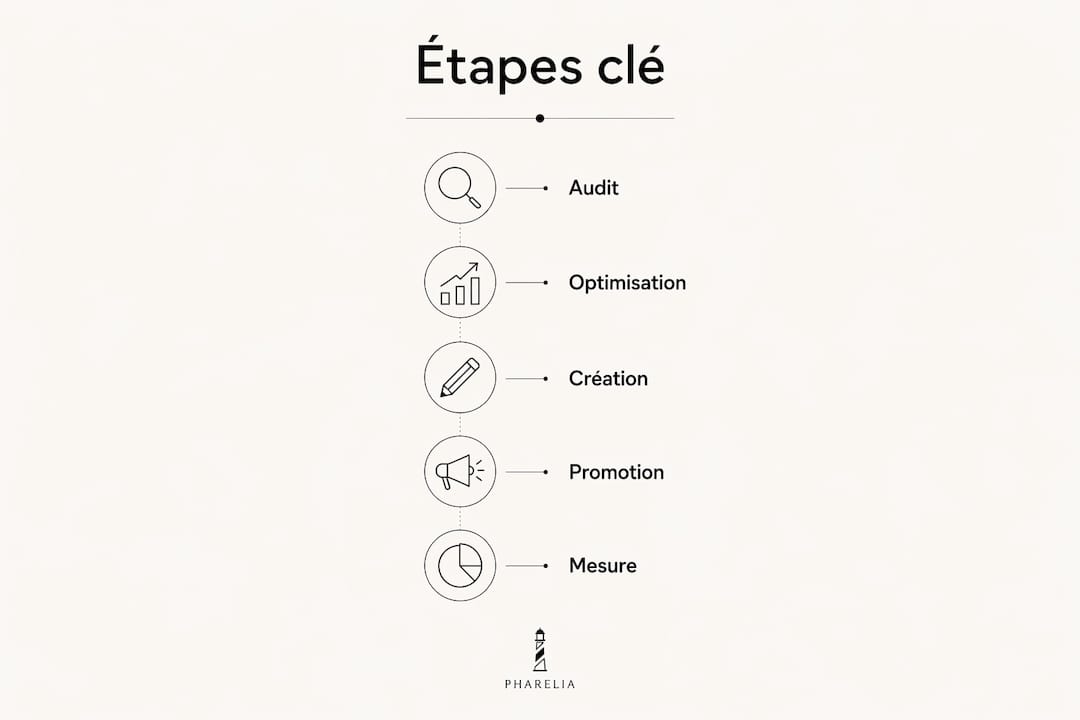
Pharelia covers all three visibility channels under one monthly contract, without an annual commitment: Google search visibility, presence in generative search engines, and answer optimization. For a small business or SME, this replaces eleven separate subscriptions, with one contact managing auditing, technical fixes, content production, and analytics reporting.
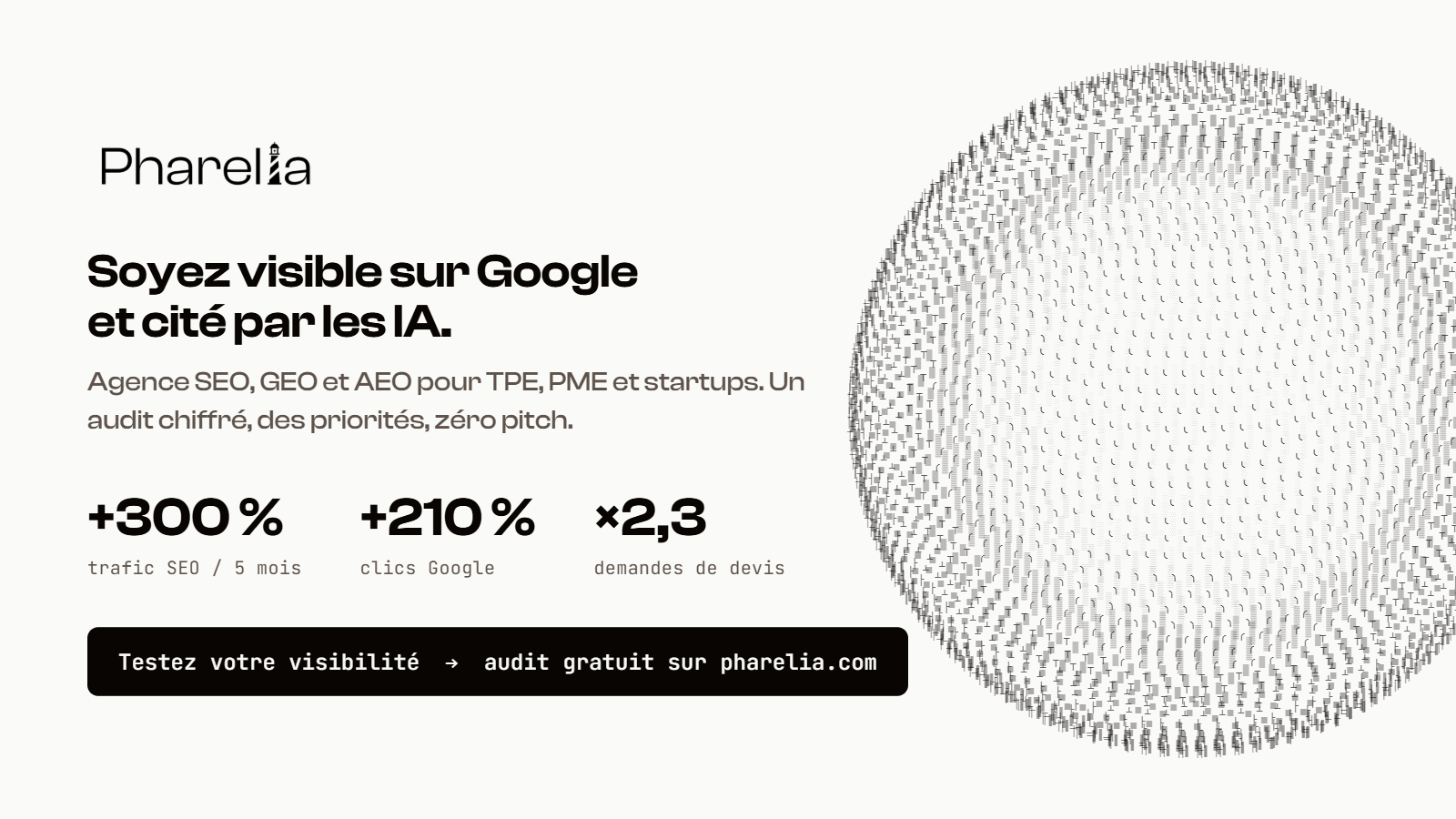
Every engagement starts with a free visibility audit based on the site's crawl, SERP, and AI mention data. Monthly packages start at 500 €/month, with publishing in your existing stack (WordPress, Shopify, Webflow, Framer, HubSpot). Applewood's results (+300 % SEO, +500 % GEO-AI) illustrate what this process delivers for a site starting from scratch. To get started, contact us.
Useful sources and further reading
- Service-public.fr: promoting your business — official French recommendations on business promotion, including free channels.
- HubSpot France: digital marketing strategy in 7 steps — an operational guide to editorial calendars, SMART KPIs, and automation.
- Mailchimp: how to promote your small business — practical small business tactics: SEO, local listings, review collection.
- EDC Paris: digital marketing strategy 2026 — academic analysis of generative AI integration into digital strategies.
- Pharelia: SEO guide for small businesses and SMEs — the recommended starting point after this article for exploring technical SEO and content publishing frequency.
- Errant Agency: using AI in marketing in 2026 — a practical guide to AI integration in campaigns, useful for GEO and AEO.
Where should you start after this guide? Run the visibility audit (crawl + indexing + AI mentions), configure GA4 with conversion goals, then optimize your Google Business Profile listing if you operate locally.
Frequently asked questions
What do GEO and AEO mean for a business?
GEO (generative engine optimization) aims to get your site cited by ChatGPT, Perplexity, and Gemini. AEO (answer engine optimization) structures content to appear in Google's rich snippets and direct answers.
What budget should a small business set for digital marketing?
A complete SEO/GEO/AEO process for a small business starts around 500 €/month, excluding advertising budget. Initial SEA test campaigns generally require an additional 200 to 500 € per month.
How long before SEO results appear?
Technical fixes produce effects within weeks. Significant organic traffic gains generally appear between 3 and 6 months after launching a regular content strategy.
How can I tell whether Google has indexed my site properly?
Type site:votredomaine.fr into Google or check the Coverage tab in Google Search Console. Excluded pages or pages with errors are listed there with their causes.
Does Pharelia work across all sectors?
Pharelia operates in seven sectors: SaaS and startups, B2B SMEs, e-commerce, consulting and professional services, local services and tradespeople, lawyers and regulated professions, and real estate. Every engagement starts with a free visibility audit.