
Introduction

To earn citations in Perplexity, make your pages accessible to crawlers, put each answer at the top of the page, and corroborate your claims with verifiable third-party sources. These three conditions are non-negotiable. Everything else is optimization.
Actions to start within 24 hours, in priority order:
High priority
- Check that PerplexityBot is not blocked in
robots.txtor your WAF/CDN configuration - Add an extractable summary (2–4 sentences, a direct answer) at the top of every strategic page
- Check indexing in Google Search Console: a page not indexed by Google or Bing has little chance of being retrieved by Perplexity
Medium priority
- Implement JSON-LD markup (FAQ, Article, Organization) on target pages
- Create or update original publishable data (an internal study, industry benchmark, numerical client result)
- Record an initial set of 20 representative prompts and run a baseline session in GA4
Low priority
- Add transcripts to existing videos to activate Perplexity's video surface
- Diversify mentions on domains Perplexity already cites in your sector
Perplexity includes clickable citations in a large proportion of its answers. Being absent from those citations means losing half the discovery funnel before a prospect even opens your website.
Key takeaways
Earning Perplexity citations requires three conditions together: technical crawl accessibility, extractable content at fragment level, and corroboration through verifiable third-party sources.
| Point | Details |
|---|---|
| Crawler access first | Check PerplexityBot in robots.txt and the WAF before any editorial optimization. |
| Sub-document extractability | Put a direct answer in 2–4 sentences at the top of every strategic section. |
| Third-party evidence | Publish original data and obtain mentions on domains already cited by Perplexity. |
| Structured measurement | Track six indicators (mention rate, share of voice, GA4 traffic…) across a set of 20–50 prompts. |
| Pharelia | Technical audit + extractable content + outreach + GSC/GA4 monitoring: a complete AEO methodology. |
Table of contents
- How Perplexity retrieves and cites your sources
- Why Perplexity changes the rules of conventional SEO
- Tactical checklist: how to increase your chances of being cited
- How to measure your visibility in Perplexity
- Pharelia's approach and numerical examples
- Common myths about Perplexity and SEO
- What most marketing teams miss about Perplexity
- Pharelia manages your visibility in Perplexity and Google
- Sources
- Frequently asked questions
How Perplexity retrieves and cites your sources
Perplexity presents itself as a real-time AI answer engine providing clickable citations and recommending verifiable sources with every answer. Its pipeline follows four distinct steps in practice.
- Query classification. Perplexity runs a multi-head classification that determines which surfaces to activate: text, video, maps, shopping. A ‘how to’ query may trigger a video widget and text results simultaneously.
The distinction between retrieved and cited is central. Perplexity can read a page without ever citing it if the content is not extractable enough or a competing source covers the same fact more directly.
What Perplexity's SSE stream reveals: practitioners intercept the real-time Server-Sent Events stream to observe which URLs are called and which fragments are read before the final answer appears. This diagnostic technique distinguishes a retrieved but uncited page from one ignored at the retrieval stage.
Why Perplexity changes the rules of conventional SEO
Conventional SEO optimizes at whole-document level: domain authority, internal linking, semantic density across the page. AI answer optimization (AEO, Answer Engine Optimization) works at fragment level. Sub-document indexing retrieves tens of thousands of small excerpts to fill the model's context window and reduce hallucinations. The direct consequence: a poorly structured 3 000-word article loses to an 800-word page where every paragraph starts with a direct answer.
What remains valid from conventional SEO:
- Technical indexability (robots.txt, canonicals, HTML rendering)
- Semantic topic coverage, including entities and co-occurrences
- Domain authority, which remains a trust signal for source selection
What changes or carries more weight for AEO:
- Freshness: pages with a visible update date and recent data are favoured
- Third-party evidence: mentions on domains already cited by Perplexity, reviews, partner studies
- Extractability: a direct answer at the start of a section, short definitions, tables, dated statements
Semantic optimization remains necessary: covering a topic conceptually, with named entities and relevant co-occurrences, improves eligibility for both Google and generative engines. Consult Pharelia's GEO guide to understand the operational differences between the two approaches.
Pro tip: *Make your internal data public: a product changelog, annual industry benchmark or anonymized usage statistics provide original data Perplexity preferentially cites because they are unique and verifiable.
Tactical checklist: how to increase your chances of being cited
Technical checks
- Crawler access: check that PerplexityBot (
PerplexityBot/1.0) is not blocked inrobots.txt, WAF rules or CDN configuration. Consult server logs to confirm actual visits. - HTML rendering: ensure critical content appears in static HTML without relying on client-side JavaScript. Server rendering or an HTML fallback is essential.
- Canonicals and indexing: any page canonicalized to another URL or excluded from Google's index is invisible to Perplexity.
Formatting for extractability
- A direct answer at the top of the page: the first two sentences must answer the main question without a preamble.
- Short definitions and dated statements: ‘In 2026, X represents Y according to [source]’ is a format LLMs extract easily.
- Structured tables and lists: comparative data in tables is retrieved as standalone fragments.
- Marked-up FAQs: add
FAQPageJSON-LD schema to pages answering frequently asked questions.
Third-party evidence and reputation
- Original publishable data: a benchmark, internal study or numerical client result with a visible methodology.
- Mentions on cited domains: identify domains Perplexity already cites in your sector and prioritise editorial placements on those sources. A guide to personalization at scale can help structure this outreach.
- Reviews and UGC: Google reviews, sourced testimonials and user-generated content strengthen the credibility perceived by models.
Schema.org structure
A minimal example of FAQPage markup in JSON-LD:
{ "@context": "https://schema.org", "@type": "FAQPage", "mainEntity": [{ "@type": "Question", "name": "Comment être cité par Perplexity ?", "acceptedAnswer": { "@type": "Answer", "text": "Rendez vos pages accessibles au crawl, structurez une réponse directe en tête de page et corroborez vos affirmations par des sources tierces." } }] }Pro tip: Add `dateModified` schema visibly in the HTML and in JSON-LD metadata. Perplexity favours pages whose freshness is explicitly signalled, particularly on queries with a strong time-related component.
The five pillars of a Perplexity-ready page are crawl access, answer-focused structure, clear brand facts, third-party evidence and citation measurement. Tactics ranked by impact confirm that publishing original data, allowing PerplexityBot and updating pages are among the highest-return actions.
How to measure your visibility in Perplexity
The six indicators to track
| Indicator | Definition | Recommended tool |
|---|---|---|
| Mention rate | % of prompts where your brand appears in the answer | Manual prompt set or audit SaaS |
| AI share of voice | % of citations earned versus competitors on the same prompt set | Manual aggregation or Am I Cited |
| Recommendation rate | % of prompts where Perplexity explicitly recommends your brand | Prompt set |
| Citation position | Your source's rank in the citation list | Manual reading of answers |
| Citation sources | Third-party domains mentioning you that are themselves cited | Backlink audit + prompt set |
| Referral traffic | Sessions from perplexity.ai in GA4, with conversion rate | GA4 + Google Search Console |
The recommended measurement framework covers these six indicators and advocates structured periodic tracking.
Building a prompt set
Perplexity is non-deterministic: the same question can produce different answers between runs. For reliable data, build a set of 20 to 50 prompts representative of your target queries, run them several times at different moments and aggregate the results. Analysing AI answers can guide the interpretation of the resulting citation patterns.
Recommended frequency: monthly audits for growing brands, quarterly for established brands. Consult the AI visibility measurement guide to build an operational dashboard.
Around 77 % of Perplexity answers contain clickable citations. In a market where most answers explicitly source their information, your brand's absence from these citations is not neutral: it is a visibly withdrawn position.
Pharelia's approach and numerical examples
Pharelia's methodology follows four sequential steps to earn AI citations.
- Technical audit: a complete crawl, PerplexityBot access checks, log analysis, and HTML rendering and canonical checks. Technical obstacles are addressed first, because no editorial optimization compensates for an inaccessible page.
- Extractable content production: every article is structured with a direct answer at the top, dated data, tables and JSON-LD markup. Semantic coverage follows E-E-A-T requirements: experience, expertise, authoritativeness, trustworthiness.
- Outreach to cited domains: identify sources Perplexity already cites in the client's sector, then secure targeted editorial placements on those domains.
- Tracking and iteration: Google Search Console for indexing, GA4 for referral traffic from perplexity.ai, and a prompt set for direct citations.
Publishable results illustrate the scale of possible gains: Applewood recorded +300 % organic SEO and +500 % GEO-AI citations; M2A improved by +86 % in one month; Groupe Squadra gained +50 % in two months.
The underestimated opportunity: intercepting Perplexity's SSE stream diagnoses precisely why a page is retrieved but not cited. This analysis reveals whether the problem is structural (a fragment that cannot be extracted), competitive (a third-party source covers the same fact more directly) or technical (the page is only partially read). Few marketing teams include this diagnostic step in their audit routine.
Common myths about Perplexity and SEO
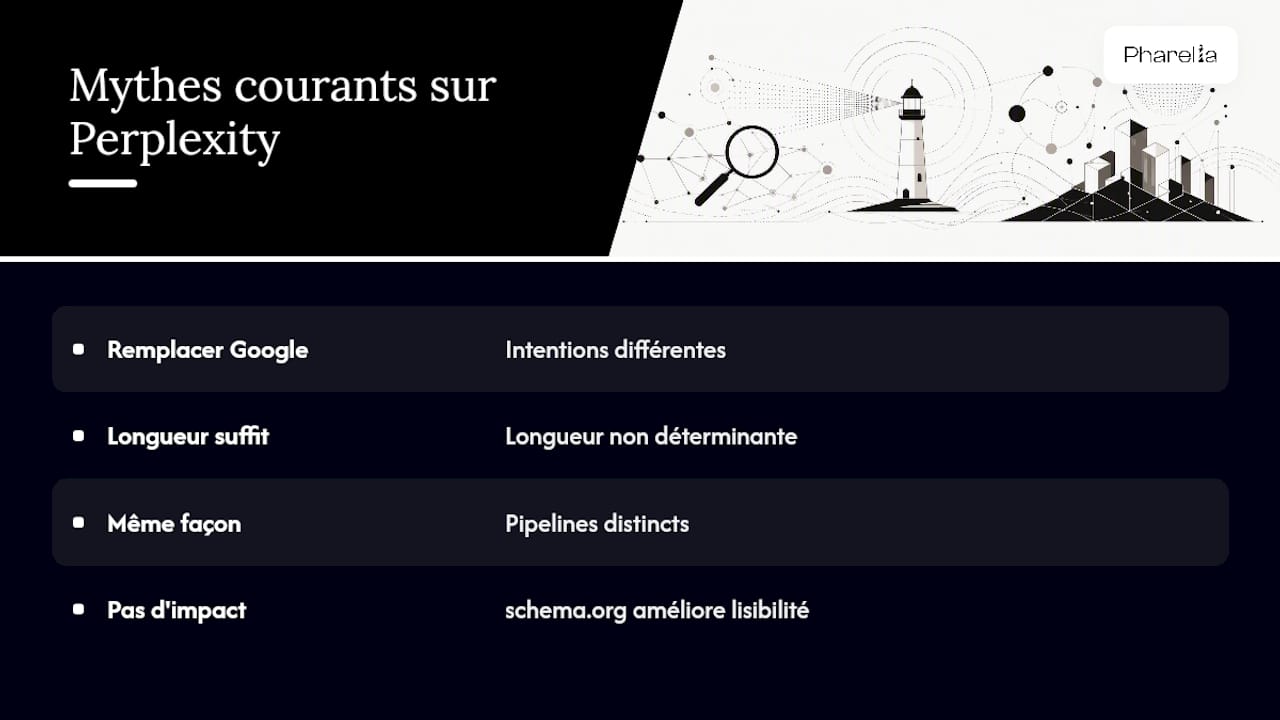
Myth 1: Perplexity will replace Google. The two engines address different intents. Google returns a list of results for users to explore; Perplexity synthesizes an answer with citations. The surfaces are complementary, and conventional SEO best practices remain relevant for eligibility in both.
Myth 2: long content is enough to get cited. Raw length does not determine citation. Extractability and third-party evidence matter more than a 5 000-word article without a direct answer at the top of each section. A well-structured 150-word fragment can beat a poorly organised comprehensive guide.
Myth 3: ChatGPT and Perplexity work the same way for SEO. ChatGPT Browse and Perplexity have distinct pipelines. Perplexity retrieves in real time with systematic citations; ChatGPT Browse is more selective and less transparent about sources. The tactics overlap (extractability, freshness, third-party evidence), but priorities differ.
Myth 4: structured data has no impact on Perplexity. Schema.org markup makes fragments easier for language models to read, although Perplexity publishes no official documentation on this point. Practitioners observe a correlation between marked-up pages and higher citation rates.
What most marketing teams miss about Perplexity
The temptation is to treat Perplexity as another Google: optimize the same pages with the same methods and hope citations follow. This is the wrong framework.
Perplexity does not rank pages. It assembles fragments. This paradigm shift radically changes what matters: not the whole page, but every paragraph taken individually. A marketing manager still measuring success only by Google rankings misses a surface where a 14,2 % conversion rate has been measured for AI search traffic, compared with 2,8 % for conventional organic traffic.

The other blind spot is measurement. Many teams know they ‘should’ track their Perplexity presence but have no protocol. Without a structured prompt set and repeated runs, the data is too noisy to guide decisions.
Finally, third-party evidence remains underestimated. Publishing excellent content on your own domain is not enough if no external source corroborates the same claims. Perplexity, like other generative engines, gives more weight to facts appearing in several independent sources. This is triangulation, not volume.
Pharelia manages your visibility in Perplexity and Google
You have just read the method. Implementing it requires time, tools and an audit routine most marketing teams do not have in-house.
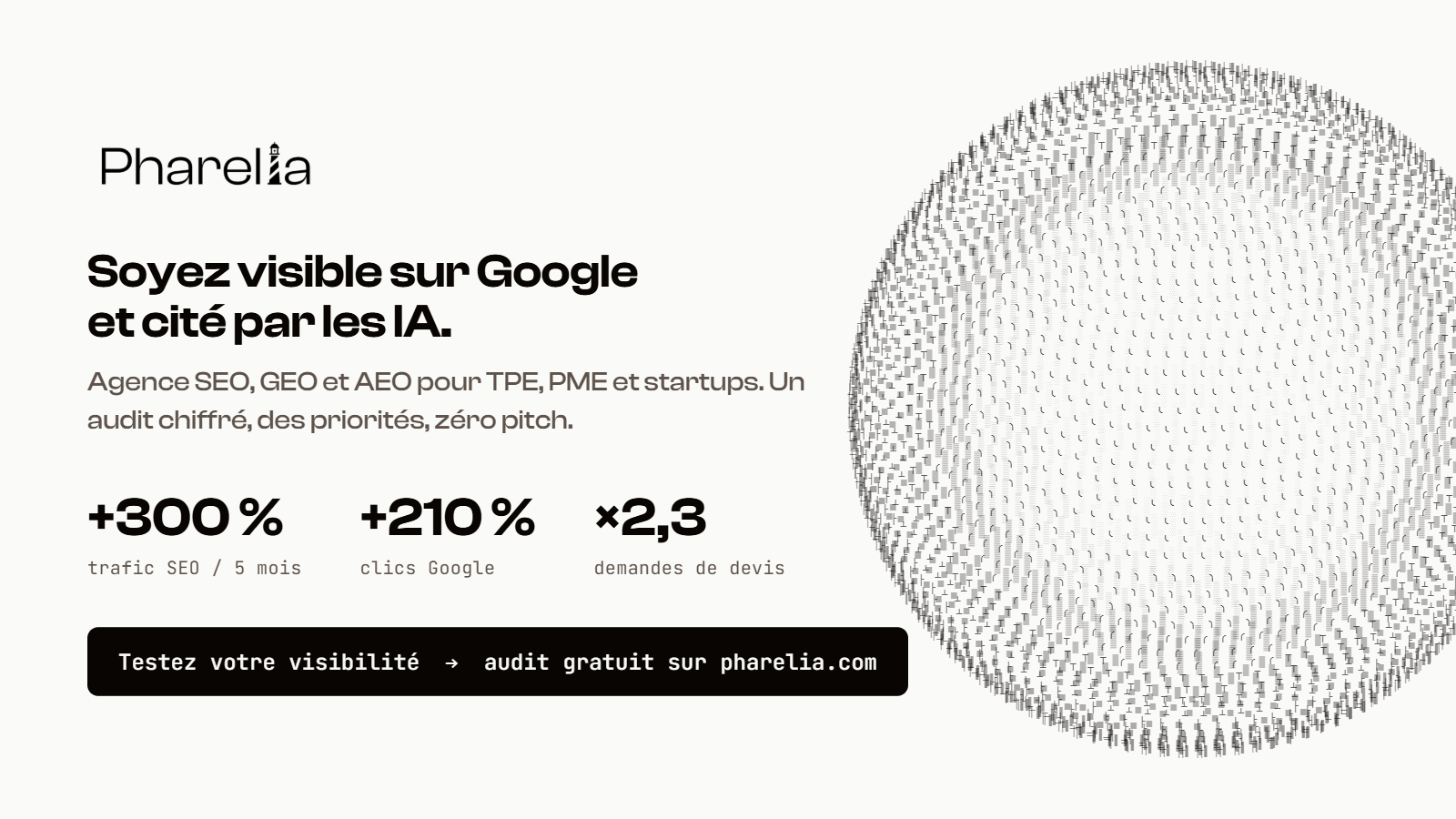
Pharelia operates the complete process for microbusinesses, SMEs and startups in France: technical crawl auditing, E-E-A-T-compliant extractable content production, outreach to domains Perplexity already cites in your sector, and monthly citation monitoring through Google Search Console, GA4 and a dedicated prompt set. One contract covers Google SEO and Perplexity, ChatGPT and Gemini citations.
Every engagement starts with a free visibility audit built on your crawl, SERP and AI mention data. Contact us to find out exactly where you stand in Perplexity today.
Sources
Frequently asked questions
Is Perplexity useful for my brand's SEO?
Yes, provided you treat Perplexity as a citation surface distinct from Google.
Can ChatGPT replace Perplexity for AI answer optimization?
The two engines have different pipelines. Perplexity retrieves web content in real time with systematic citations; ChatGPT Browse is more selective. Extractability and third-party evidence tactics apply to both, but Perplexity is more transparent about its sources and easier to audit with a prompt set.
Is Perplexity better than Google for finding information?
The two address different intents. Google returns a list of sources to explore; Perplexity synthesizes an answer with direct citations. For a brand, the challenge is not choosing one but appearing on both surfaces, because a prospect may move between them during the same search session.
How can I tell whether Perplexity already cites my website?
Build a set of 20 to 50 prompts representative of your target queries, run them several times (Perplexity is non-deterministic) and aggregate the results. Traffic from perplexity.ai is also visible in GA4 under the direct referral source. A structured audit with Google Search Console completes the diagnosis.
Is Perplexity suitable for B2B marketing in France?
Yes. B2B queries with a strong informational component (comparisons, definitions, technical guides) are precisely the intents where Perplexity generates sourced answers. French businesses publishing original data and structured French-language content have a real opportunity to earn citations on these queries.
Recommendation
- AI search optimization: SEO, GEO and AEO articles | Pharelia
- AI content and Google: penalties or not in 2026? | Pharelia
- Pharelia · Measurable SEO and AI visibility