
Introduction

In brief: - A PrestaShop SEO agency optimizes the platform to improve visibility on Google and generative engines. It fixes technical issues such as URLs, crawling and performance to increase qualified traffic. Content strategy, link building and precise monitoring ensure sustainable growth for online stores.
A PrestaShop SEO agency is a specialist provider that optimizes a PrestaShop store technically and semantically to improve its visibility on Google and generative engines such as ChatGPT or Perplexity. Organic search is not a cost: it is an asset producing qualified traffic without a recurring advertising budget. A store with strong search visibility attracts buyers at the precise moment they are looking for your products. For microbusiness and SME owners, outsourcing this work to an agency experienced in PrestaShop SEO often represents the most sustainable growth lever available.
What are the technical specifics of SEO on PrestaShop?
PrestaShop is a powerful e-commerce platform, but by default it creates several technical obstacles to search visibility. Identifying and fixing them is the first task of a specialist SEO agency.
URL structure and numeric identifiers
By default, PrestaShop inserts numeric identifiers into product and category URLs. A clean, descriptive URL without these identifiers improves understanding by crawlers and visitors' click-through rate. An agency configures URL rewriting rules in the .htaccess file to produce readable addresses such as /chaussures-cuir-homme/ rather than /product?id=142&cat=8.
Crawl budget management and duplicate content
Crawl budget refers to the number of pages Googlebot agrees to explore on a site within a given time. On PrestaShop, faceted navigation filters (size, color, price) generate thousands of near-identical URLs. Blocking pages with no SEO value, such as the cart, filters and sorting pages, in the robots.txt file preserves crawl budget for the pages that really matter.
Core Web Vitals and modules
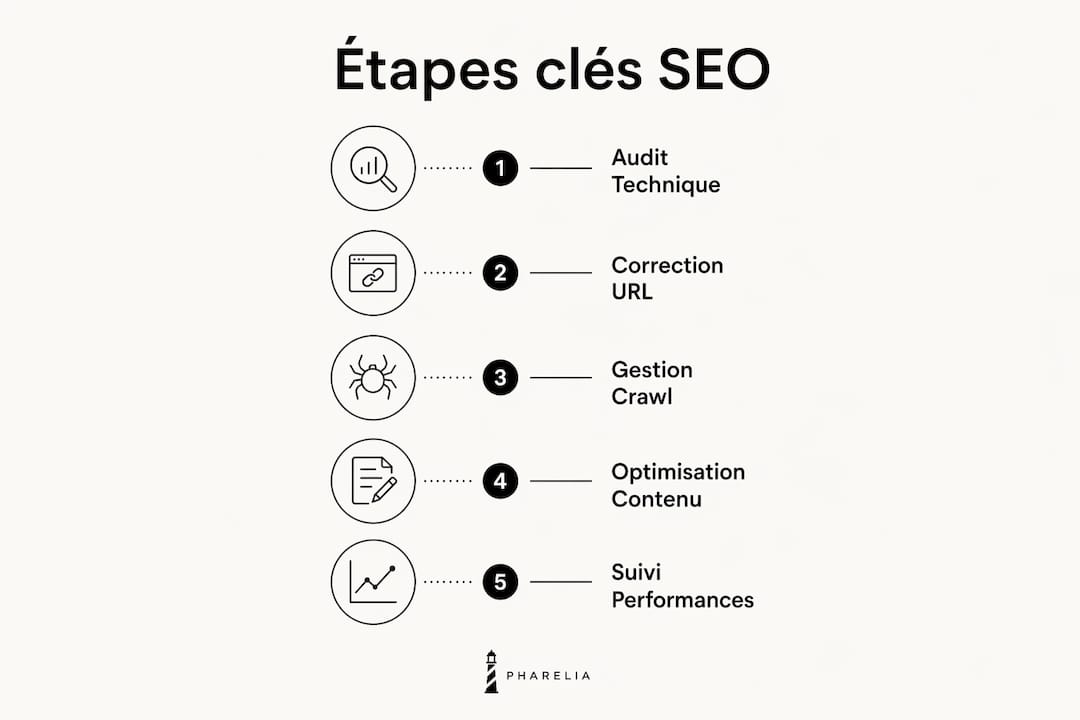
Core Web Vitals are visual performance indicators measured by Google: loading time, visual stability and responsiveness. Adding more and more modules to PrestaShop worsens these indicators by increasing the code executed on every page load. A competent agency audits installed modules, removes redundancies and favors direct code interventions over piling up third-party solutions.
Other technical points to master:
- Canonical tags: they tell Google which version of a page is the reference, avoiding duplicate-content penalties between product variants.
- 301 redirects: essential when redesigning a site hierarchy or changing URLs, to transfer accumulated authority to the new addresses.
- `sitemap.xml` file: must list only indexable pages and be submitted to Google Search Console to speed up crawling.
- Structured data: Schema.org markup on product pages allows stars, price and availability to appear directly in Google results.
Pro tip: Before any SEO project, carry out a [complete SEO audit](https://pharelia.com/en/resources/audit-seo-checklist) of your PrestaShop store. A technical crawl reveals 404 errors, orphan pages and canonicalization issues hindering indexing within a few hours.
How does a PrestaShop SEO agency optimize content?
Technical work alone is not enough. A well-configured PrestaShop store with poor product pages remains invisible on queries with strong purchase intent. Content strategy is the second pillar of organic search.
- Original, substantial product pages. Optimizing product pages with original content of at least 300 words is decisive for avoiding duplicate content and improving rankings. Copying and pasting supplier descriptions is the most widespread mistake: Google detects it and demotes the affected pages.
- Hn heading hierarchy. Each page must have a single H1 heading containing the main query, followed by H2 and H3 headings structuring the content for bots and readers. An agency audits this hierarchy across the entire catalog.
- Semantic silo architecture. Implementing a silo architecture avoids diluting SEO link equity and stabilizes rankings for key pages. In practice, each main category groups thematically consistent subcategories and product pages, without cross-links to unrelated areas.
- Internal linking and semantic content clusters. Intelligent internal linking and semantic content clusters help deeper pages rank and capitalize on long-tail searches. A contextual link between a product page and a related blog article transfers authority and guides visitors toward a purchase.
- Blog and educational content. A blog integrated into PrestaShop captures informational queries before purchase. An article on ‘how to choose your hiking shoe size’ attracts qualified visitors who then discover the catalog.
Pro tip: Use Google Search Console data to identify queries where your store appears in positions 11–20. These pages are priority candidates for content enrichment: a moderate effort is often enough to move them onto the first page.
How important is link building for a PrestaShop store?

Link building refers to all external links pointing to your store from other sites. Google interprets these links as votes of confidence. The more recognized the site citing you is, the stronger the signal.
Backlinks from authoritative sites provide the strongest votes of confidence for Google search visibility. A link from a specialist publication in your sector is worth more than ten links from generic directories.
A PrestaShop SEO agency builds this authority through several levers:
- Guest blogging: publishing bylined articles on partner sites, with a contextual link to your store.
- Digital PR: securing mentions in online media during product launches or industry studies.
- Editorial partnerships: link exchanges with complementary, noncompeting businesses addressing the same audience.
- Stronger internal linking: links between your own pages distribute acquired authority to priority product pages and categories.
- Recovering lost links: auditing broken backlinks or links redirected to deleted pages, then correcting them to avoid wasting accumulated authority.
Domain Authority (DA), an indicator developed by Moz, measures the overall strength of a site's link profile on a scale from 0 to 100. A PrestaShop store with low DA struggles to rank on competitive queries, even with quality content. Link building is the lever that improves this indicator over the long term.
How do you choose the right PrestaShop SEO agency for your microbusiness or SME?
The SEO agency market is crowded. Not all agencies understand PrestaShop's specific characteristics, and some apply generic methods that produce few results for an e-commerce store.
Criteria to evaluate before signing:
- Technical mastery of PrestaShop: the agency must understand module architecture, URL management, the
.htaccessfile and the platform's native indexing settings. - Documented initial diagnosis: every serious project starts with a technical and semantic audit, not a generic commercial proposal.
- Transparent monitoring: performance must be measured through Google Search Console and Google Analytics (GA4), with regular reports on rankings, organic traffic and conversions.
- Integrated content approach: an agency handling only technical work without producing content delivers incomplete work.
- Verifiable references: ask for e-commerce client cases with concrete metrics (changes in organic traffic, rankings on target queries).
Pro tip: Ask this question at your first meeting: ‘How do you manage duplicate content generated by navigation filters on PrestaShop?’ A competent agency immediately answers with precise technical solutions. A vague answer signals a lack of experience with the platform.
The following table summarizes the differences between a generalist approach and a specialist PrestaShop approach:
| Criterion | Generalist agency | PrestaShop specialist agency |
|---|---|---|
| Technical audit | Standard, not tailored to the platform | PrestaShop-specific crawl, modules, URLs |
| Duplicate content management | Basic handling | Canonicals, robots.txt, facets |
| Performance monitoring | Overall traffic | Rankings by category, conversion rate |
| Link building | Link volume | Sector-specific, contextual links |
| Reporting | Generic monthly reporting | Aligned with business objectives |
Publishing cadence is also a selection criterion: an agency regularly producing optimized content generates cumulative results far beyond a one-off intervention.
Key takeaways
Search visibility for a PrestaShop store rests on three inseparable pillars: fixing the platform's specific technical obstacles, a content strategy structured into semantic silos, and targeted link building from authoritative industry sources.
| Point | Details |
|---|---|
| PrestaShop technical work | Fix URLs, crawl budget and Core Web Vitals before taking any content action. |
| Original content | Each product page must exceed 300 words of unique content to avoid duplicate-content penalties. |
| Semantic architecture | Thematic silos stabilize rankings for categories and key product pages. |
| Industry link building | Backlinks from authoritative sites in your sector produce the most lasting ranking gains. |
| Ongoing management | Search Console and GA4 allow monthly strategy adjustments based on real performance data. |
What I observe after years working on e-commerce SEO
Most business owners who contact me have already tried SEO. They installed an ‘all-in-one’ module, filled in a few meta tags and waited for results. Nothing came. The mistake is not in the intention: it is in the method.
Reducing SEO to a list of keywords is a major mistake. It is an engineering discipline combining technical optimization and content strategy. On PrestaShop, this reality is even more pronounced than elsewhere. The platform creates structural problems that modules do not solve: they hide them temporarily, sometimes making performance worse.
I also observe a tendency to multiply SEO modules on PrestaShop, thinking that adding more produces better results. The opposite is true. Too many modules increase code weight and worsen Core Web Vitals, directly harming rankings. Stores progressing fastest are often those that simplified their technical stack before accelerating content production.
The other development I watch closely concerns generative engines. ChatGPT, Perplexity and Gemini cite sources indexed by Google. A poorly indexed PrestaShop store does not appear in these answers, even if its products are excellent. Traditional SEO and AI visibility are now linked. Working on one without the other means accepting that you will miss a growing part of the discovery funnel.
— Louis
Pharelia supports your PrestaShop store toward measurable visibility
Pharelia works on e-commerce store visibility across Google, ChatGPT, Perplexity and AI Overviews under one contract. Every project starts with a free technical and semantic audit built on your site's crawl, SERP and AI mention data.
Results are measured monthly through Search Console and GA4, with reporting aligned with your business objectives. The Applewood client case illustrates what an approach combining SEO and AI visibility produces: +300 % organic traffic and +500 % citations in generative engines. For e-commerce stores, Pharelia operates the entire system: technical work, content, link building and AI mention tracking, without multiplying providers. Contact Pharelia for an initial personalized diagnosis.
Frequently asked questions
What is a PrestaShop SEO agency?
A PrestaShop SEO agency is a provider specializing in organic search for stores built on the PrestaShop platform. It understands the platform's technical specifics: URL management, crawl budget, modules, Core Web Vitals and structured data.
How long does it take to see SEO results on PrestaShop?
The first ranking gains generally appear between 3 and 6 months after technical and content optimization begins. Results then accumulate month after month, unlike advertising campaigns that stop as soon as the budget is cut.
Why is PrestaShop SEO more complex than standard SEO?
PrestaShop generates specific issues by default: URLs with numeric identifiers, duplicate content linked to faceted navigation filters, and a risk of degraded performance from accumulating modules. These points require platform-specific technical expertise.
How do you measure a PrestaShop SEO agency's effectiveness?
Indicators to track are rankings on target queries, organic traffic in GA4, indexing coverage rate in Google Search Console and changes in revenue generated by the organic channel. Monthly reporting on these metrics is the minimum expected.
Does PrestaShop SEO replace paid advertising?
SEO does not immediately replace paid advertising, but reduces dependence over the long term. A well-executed SEO strategy can generate up to 70 % of sales at 12 months while significantly reducing advertising budgets.