
Introduction

In brief: - Generative engine optimization aims to structure content so it is cited in AI answers. It complements SEO by emphasizing content quality, structure and credibility. SMEs must build on solid SEO, produce factual content and track AI mentions to optimize their visibility.
Generative engine optimization (GEO) is the discipline of structuring and enriching content to be cited in synthesized answers produced by AI engines such as ChatGPT, Perplexity, Gemini or Mistral. GEO does not replace SEO: it adds an extractability layer, meaning a piece of content's ability to be selected, absorbed and reproduced by a generative model. Adding authoritative citations increases the probability of being cited by AI by 115 %. This figure means an SME that correctly structures its sources can multiply its presence in AI answers without increasing its advertising budget. Seer Interactive measures a 14,2 % conversion rate for AI search traffic, compared with 2,8 % for traditional organic traffic: the quality of the audience arriving through AI justifies the investment.
How does generative engine optimization differ from traditional SEO?
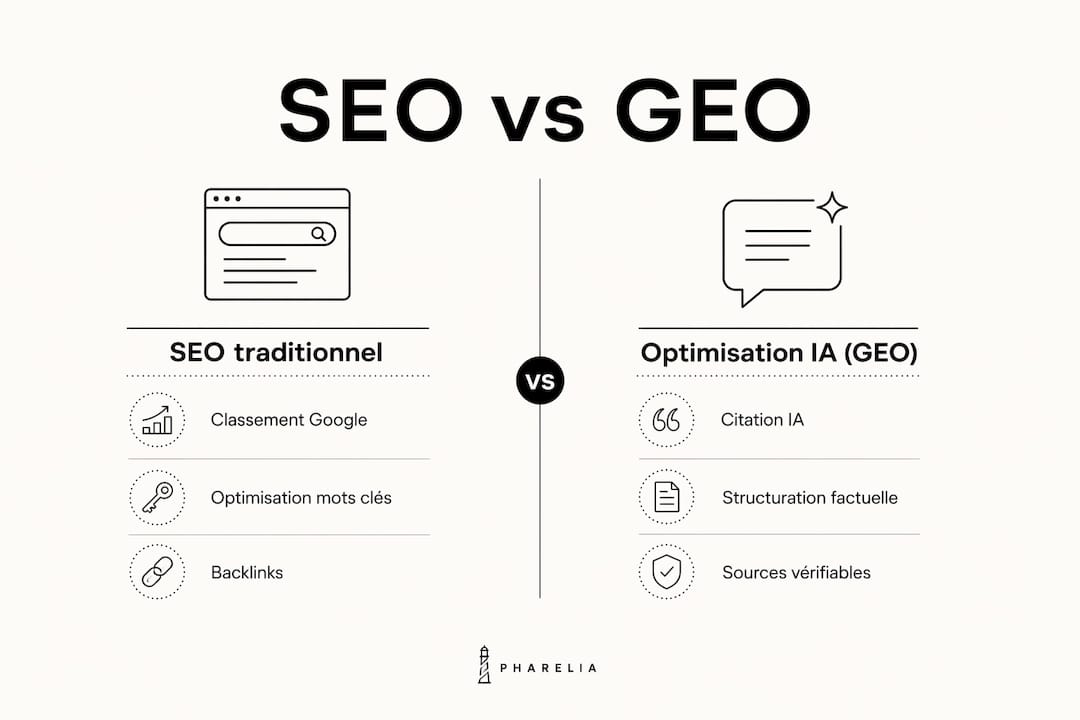
SEO targets a ranking on Google or Bing search results pages. GEO targets a citation in an answer written by AI. These are two distinct objectives, even though their technical foundations overlap.

How AI selects sources
A generative engine follows several steps before citing a source. It must first access the content (crawlability), then understand it (structure), then judge whether it can be cited (extractability), then absorb it into its synthesis. Around 15 % of pages retrieved by AI are actually absorbed into the final answers. This means most pages ranking well on Google are never cited by AI assistants because they lack sufficient extractability.
What GEO requires beyond SEO
| Criterion | Traditional SEO | AI optimization |
|---|---|---|
| Main objective | Position in SERPs | Citation in an AI answer |
| Key metric | Organic traffic, rankings | Citation rate, AI share of voice |
| Content structure | Keywords, tags, linking | Self-contained passages, attributable facts |
| Technical priority | Core Web Vitals, indexing | Static HTML, structured data |
| Credibility | Backlinks, domain authority | E-E-A-T, unlinked mentions, verifiable sources |
Both disciplines share crawlability and authority as prerequisites. But GEO adds another requirement: each passage must be extractable and understandable independently of the rest of the page. AI does not read an article from top to bottom like a human. It selects self-contained blocks of information.
Behavior also varies across platforms and markets. In 540 tests conducted in China, source overlap between generative engines was only 20–30 %. An effective GEO strategy therefore does not rely on a single engine.
What strategies can a microbusiness or SME apply in practice?

The good news for small businesses: GEO does not require an unaffordable budget. It requires a method.
Priority steps
- Carry out a complete [visibility audit](https://pharelia.com/en/resources/audit-seo-checklist). Check that your pages are indexed, your Core Web Vitals are satisfactory and your structured data (Schema.org) is in place. A site poorly indexed by Google mechanically reduces its chances of being cited by ChatGPT or Perplexity, which rely on Google and Bing indexes.
- Produce factual, specific content. Generic content is around 50 % less likely to be cited by AI. Each article must contain dated facts, identified figures and verifiable sources. Content saying ‘sales increased’ is ignored. Content saying ‘sales grew by 23 % in the first quarter of 2025 according to INSEE’ can be cited.
- Aim for formats between 1 000 and 3 000 words. Encyclopedic pages gain three times more influence per citation than short news pages. For an SME, this means industry guides, detailed comparisons or documented case studies.
- Structure each page into self-contained passages. AI must be able to extract a paragraph and understand it without reading the rest of the article. Use clear subheadings, numbered lists and explicit definitions at the first occurrence of each technical term.
- Make content accessible in static HTML. AI does not read content loaded dynamically through complex JavaScript. Vercel confirmed this in 2025: AI crawlers ignore client-rendered blocks. If your site relies on a JavaScript framework, check that server rendering is enabled or that key content is accessible in raw HTML.
- Increase brand mentions outside your site. A presence on Reddit, industry forums and YouTube increases generative engines' trust in your brand. AI learns from vast corpora including web discussions: a brand cited in authentic conversations is perceived as more reliable than one visible only on its own site.
Pro tip: Write an ‘About’ page explicitly naming your leaders, their years of experience and certifications obtained. E-E-A-T signals (experience, expertise, authority, trust) are strongly correlated with AI citation frequency according to SEO experts.
Advanced SEO strategies for microbusinesses and SMEs show that publishing cadence matters as much as quality on individual occasions. Regularly publishing updated content sends a freshness signal that AI values.
How do you measure your GEO strategy's effectiveness?
Traditional SEO metrics are not enough to assess GEO. A site can lose organic traffic while gaining AI citations because users obtain their answer directly in the assistant without clicking. Ahrefs measures 15–30 % fewer clicks on informational queries where Google displays an AI Overview.
Key indicators to track
- AI citation rate: how often your brand or content appears in answers from ChatGPT, Perplexity, Gemini and Mistral for your target queries.
- AI share of voice: your share of citations across a set of industry queries, compared with your market's.
- Unlinked mentions: the number of times your name appears on third-party platforms without a direct link to your site.
- AI traffic: sessions from AI referrals in Google Analytics 4, identifiable through sources ‘perplexity.ai’, ‘chat.openai.com’ or ‘gemini.google.com’.
- AI traffic conversion rate: compare it with traditional organic traffic to justify GEO investment.
Tools available for GEO tracking
| Tool | Main use | GEO relevance |
|---|---|---|
| Google Search Console | Google rankings and impressions | Indirect (SEO foundation) |
| Google Analytics 4 | Traffic and conversions by source | Direct (AI traffic) |
| Semrush AI Visibility Toolkit | AI citation tracking | Direct (AI share of voice) |
| Manual mention tracking | Presence on forums, Reddit, YouTube | Direct (unlinked mentions) |
Tracking AI citations is essential for measuring a GEO strategy's success. Without data on your mentions in AI answers, you are managing blindly.
What are the main GEO pitfalls to avoid?
GEO attracts shortcuts that damage visibility over the medium term. Here are the most common mistakes among microbusinesses and SMEs getting started.
- Producing generic content to ‘please AI’. Generative models favor specificity and factual richness. Vague text, even if well structured, will be ignored in favor of a source citing precise data.
- Neglecting technical accessibility. Content that cannot be crawled is invisible to AI, regardless of its writing quality. Regularly check that your pages are not blocked by robots.txt or unresolved JavaScript rendering.
- Relying on a single AI platform. Optimizing only for ChatGPT at the expense of Perplexity, Gemini or Mistral reduces your reach. Cited sources vary substantially from one engine to another, as the low-overlap data across platforms shows.
- Ignoring content updates. AI values freshness. An article published in 2022 without updates gradually loses relevance in generated syntheses. Plan at least an annual review for your pillar content.
- Sacrificing human readability. GEO should not turn your pages into lists of facts without a connecting thread. AI is also learning to detect over-optimized content. Text serving the human reader first remains the best foundation.
Pro tip: Check that your site appears on Wikipedia or is cited by sources referenced on Wikipedia. A Wikipedia presence improves credibility perceived by AI, which frequently uses the platform as a reference source.
Key takeaways
GEO rests on a solid SEO foundation, enriched with extractability, verifiable facts and mentions distributed across third-party platforms.
| Point | Details |
|---|---|
| GEO complements SEO | A site poorly indexed by Google will not be cited by AI: SEO remains the foundation. |
| Extractability above all | Structure each passage so it can be understood without additional context. |
| Dated, identified facts | Generic content is 50 % less likely to be cited than factual content. |
| Measure AI citations | Track your AI share of voice with dedicated tools, beyond traditional SEO metrics. |
| Multi-platform presence | Mentions on forums, Reddit and YouTube strengthen generative engines' trust in your brand. |
What I observe in practice with French SMEs
GEO is often presented as a radical break with SEO. That is not what I observe in practice. Companies obtaining citations in AI answers are almost always those that already had solid SEO: well-indexed pages, structured content and authority built over time.
What changes is the granularity of editorial work. Previously, a good article was enough to rank. Today, each paragraph must be able to stand alone, cited out of context in an AI answer. It is a change in writing approach, not a technological revolution.
What I recommend to microbusiness and SME owners: do not abandon SEO to chase GEO. SEO and GEO complement each other in a real, documented way. Start by fixing technical obstacles, then enrich existing content with precise data and citable sources. Results arrive within a few months, not a few weeks.
The mistake I see most often: owners publishing content in bulk, without structure or verifiable facts, hoping volume will compensate for quality. AI does not work that way. It selects the most credible, best-structured sources, regardless of the volume published.
— Louis
Pharelia supports your SEO and GEO visibility
Being cited by ChatGPT or Perplexity cannot be improvised. It requires a precise visibility audit, structured content production and ongoing AI mention tracking.
Pharelia covers all three surfaces under one contract: Google search visibility (SEO), presence in generative engines (GEO) and answer optimization (AEO). Every project starts with a free visibility audit built on your site's crawl, SERP and AI mention data. The results achieved with our clients show what this approach actually produces: +300 % SEO and +500 % AI citations for Applewood, +50 % in two months for Groupe Squadra. To learn more about our approach, consult the About Pharelia page.
Frequently asked questions
What is generative engine optimization (GEO)?
GEO is the practice of structuring content to be cited in answers generated by AI such as ChatGPT, Perplexity or Gemini. It complements SEO without replacing it.
Does GEO replace SEO for an SME?
No. SEO remains the foundation: AI relies on pages indexed by Google and Bing. A site with poor Google search visibility has little chance of being cited by AI assistants.
Which content is most often cited by AI?
Content between 1 000 and 3 000 words, structured into self-contained passages and rich in dated facts and verifiable sources. Generic content is around 50 % less likely to be cited.
How do I know whether AI cites my site?
Track your AI referral traffic in Google Analytics 4 and use AI citation tracking tools such as Semrush AI Visibility Toolkit to measure your share of voice for target queries.
How long does it take to see GEO results?
The first results generally appear within a few months, provided basic SEO is in order and content is regularly updated with precise data and citable sources.