
Introduction

At a glance: - Boosting SEO means improving a site's Google ranking to attract qualified visitors without paying per click. A technical audit, keywords organized by intent, and technical optimization are essential to an effective strategy. Regular performance monitoring lets you adjust the strategy and achieve lasting results.
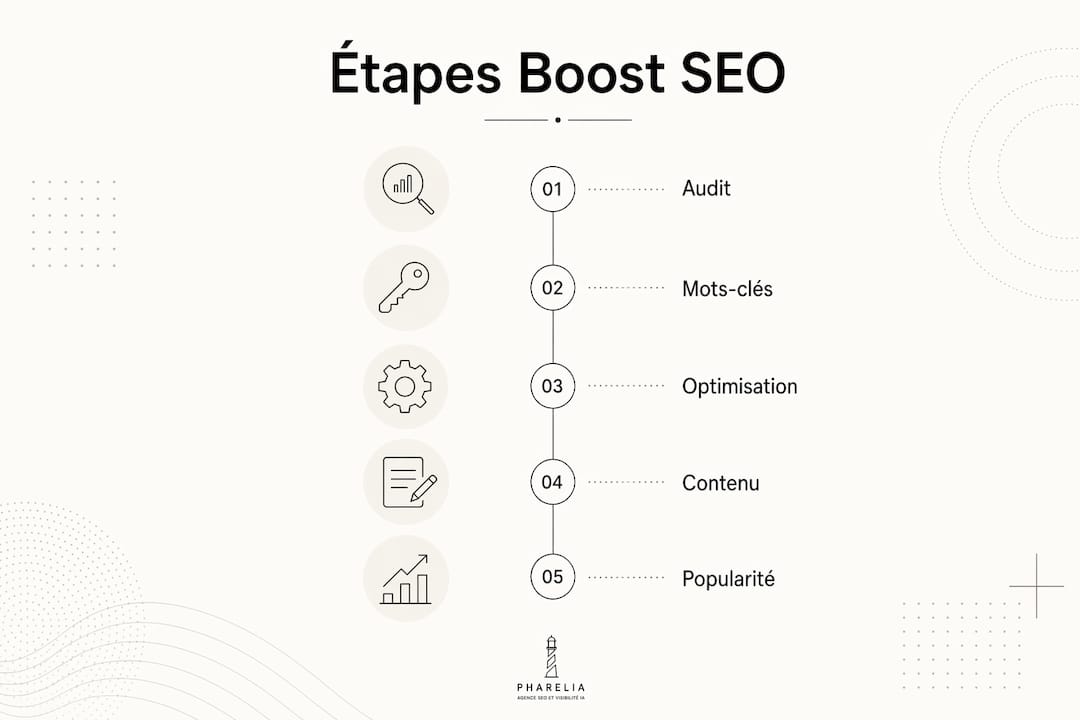
Boosting SEO, or organic search visibility, means improving your site's ranking on Google and other search engines to attract qualified visitors without paying for every click. For a small business or SME owner in France, it is often the most cost-effective way to generate inbound enquiries. An effective SEO strategy rests on four pillars: an initial audit, a keyword architecture, solid technical optimization, and targeted content production. Current standards such as Google's Core Web Vitals and the E-E-A-T framework (Experience, Expertise, Authoritativeness, Trustworthiness) define what Google expects of a site to rank it highly.
Why auditing your site is the first step in boosting SEO
An SEO audit is a complete diagnosis of your site. It covers three dimensions: technical factors (indexing, speed, security), content (quality, relevance, cannibalization), and inbound links (backlinks). Without this assessment, you risk investing in content Google cannot read or that competes with your own pages.
A technical audit detects blocking errors such as pages mistakenly set to noindex, an overly restrictive robots.txt file, duplicate content, or orphan pages. These problems prevent Google from crawling and indexing your site properly, even if your content is excellent. Fixing them first delivers quick, measurable gains.
Recommended audit tools are Google Search Console (free, provided by Google) and Screaming Frog (crawling software that analyzes all your site's URLs). Google Search Console reveals unindexed pages, coverage errors, and queries generating impressions without clicks. Screaming Frog identifies missing Title tags, redirect chains, and abnormal loading times.
These are the most common errors found during an audit:
- Orphan pages: pages with no incoming internal links, invisible to Google and your visitors.
- Keyword cannibalization: two pages target the same query, neutralizing each other in the results.
- Excessive loading time: a slow site harms user experience and rankings.
- Missing or duplicate Title tags: Google then generates its own titles, often less relevant.
- Thin content: pages with fewer than 300 words that provide no real value.
Pro tip: Start by exporting Google Search Console's coverage report. Filter excluded pages and identify those that should be indexed. This is often where the quickest gains are hiding.
Pharelia starts every engagement with a free visibility audit based on the site's crawl, SERP, and AI mention data. This audit reveals priority barriers before any content production.

How to choose and organize keywords to attract the right audience
Keyword research is not about listing popular terms. It is about mapping the questions your buyers ask at each stage of their decision-making process.
The TOFU/MOFU/BOFU model structures this map into three levels:
- TOFU (Top of Funnel): broad, informational queries. The user is discovering a problem. Example: “how to improve my site's SEO”. These queries generate traffic but few direct conversions.
- MOFU (Middle of Funnel): comparison or evaluation queries. The user is looking for a solution. Example: “SEO agency for SMEs France”. The traffic is better qualified.
- BOFU (Bottom of Funnel): transactional or branded queries. The user is ready to act. Example: “free SEO audit SME Paris”. Volume is low, but conversion rates are high.
The distinction between generic and long-tail keywords is decisive for a small business or SME. A generic keyword such as “SEO” generates millions of searches but is dominated by national providers with large budgets. A long-tail keyword such as “organic SEO plumber Lyon” attracts fewer visitors, but they are precisely within your catchment area and looking for exactly what you offer.
A topical intent map groups queries into semantic clusters. A cluster is a set of related pages around a central topic. For example, an “SEO audit” cluster includes an audit pillar page and supporting pages on technical, content, and backlink audits. This structure helps Google understand your expertise on a subject.
A semantic content cluster applies this logic to site architecture. Every supporting page links to the pillar page, and the pillar page links back to supporting pages. This internal linking concentrates authority on the most important pages and guides visitors toward conversion.
Technical optimization and UX: the pillars of effective SEO
Technical SEO covers speed, responsive design, HTTPS, URL optimization, and content structure through heading tags. These elements determine Google's ability to crawl, understand, and rank your site. Excellent content cannot compensate for a technically flawed site.
Core Web Vitals are performance metrics Google measures to assess user experience. They include LCP (Largest Contentful Paint, the time to display the main content), INP (Interaction to Next Paint, responsiveness to interactions), and CLS (Cumulative Layout Shift, visual page stability). A site failing these metrics loses rankings, even with relevant content.
These are the technical points to check first:
- HTTPS: the green padlock signals trust to Google and your visitors. A site using HTTP is penalized.
- Mobile first: Google indexes your site's mobile version first. A design unsuitable for smartphones directly reduces your ranking.
- Clean URLs: a URL such as
/services/audit-seo/is preferable to/page?id=42. It is readable for Google and your visitors. - Title and Meta description tags: the Title should contain the main keyword and stay below 60 characters. The Meta description (below 160 characters) influences click-through rate in results.
- Heading tags: one H1 per page, H2s for main sections, and H3s for subsections. This hierarchy helps Google understand content structure.
- Structured data (Schema.org): JSON-LD tags enabling Google to display rich snippets (stars, FAQs, prices) in results. These enhancements increase click-through rate.
| Technical element | SEO impact | Priority |
|---|---|---|
| Core Web Vitals | Rankings and user experience | High |
| HTTPS | Trust and indexing | High |
| Mobile first | Priority indexing by Google | High |
| Structured data | Rich snippets and visibility | Medium |
| Internal linking | Authority passed between pages | Medium |
Pro tip: Test your Core Web Vitals with PageSpeed Insights (Google's free tool). Focus on LCP first: compressing images and enabling caching often resolves 80 % of speed problems.
How to create content that improves search visibility
Content that ranks precisely meets search intent, is structured for quick reading, and relies on verifiable evidence. Quantity does not compensate for relevance. Publishing one comprehensive article per week is better than a superficial article every day.
The most effective formats for small businesses and SMEs are:
- Practical guides: they answer a complete question and establish your expertise. A guide on “how to choose an SEO provider” attracts MOFU-stage prospects.
- FAQs: they capture conversational queries and can be used directly by generative AI (ChatGPT, Perplexity) in its answers.
- Case studies: they demonstrate expertise through tangible results. Google values E-E-A-T, which includes demonstrated experience through real examples.
- Lists and comparisons: they answer “best X for Y” queries and generate featured snippets.
Updating existing content is often more cost-effective than creating new articles. An article published two years ago can return to the first page by updating data, adding an FAQ section, and optimizing tags. This approach draws on the content audit performed beforehand.
Natural keyword integration follows intent, not a target density. The main keyword appears in the Title tag, H1, first 100 words, and at least one H2. Semantic variations (synonyms, related questions) enrich the text without forced repetition. Google understands context; it does not count occurrences.
To be cited by generative AI, your content should answer a question directly in the opening paragraphs, use lists and tables, and rely on verifiable sources. Google values exactly these qualities too, making the two goals compatible.
How to build authority and measure SEO results
Backlinks, or inbound links, are votes of confidence from other sites. Quality takes priority over quantity: a link from a recognized, relevant site in your sector is worth more than ten links from generic directories. Google detects and penalizes artificial link schemes.
Natural strategies for gaining relevant links include:
- Press relations and local media: an article in a regional newspaper or a mention in a trade magazine generates a quality link.
- Sector partnerships: link exchanges with complementary partners (not direct competitors) in your industry.
- Creating citable resources: a guide, study, or free tool that other sites will naturally reference.
- Expert contributions: opinion pieces, interviews, and podcasts that generate mentions and links.
Performance tracking relies on two free tools. Google Search Console and Google Analytics let you continually adjust your strategy. Search Console reveals rankings, impressions, and click-through rate (CTR) by query. Google Analytics (GA4) measures visitor behavior on the site: page views, session duration, and conversion rate.
Key monthly metrics are total organic traffic, the number of keywords ranking on page 1, average CTR, and the number of indexed pages. Falling CTR on a well-ranked query often indicates that its Title or Meta description tag needs reworking.
Pro tip: Create a 30-minute monthly routine: export Search Console's performance report, identify the 5 queries with the most impressions and a CTR below 3 %, then rework those pages' Title tags. This action offers the best effort-to-result ratio.
Key takeaways
Organic visibility improves sustainably by combining a rigorous technical audit, keyword architecture organized by intent, targeted content, and monthly metric tracking.
| Point | Details |
|---|---|
| Start with an audit | Identifying blocking errors before production avoids wasting resources. |
| Structure by intent | Organizing keywords into TOFU/MOFU/BOFU clusters targets each stage of the buying journey. |
| Get the technical foundations right | Core Web Vitals, HTTPS, and mobile-first design determine indexing and rankings. |
| Produce targeted content | Precisely meeting an intent with verifiable evidence generates traffic and AI citations. |
| Measure and iterate | Monthly Search Console tracking lets you adjust the strategy around what actually works. |
What I observe after years of working on SEO for French SMEs
Most business owners I meet share the same instinct: produce more content. It is understandable, but often the wrong priority. Producing without auditing existing content misdirects effort. I have seen sites with 200 articles, 80 % of which cannibalized each other, without a single page reaching Google's first page.
What I observe in 2026 is that Google and generative AI are converging on the same criterion: clarity. Content answering a question directly, with evidence and a readable structure, ranks better and earns more citations. Publishing frequency matters, but structure matters more.
The second blind spot I regularly encounter is technical neglect. Business owners invest in writing for months without knowing half their pages are not indexed because of a misconfigured robots.txt file. A technical audit is not optional. It is the foundation.
Finally, SEO is not a one-off project. It is a process adjusted each month according to data. SMEs progressing fastest are those that establish a simple measurement routine and act on early signals before they become problems.
— Louis
Pharelia supports your visibility growth, from audit to results
Pharelia manages online visibility for French small businesses, SMEs, and startups across Google, ChatGPT, Perplexity, and other generative search engines under one contract. Every engagement starts with a free audit identifying priority barriers before any action.
The published results speak for themselves: Applewood achieved +300 % in organic search visibility and +500 % in AI citations following an overhaul of its architecture and content strategy. For tradespeople and local services, Pharelia adapts the strategy to the catchment area and location-specific queries that generate calls and quote requests. A free visibility audit is available at pharelia.com to start the diagnosis.
Frequently asked questions
What does an SEO boost mean in practice?
An SEO boost means the actions taken to improve a site's search engine rankings. This covers technical auditing, keyword research, content production, and inbound link development.
Where should I start to improve organic visibility?
An SEO audit is the first step. It reveals blocking errors (unindexed pages, duplicate content, insufficient speed) before any production or optimization begins.
How long does it take to see SEO results?
Initial technical results (indexing, error corrections) can be measured within weeks. Ranking gains on competitive keywords generally require 3–6 months of continuous work.
Do Core Web Vitals really affect rankings?
Yes. Google has used Core Web Vitals as a ranking signal since 2021. A slow or visually unstable site loses rankings against a technically better-configured competitor, even with equivalent content.
How can I tell whether my SEO strategy is working?
Google Search Console measures impressions, clicks, and rankings by query. Monthly monitoring of these metrics, combined with Google Analytics for on-site behavior, is enough to assess the effectiveness of your actions.