
Introduction

At a glance: - SaaS digital marketing means attracting, converting, and retaining customers on a subscription model through varied channels. Diversify channels from 500 000 € ARR and prioritize SEO to reduce acquisition costs. AI integration automates personalization, nurturing, and onboarding while preserving a human approach.
SaaS digital marketing encompasses coordinated digital actions to attract, convert, and retain customers on a subscription model. Unlike traditional product marketing, it incorporates three specific constraints: customer acquisition cost (CAC), customer lifetime value (LTV), and churn rate. A well-built multichannel strategy reduces CAC while extending subscriber lifetimes. For owners and marketing managers of small businesses, SMEs, and startups, mastering these activities directly determines long-term profitability.
What are the main channels in SaaS digital marketing?
SaaS digital marketing rests on five complementary channels. Each addresses a specific growth stage and a different customer profile.
- SEO (organic search visibility): generates qualified traffic over 2–5 years without a marginal cost per visit. It is the most cost-effective medium-term channel for SaaS products with long sales cycles.
- Paid advertising (LinkedIn Ads, Google Ads): produces immediate results but continuously consumes budget. Relevant at launch for validating messages and segments.
- Multichannel outbound: cold email sequences, LinkedIn Sales Navigator, targeted calls. Suited to B2B SaaS products with a high average contract value.
- Partner marketing: technical integrations, co-marketing, presence in industry marketplaces. Partnerships reduce CAC by 40 to 60 % compared with traditional paid acquisition. Most French SaaS SMEs underuse this channel.
- Community management: forums, LinkedIn groups, community Slack spaces. Builds awareness and reduces churn by creating a sense of belonging.
PLG, SLG, or a hybrid model: how does it affect channel selection?
The growth model directly determines which channel mix to prioritize. PLG (Product-Led Growth) suits intuitive solutions needing little support: users try, adopt, then pay. SEO and content marketing play a central role. SLG (Sales-Led Growth) applies to complex cycles involving negotiation: outbound and Account-Based Marketing (ABM) take precedence. ABM supports higher conversion rates for enterprise accounts because every account is treated as an individual market. Hybrid models combine both approaches according to the target customer segment.

Channel diversification is not optional. From 500 000 € ARR, at least two acquisition channels are necessary. From 5 million euros ARR, four channels are recommended to absorb algorithm or market fluctuations. A strategy combining 3–4 channels reduces CAC by 30 to 40 %. This reduction directly changes the profitability equation.
Pro tip: Before activating a new channel, check that your [basic SEO audit](https://pharelia.com/en/resources/audit-seo-checklist) is complete. A poorly indexed site cancels out part of your paid and outbound efforts.
How should SaaS marketing budgets be allocated by phase?
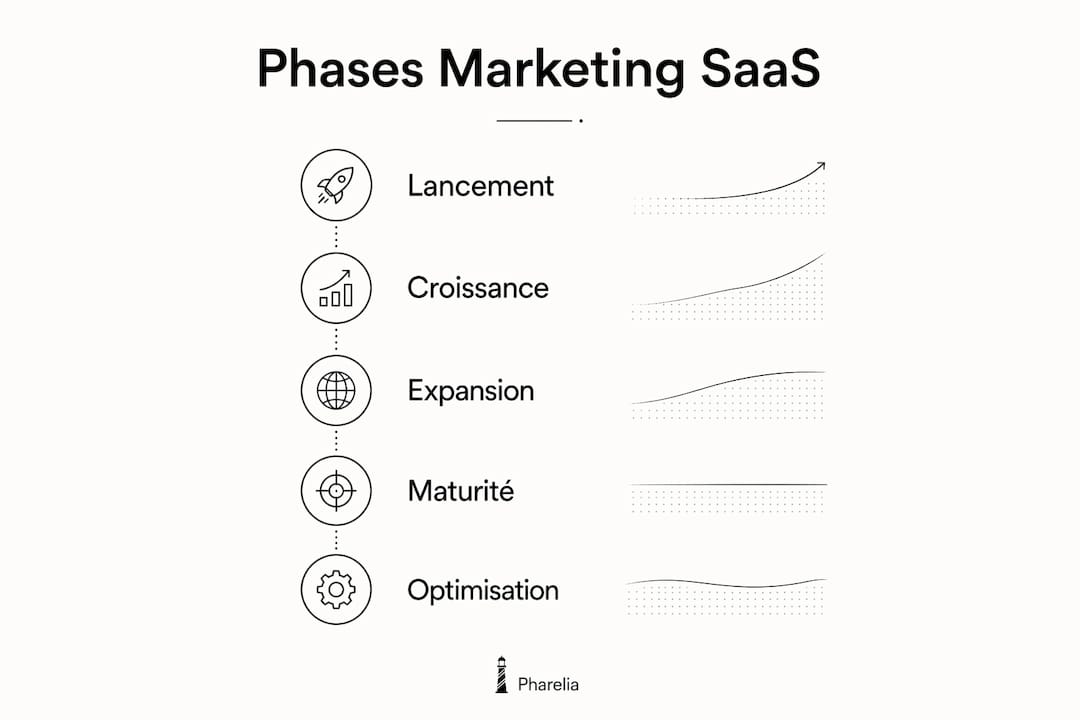
Budget allocation depends on product maturity. Here are the recommendations by phase.
- Launch phase (pre-PMF): allocate 40 to 60 % of the budget to content and SEO, and the rest to paid acquisition. The aim is to test messages quickly and identify converting segments.
- Post-PMF phase (validated Product-Market Fit): move to 70 % content and SEO, 30 % paid. SEO begins to produce a regular organic flow. Reducing paid dependence protects margins.
- Accelerated growth phase: add partnerships as a third budget pillar. An integration or co-marketing program with complementary providers generates qualified leads at low marginal cost. The effect accumulates over 12–24 months.
- Scaling phase: maintain publishing frequency for SEO authority and increase outbound investment in enterprise segments. ABM warrants a dedicated budget once average contract value exceeds 10 000 € per year.
Publishing frequency is often more decisive than the total content budget. Over 18 months, one optimized article published weekly outperforms a content campaign concentrated into two months.
Pro tip: Never reduce the SEO budget during paid growth. The two channels reinforce each other: content improves ad Quality Score and reduces cost per click.
Which KPIs should guide your SaaS marketing strategy?
Four metrics structure management of a SaaS marketing process.
- CAC (customer acquisition cost): total marketing and sales spending divided by new customers over a period. CAC ranges from 50–150 € for PLG SaaS to 4 000–8 000 € for enterprise solutions. This gap warrants radically different strategies by segment.
- LTV (customer lifetime value): total revenue generated by a customer throughout the subscription. Calculate LTV by multiplying average monthly revenue by average retention duration.
- LTV/CAC ratio: the ideal ratio exceeds 3 to ensure financial sustainability. Below 3, every euro spent on acquisition destroys long-term value.
- Churn rate: a high churn rate undermines profitability even with effective acquisition. A SaaS business acquiring 100 new customers per month but losing 80 is not growing. Retention is therefore a marketing channel in its own right.
Track these metrics monthly and segment them by acquisition channel. A channel with low CAC but high churn is less profitable than one with higher CAC and strong retention. SaaS marketing requires an educational approach focused on onboarding and churn reduction, not just new account acquisition.
How should AI be integrated into SaaS marketing campaigns in 2026?
Generative artificial intelligence transforms three dimensions of SaaS marketing: personalization, customer journey automation, and content production.
- Personalization at scale: large language models (LLMs) adapt email messages, landing pages, and outbound sequences to every prospect segment. This level of personalization was reserved for large marketing teams three years ago.
- Lead nurturing automation: CRM tools with scoring and automation have become essential for personalizing experience and optimizing the customer lifecycle. A prospect downloading a white paper automatically enters a sequence calibrated to their profile and behavior.
- Automated onboarding: email sequences triggered by in-app actions reduce churn during activation. A user who has not completed a key step receives a targeted message within 24 hours.
Pro tip: AI should accelerate production, not replace customer understanding. In SaaS marketing, AI should support human creativity and detailed prospect knowledge, not substitute for them. Review every generated piece of content through your ICP (ideal customer profile).
Google's AI Overviews also change how prospects discover content. A SaaS business whose articles are cited by ChatGPT or Perplexity captures an audience that never clicks traditional organic results. Generative search visibility is becoming an acquisition channel in its own right for B2B SMEs.
Key takeaways
Effective SaaS digital marketing combines SEO, paid acquisition, partnerships, and automation, calibrated to product maturity and the LTV/CAC ratio.
| Point | Details |
|---|---|
| Diversify channels from the outset | Activate at least two acquisition channels before reaching 500 000 € ARR to avoid dependence on a single channel. |
| Allocate 40–70 % to content and SEO | The SEO share increases after PMF validation to reduce long-term marginal acquisition costs. |
| Monitor the LTV/CAC ratio | A ratio below 3 signals an unprofitable model, regardless of acquisition volume. |
| Treat churn as a marketing factor | Automated onboarding and post-purchase nurturing reduce churn and increase LTV without additional acquisition cost. |
| Integrate AI thoughtfully | Use AI to personalize and automate, but retain human control of strategy and customer knowledge. |
What I observe in practice with French SaaS businesses
Most SaaS founders I meet make the same mistake: they launch LinkedIn Ads or Google Ads in the first month, gain a few leads, then wonder why CAC explodes as budget increases. Paid acquisition works for validating a message. It does not build a sustainable acquisition engine.
What is almost always missing is the organic foundation. A SaaS business without indexed content or domain authority pays full price for every lead indefinitely. SEO is not a luxury for large companies. It is the foundation that makes all other channels cheaper to operate.
Another blind spot I often see: churn is treated as a product problem rather than a marketing problem. Yet poor onboarding, generic post-registration emails, and absent educational nurturing explain a significant share of early cancellations. Marketing does not stop at conversion.
Finally, partnerships remain underused in France. Integrations with complementary tools, joint webinars, and visibility exchanges with noncompeting providers generate qualified leads at costs paid acquisition cannot achieve. This channel takes time to work, but its impact accumulates.
— Louis
Pharelia supports SaaS businesses and B2B SMEs with visibility
Pharelia develops SaaS and startup visibility across three channels simultaneously: Google, AI Overviews, and generative search engines such as ChatGPT and Perplexity. Every engagement starts with a free audit based on the site's crawl, SERP, and AI mention data.
The Applewood case study illustrates the results of a coordinated SEO and AI strategy: +300 % organic visibility and +500 % citations in AI answers. For SaaS businesses and B2B SMEs seeking structured acquisition without depending solely on paid channels, Pharelia operates the entire process under one contract. See the dedicated B2B SME service to understand how this model applies to your context.
Frequently asked questions
What is SaaS digital marketing?
SaaS digital marketing encompasses coordinated digital actions to attract, convert, and retain subscription customers while managing CAC, LTV, and churn rate.
What SEO budget should a SaaS business allocate at launch?
At launch, 40 to 60 % of the marketing budget should go to content and SEO. This rises to 70 % after Product-Market Fit validation.
What LTV/CAC ratio should a profitable SaaS business target?
The LTV/CAC ratio should exceed 3 to ensure financial sustainability. Below this threshold, every euro invested in acquisition destroys long-term value.
How many acquisition channels does a growing SaaS business need?
At least two channels are necessary from 500 000 € ARR, and four are recommended from 5 million euros ARR to reduce dependence on a single channel.
How does AI improve SaaS marketing in 2026?
AI enables message personalization at scale, lead nurturing automation, and onboarding triggered by in-app behavior. It should complement human strategy, not replace it.
Recommended reading
- ChatGPT search visibility in 2026: an operator's guide | Pharelia
- SEO & AI visibility for real estate — Pharelia
- SEO & AI agency for e-commerce and marketplaces — Pharelia
- M2A · SEO and AI case study | Pharelia