
The essentials in 60 seconds
ChatGPT search optimization means making your pages suitable for citation by AI assistants. The good news: Google confirms in its May 2026 guide that optimizing for generative AI remains SEO. No magic file, no secret format. You improve clarity, authority and factual data, and measure citations, not just organic clicks.
On the accounts we manage, we now track two dashboards in parallel: Google rankings and citations in ChatGPT, Perplexity and AI Overviews. This article separates facts from myths: what is really changing in 2026, what serves no purpose, and the practical decisions I make for a website seeking citations.
Is ChatGPT search optimization a new channel?
No. It is SEO with a different output surface. Google is explicit in its official May 2026 AI guide: ‘optimizing for generative AI means optimizing for search’. Search Engine Journal summarises the position as AEO and GEO remaining SEO. The foundations do not change; measurement does.
What we observe among our clients: the same pages that rank well also serve assistants better, provided they are structured as clear answers. The difference is not exotic tooling but how you write: one verifiable claim per paragraph, an attributed figure, a definition at the start of a section.
llms.txt and structured data: myths to dismiss
Google Search does not use llms.txt: it neither helps nor penalises. The mythbusting section of its May 2026 guide is clear. No requirement to ‘chunk’ your content, no need to write specifically for AI, and no structured data requirement for generative search. Structured data remains useful for conventional rich results, nothing more.
An honest qualification: llms.txt may serve some third-party crawlers, but there is no evidence of a Google effect. My production decision: I do not spend an hour on llms.txt while content and linking are not solid. I retain schema where it triggers a measurable rich result, not as a magical ritual ‘for AI’.
| What we hear | What Google says (May 2026) | My decision |
|---|---|---|
| ‘Add an llms.txt’ | Not used by Google Search | Ignored until the substance is good |
| ‘Split content into chunks’ | Not required | We write for humans, with clear answers |
| ‘Schema boosts AI’ | Not required for generative AI | Retained for conventional rich results |
| ‘Write for the machine’ | No, write useful content | Answer-first + real expertise |
Why ranking well on Google is no longer enough
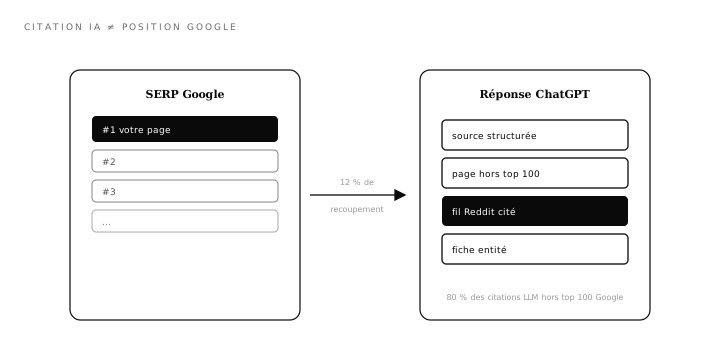
Because AI citations do not copy the SERP. According to Higoodie (2026), ChatGPT citations overlap with only around 12 % of Google's SERP, and only ~11 % of domains are cited by both ChatGPT and Perplexity. Ranking number 1 does not guarantee an assistant citation.
Further undermining the illusion of continuity, Ahrefs (15 000 queries) shows that ~80 % of LLM citations do not even rank in Google's top 100. And the share of AI Overviews citations from Google's top 10 fell from around 76 % (mid-2025) to ~38 % (early 2026). The SEO/citation correlation is weakening.
AI citation is moving away from the conventional SERP.
- % of citations from the top 10
Source: Higoodie / Ahrefs (2026)
View chart data
| Reference | % of citations from the top 10 |
|---|---|
| Mid-2025 | 76 |
| Early 2026 | 38 |
- overlap between ChatGPT citations and Google's SERP
- ~12 %
- Higoodie (2026)
- of LLM citations outside Google's top 100
- ~80 %
- Ahrefs (2026)
- of domains cited by ChatGPT AND Perplexity
- ~11 %
- Higoodie (2026)
Is AI traffic worth as much as organic traffic?
In volume, no; in value, often yes. Where AI Overviews is deployed, Ahrefs measures a CTR drop of 15 to 30 % on informational queries, with ~69 % zero-click queries. But Seer Interactive reports an AI traffic conversion rate around 14,2 %, versus ~2,8 % for organic traffic.
Where does this traffic go? ChatGPT accounts for ~87 % of AI referral traffic (Conductor, 2026); Perplexity ranks 3rd (~7,7 %, Statcounter May 2026). On the accounts we manage, the consequence is clear: a website can lose clicks while gaining clients, provided it tracks the right indicators. For the method, see AEO vs SEO vs GEO.
- Informational CTR down 15-30 % where AI Overviews appears (Ahrefs).
- ~69 % zero-click queries on these surfaces.
- AI traffic ~14,2 % conversion versus ~2,8 % for organic traffic (Seer Interactive).
- ChatGPT ~87 % of AI referral traffic (Conductor 2026).
Your tools mislead you: GSC and GA4 in 2026
Search Console provides a generative AI performance report for AI Overviews and AI Mode impressions. Google reports a global rollout as of August 31, 2026, with access limitations depending on the property and impression volume. This data is also included in the Web report: do not add it to that report's total. In GA4, check the AI Assistant channel and source/medium data for identifiable sessions. Traffic with no identifiable source may appear as Direct — a custom channel group does not reconstruct a lost source. Do not therefore reattribute all Direct traffic to AI. For ChatGPT, also keep the answers observed for your target queries: they supplement traffic measurement without replacing conversions.
My operational decision: isolate AI traffic with a list of referral sources (chat.openai.com, perplexity.ai, etc.) and track citations, not just clicks. We document the French context because AI Overviews is coming to France in summer 2026, which will amplify these measurement distortions.
- Segment AI traffic in GA4 using a referral list (assistants do not appear automatically).
- Do not read GSC impressions as a pure signal: they include AI Overviews.
- Track citations (are you named in the answer?), not just rankings.
- Realign objectives around conversion, where AI traffic outperforms.
France in 2026: what I would do now
Google announced the launch of AI Overviews and AI Mode in France on July 22, 2026. AI Overviews appears when Google considers a generated answer useful for the query; it does not replace all conventional results. Work on your pages and track actual citations; the launch guarantees neither their selection nor a commercial result.
Meanwhile, the May 2026 core update ended on 2 June and a global spam update launched on 24 June. The Quality Rater Guidelines convey a consistent message: Google judges quality, not production method. Low-value mass-produced content receives the lowest rating, AI or not. Reddit, heavily cited by LLMs because it can be fully retrieved, remains a distribution tactic to consider.
| Workstream | Practical action | Why |
|---|---|---|
| Pillar pages | Rewrite with an answer-first approach and attributed figures | AI citation suitability + rankings |
| Authority (E-E-A-T) | Add a byline, dates and sources; show practical experience | Quality rater score |
| Measurement | Segment AI traffic and track citations | Misleading GSC/GA4 data |
| Distribution | Presence on Reddit / retrievable platforms | Disproportionately cited by LLMs |
For complete planning and support, see our services: we adapt these workstreams to your situation without selling a magic format.
Frequently asked questions
Is ChatGPT search optimization different from SEO?
No, not fundamentally. Google confirms in May 2026 that optimizing for generative AI means doing SEO. The measures remain authority, clarity and useful content. What changes is the output surface and therefore measurement: track assistant citations alongside organic rankings.
Should I add an llms.txt file to get cited by ChatGPT?
Not for Google. Its May 2026 guide specifies that Google Search does not use llms.txt, either to help or to penalise. Some third-party crawlers may read it, but there is no evidence of a Google effect. My recommendation: spend no effort on it until content and internal linking are solid.
Does structured data improve AI citation?
It is not required for generative search, according to Google (May 2026). Schema remains useful for conventional rich results but does not ‘unlock’ AI citations. Focus first on clear, sourced, verifiable answers, which assistants are most willing to use.
Why is my organic traffic falling while impressions rise?
More impressions do not guarantee more clicks. Check the scope, queries, rankings and periods before interpreting CTR. Search Console has an AI impressions report, with those impressions already included in the Web report; their totals must not be added together. Track ChatGPT citations separately, then attributable sessions and conversions in GA4.
Does traffic from ChatGPT convert well?
Yes, often better than organic traffic. Seer Interactive measures an AI traffic conversion rate around 14,2 %, versus ~2,8 % for organic traffic. Volume remains lower, but intent is better qualified. ChatGPT also accounts for around 87 % of AI referral traffic (Conductor 2026), making it the priority.
When is AI Overviews coming to France?
Google announced the launch of AI Overviews and AI Mode in France on July 22, 2026. AI Overviews does not appear for every search: Google shows it when it provides a useful answer to the query.