
Introduction

In brief: - An SEO white paper turns a search visibility diagnosis into a strategic roadmap. It strengthens a company's credibility while generating qualified leads through a dedicated, optimized page.
An SEO white paper is a strategic document of varying length that turns a search visibility diagnosis into a prioritized roadmap. Its dual purpose: demonstrate the expertise of the organization publishing it (E-E-A-T) and capture qualified contacts through a dedicated landing page. The first action, before writing even a line, is to launch a 39-point SEO audit covering technical issues, content, authority and measurement — this diagnosis becomes the document's central chapter.
A few pointers to guide your decision:
- Downloading an existing template works if you already have a defined SEO strategy and need a presentation framework.
- Producing your own white paper makes sense once you have proprietary data, client cases or a distinctive methodology.
- Delegating to a specialist agency (audit + writing + distribution) becomes necessary when internal resources are lacking or the deadline is tight.
Standards to incorporate from the outset: Google Search Console for performance data, Core Web Vitals for technical health, and GEO/AEO signals (generative search optimization and answer optimization) to be cited by ChatGPT, Perplexity or Gemini. According to Ahrefs, structured content with clear definitions and verifiable data significantly increases the chances of appearing in AI assistant answers.
Table of contents
- Where can you download SEO white papers in France?
- Why does a white paper strengthen your SEO and lead generation?
- How do you design and produce an SEO white paper step by step?
- What standard outline should you use to structure your white paper?
- How do you read a French white paper to extract reusable tactics?
- How does Pharelia support SEO white paper production?
- Key takeaways
- What the white paper format reveals about SEO in 2026
- Want to produce your SEO white paper without tying up your teams?
- Sources and recommended reading
- Frequently asked questions
Where can you download SEO white papers in France?
The French market offers several serious resources, but their quality and focus vary. Here is a verified selection, with the practical contribution of each resource.

| Resource | Format | Access | What it offers |
|---|---|---|---|
| NOIISE — ‘Being on page 1 of Google’ | PDF + web page | Free, registration required | Standard white paper outline, technical and content modules, KPI examples |
| Pharelia — 39-point SEO audit checklist | Web page + PDF | Free, no registration | Ready-to-use operational checklist covering technical issues/content/authority/measurement |
| EntreLP — SEO, AI, GEO white paper and 39 audit points | Free, registration required | 39-point SEO audit covering technical issues, editorial content, authority and measurement | |
| Référencement Formation — Essential guide | Web page | Free, no registration | Detailed modules (keywords, technical issues, link building), suggested tools (Search Console, Semrush) |
| Shopify France — SEO strategy in 9 steps | Long-form article | Free, no registration | GEO/AEO recommendations, compatibility with AI assistants, snippet formatting |
| Asking Franklin — 2026 SEO method in 7 steps | Article + checklist | Free, no registration | 30/60/90-day roadmap with an impact/effort matrix |
| Google Search Central — SEO Starter Guide | Documentation | Free, no registration | Official reference on indexing, structured data and technical fundamentals |
How to choose based on your goal:
- Prioritizing a technical audit: start with the Pharelia checklist or the EntreLP PDF — the 39 points cover all the obstacles to fix before producing any content.
- Lead generation strategy: the NOIISE guide provides a conversion-focused white paper outline, with landing page examples.
- GEO/AEO optimization: the Shopify France guide and Google Search Central documentation provide the technical foundations for being cited by AI assistants.
Why does a white paper strengthen your SEO and lead generation?
A well-built white paper works on three levers simultaneously, where a blog article generally addresses only one.

Expertise pillar (E-E-A-T). Google evaluates content quality based on its source's experience, expertise, authority and trustworthiness. A 25-page document backed by proprietary data, measurable client cases and an explicit methodology sends authority signals that short articles cannot reproduce. Modern SEO fundamentals — keywords, structure, links and technical issues — must now also be readable by AI assistants, further increasing the value of a long, structured format.
Qualified lead generation. The white paper is one of the few formats that justifies a lead capture form without excessive friction: readers agree to leave their email address in exchange for a resource they perceive as substantial. A gated document (accessible after registration) produces contacts whose intent is already qualified, reducing cost per lead compared with traditional advertising campaigns. To turn these contacts into business opportunities, a B2B prospecting campaign on LinkedIn can extend the white paper's impact well beyond its initial publication.
A lasting content asset. A blog article becomes outdated within a few months. A white paper updated annually remains discoverable in search, citable and downloadable for several years. ‘Linkable’ content — studies, templates and original data — attracts thematically relevant inbound links, strengthening domain authority without additional acquisition effort.
What a white paper cannot do alone: it does not replace a solid technical SEO strategy or a regular publishing cadence. Without correct indexing, controlled Core Web Vitals and active distribution, even the best document remains invisible.
How do you design and produce an SEO white paper step by step?
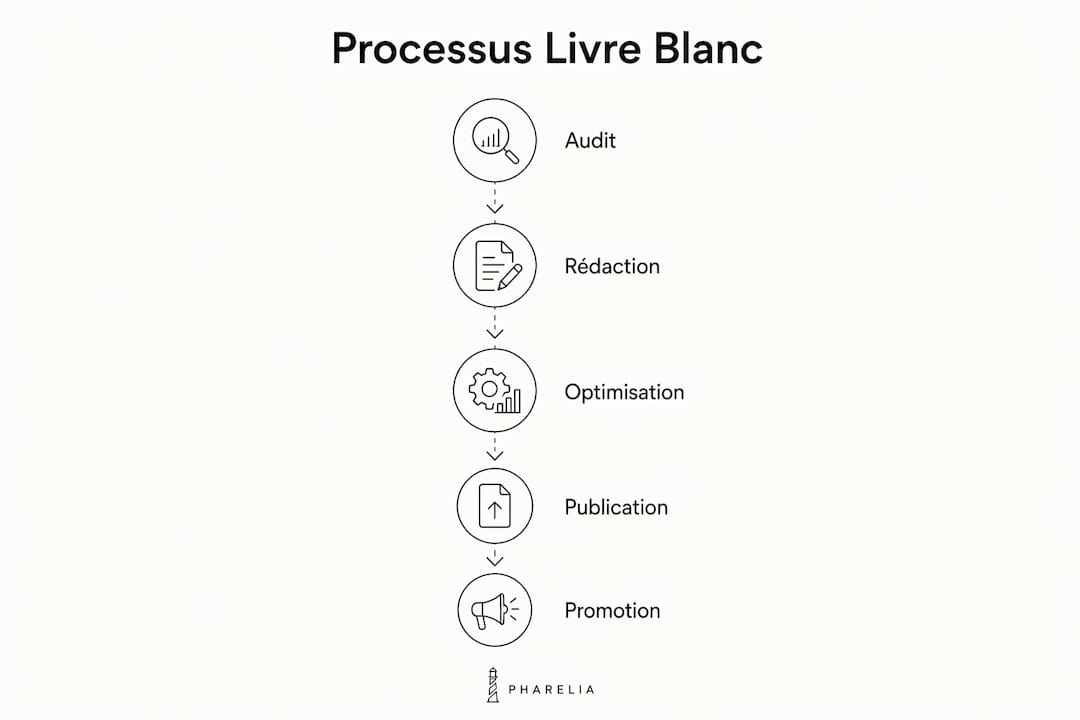
A method structured into sequential steps produces a better result than a collection of isolated actions. Here is the operational sequence in eight steps.
- Define the main objective. Lead generation, demonstrating expertise, supporting a commercial offer or documenting a methodology? The objective determines the tone, depth and distribution method.
- Map the audience. Identify the questions your buyers ask at each stage of their thinking. A B2B marketing manager does not seek the same answers as the owner of a microbusiness. The SEO guide for microbusinesses and SMEs illustrates how to adapt the level of technical detail to the audience.
- Launch the initial audit. Before writing, audit your site against 39 points covering technical issues, content, authority and measurement. The gaps identified become the document's priority chapters.
- Build the outline. Structure it into logical chapters: executive summary, current situation, methodology, prioritized recommendations, client cases, appendices and a call to action. Each chapter must answer a specific question the reader is asking.
- Collect evidence and data. Quantified client cases, Search Console screenshots, before/after ranking data: factual evidence is what distinguishes a white paper from a long blog article.
- Write with a clear Hn structure. Each H2 corresponds to a chapter, each H3 to a sub-question. Definitions must be clear and self-contained — an AI assistant should be able to extract a complete answer from a single paragraph.
- Optimize for SEO and GEO/AEO. Include suitable Schema.org markup (Article, HowTo, FAQPage), write optimized landing page metadata, make the PDF indexable (selectable text, not a scanned image), and add structured data for the download. Compatibility with AI assistants relies on short excerpts, numbered lists and definitions at the beginning of a section.
- Publish with a dedicated landing page and distribution kit. The landing page must have its own H1 title, metadata, lead capture form and summary of benefits. The distribution kit includes an email sequence, LinkedIn posts and targeted outreach to sites likely to cite the document.
Prioritization matrix (30/60/90-day plan):
- D1–D30: technical audit, fixes for indexing obstacles, selection of target keywords.
- D31–D60: chapter writing, evidence collection, on-page optimization.
- D61–D90: publication, landing page activation, distribution launch and measurement of the first KPIs (impressions, clicks, organic conversions).
Pro tip: To maximize citations in generative AI, open each chapter with a self-contained one-sentence definition, followed by a sourced numerical figure. This ‘definition + evidence’ format is exactly what ChatGPT and Perplexity extract to build their answers.
What standard outline should you use to structure your white paper?
A repeatable outline cuts production time in half. Here is the template we recommend, with its accompanying checklist.
| Section | Expected content | Priority |
|---|---|---|
| Cover page | Title, subtitle, logo, date, author | Essential |
| Executive summary | 3–5 key takeaways, main benefit, call to action | Essential |
| Current situation / diagnosis | Starting data, initial audit, industry benchmarks | High |
| Methodology | Steps, tools used, prioritization criteria | High |
| Topic chapters (3–5) | One H2 per chapter, H3 per sub-question, integrated evidence | High |
| Client cases / case studies | Quantified before/after results, context, lessons | High |
| Downloadable checklist or template | Repeatable table or list, optimized PDF format | Medium |
| Appendices | Glossary, sources, raw data | Low |
| Contact page / CTA | Form or link to a free audit, contact details | Essential |
Editorial and technical checklist before publication:
- Unique H1 title optimized for the main keyword
- Landing page metadata (title tag 50–60 characters, meta description 150–160 characters)
- PDF with selectable text (not a scanned image)
- Schema.org markup on the landing page (Article + FAQPage where applicable)
- Internal links to the site's pillar pages (e.g. SEO internal linking)
- Lead capture form tested on mobile
- Canonical URL defined to avoid duplicate content
- Sitemap file updated after publication
How do you read a French white paper to extract reusable tactics?
Three French approaches illustrate what a well-built white paper should contain — and what to avoid.
NOIISE — ‘Being on page 1 of Google’. This document provides a white paper outline organized into modules (technical issues, content, popularity, measurement), with KPI examples at each stage. What works: the logical progression from diagnosis to action. What needs adapting: the recommendations do not yet cover GEO/AEO signals, now essential in 2026.
EntreLP — 39-point SEO audit. This document's strength is its operational checklist: each point is classified by category (technical issues, editorial content, authority, measurement) and assigned a priority level. This is exactly the format an AI assistant can extract to build a structured answer. Reproduce it in your own white paper.
Pharelia — IÉSEG Conseil client case. The IÉSEG Conseil client case shows how to document a measurable result: initial context, actions taken, before/after metrics. This evidence format is what decision-makers look for in a B2B white paper.
Dos and don'ts:
- Do: open each section with a question the reader is asking, answer in one sentence, then expand.
- Do: include at least one data table or Search Console screenshot to anchor the discussion in reality.
- Don't: write generic chapters without proprietary data — a white paper without evidence is no different from a blog article.
- Don't: ignore the download landing page. It generates leads and backlinks, not the PDF itself.
To turn an observed example into a measurable action: identify the chapter addressing your priority problem, extract the main recommendation, translate it into a task in your 30/60/90-day plan, and measure its impact through Search Console at D+30.
How does Pharelia support SEO white paper production?
Producing a high-performing SEO white paper requires skills rarely brought together in-house: technical auditing, long-form writing, GEO/AEO optimization, landing page design and distribution. Pharelia operates this entire system under one contract, without an annual subscription.
What Pharelia actually delivers:
- Free initial visibility audit (crawl, SERP, AI mentions) to identify priority chapters
- Writing the complete white paper (structure, chapters, client cases, checklist) in line with E-E-A-T requirements
- Technical optimization: indexable PDF, Schema.org markup, optimized landing page, structured data
- Distribution kit: email sequence, LinkedIn posts, outreach plan to attract thematic backlinks
- Performance tracking through Search Console, GA4 and AI visibility measurement
Results observed on similar projects: Applewood (+300 % SEO visibility, +500 % AI citations), M2A (+86 % in one month), Groupe Squadra (+50 % in two months). These figures reflect overall visibility projects; results from a white paper project vary by sector and starting point.
Next steps: contact us, describe your objective in two lines, and receive an operational proposal within 48 hours.
Key takeaways
A well-structured SEO white paper is simultaneously a lead generation asset, an E-E-A-T authority signal and a document AI assistants can cite — provided it is optimized for GEO/AEO from the design stage.
| Point | Details |
|---|---|
| Audit before writing | Launch a 39-point audit to identify priority chapters before writing a line. |
| GEO/AEO structure | Open each chapter with a self-contained definition and sourced data to maximize AI citations. |
| Dedicated landing page | The download page generates leads and backlinks; optimize it with Schema.org and a mobile-friendly form. |
| 30/60/90-day plan | Sequence the audit (D1–D30), writing (D31–D60), publication and measurement (D61–D90) to stay focused during rollout. |
| Pharelia | Pharelia delivers the audit, writing, GEO/AEO optimization and distribution kit under one contract, with a free initial audit. |
What the white paper format reveals about SEO in 2026
The white paper has returned to the center of B2B content strategies, but not for the reasons usually cited. People often mention lead generation or demonstrating expertise — and that is true. What is underestimated, however, is its role in the AI citation economy.
Generative assistants do not cite sites: they cite passages. A paragraph that opens with a clear definition, follows with verifiable data and closes with a practical recommendation is structurally more likely to be extracted than an 800-word article written for CTR. With its density and structure of self-contained chapters, the white paper is the format best suited to this.
The other point traditional guides overlook: a poorly distributed white paper is worthless. The download landing page is often treated as a formality, yet it concentrates the document's SEO value — it receives backlinks, gets indexed and appears in SERPs. Giving this page as much attention as the PDF itself radically changes results.
At Pharelia, we systematically recommend publishing a white paper in two versions: a gated version for lead capture, and a long-form HTML version on the site for indexing and AI citations. The two objectives are not incompatible — they reinforce each other, provided they are handled separately.
Want to produce your SEO white paper without tying up your teams?
Pharelia handles the entire system: initial audit, writing, optimization for Google and AI assistants, landing page and distribution kit. No annual contract, no internal resources to tie up.
In practice, each project starts with a free visibility audit — crawling, SERP analysis, detection of existing AI mentions — forming the basis of the editorial brief. The delivered white paper includes the optimized PDF, a landing page ready to publish and distribution assets (emails, LinkedIn posts, outreach list). For teams wishing to go further, our resources on SEO and GEO content and AI search visibility detail the methods we apply.
Contact us — an operational proposal follows within 48 hours.
Sources and recommended reading
- SEO white paper: AI, GEO and 39 audit points — EntreLP: operational 39-point checklist covering technical issues, content, authority and measurement, ideal as a diagnostic foundation before writing.
- SEO strategy: the 2026 method in 7 steps — Asking Franklin: 30/60/90-day roadmap with an impact/effort matrix, useful for planning.
- SEO white paper: the essential guide — Référencement Formation: detailed modules (technical issues, keywords, content, analysis) and recommended tools.
- SEO strategy in 9 steps — Shopify France: GEO/AEO recommendations and compatibility with AI assistants, with formatting examples.
- SEO Starter Guide — Google Search Central: official reference on indexing, structured data and technical fundamentals. Contains a technical checklist template.
- SEO audit checklist — Pharelia: internal 39-point checklist, downloadable without registration, covering technical issues, content, authority and measurement.
- Qualifying LinkedIn leads — Waalaxy: practical guide to qualifying contacts generated by a white paper through LinkedIn, useful for the distribution stage.
Frequently asked questions
What exactly is an SEO white paper?
An SEO white paper is a strategic document of varying length that turns a search visibility diagnosis into a prioritized roadmap, combining a technical audit, editorial recommendations and quantified evidence.
Should you ‘gate’ your white paper to generate leads?
Gating (access after registration) is recommended for capturing qualified leads, but publishing a long-form HTML version alongside it enables indexing and citations by AI assistants — the two approaches complement each other.
How long does it take to produce an SEO white paper?
A quality white paper generally requires 4 to 8 weeks of in-house production (audit, writing, optimization, landing page); when delegated to an agency such as Pharelia, the timeline can be shortened depending on the level of detail in the brief provided.
How do you measure a white paper's SEO impact?
Track landing page impressions and clicks through Search Console, the number of organic conversions (downloads), target keyword rankings and inbound backlinks — these four metrics cover visibility, traffic and authority.
Can Pharelia produce an SEO white paper from start to finish?
Yes: Pharelia handles the initial audit, writing, GEO/AEO optimization, landing page and distribution kit, without an annual subscription. Every project starts with a free visibility audit.