
Introduction

At a glance: - Digital advertising agencies create and optimize online campaigns across multiple channels. They use artificial intelligence to improve budget reallocation and test ad variations. Careful monitoring of key metrics and strategic involvement are essential for lasting results.
A digital advertising agency specializes in creating, managing and optimizing online advertising campaigns to improve businesses' visibility and customer acquisition. It uses channels such as Google Ads, Meta Ads and LinkedIn Ads, and now incorporates artificial intelligence (AI) to manage budgets in real time. For a marketing manager or an SME owner, understanding what such an agency actually does, and how to get the most from it, has become an operational necessity. This article explains the services, methods, selection criteria and performance metrics you need to understand.
What are a digital advertising agency's main services?
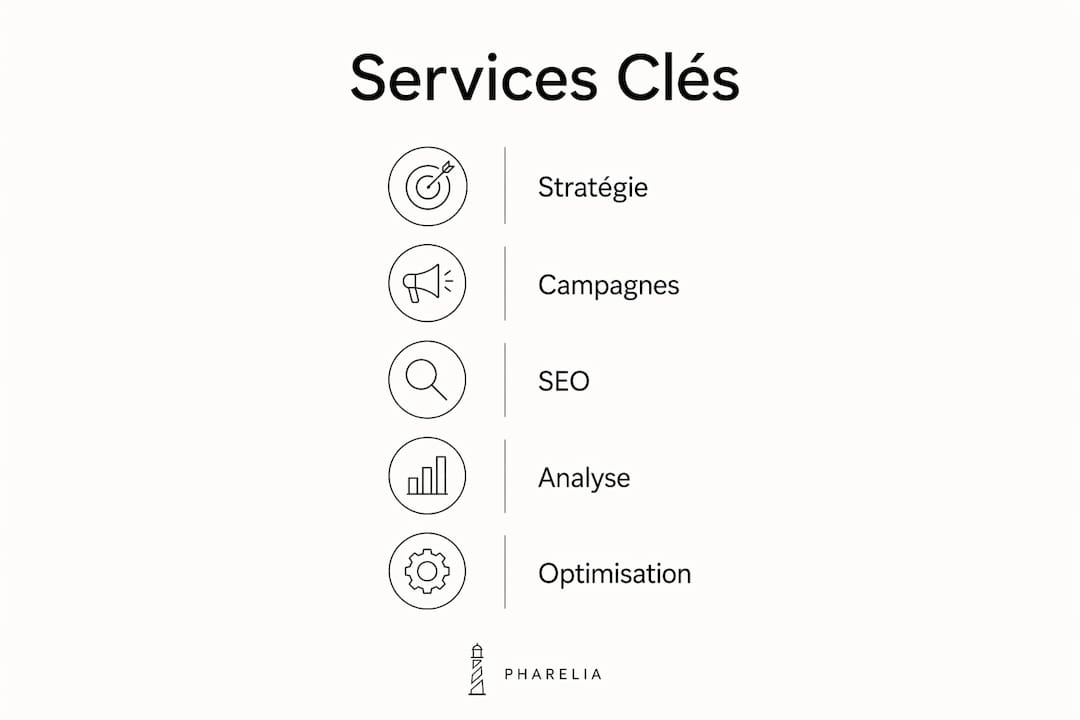
An online advertising agency provides much more than simply running ads. It designs, manages and adjusts a company's entire advertising setup across digital channels.
The core services include:
- Campaign creation and management: Google Ads for paid search (SEA), Meta Ads for Facebook and Instagram, LinkedIn Ads for B2B, TikTok Ads for younger audiences, and Microsoft Advertising for additional coverage. Channels are selected based on the sector, target audience and available budget.
- Copywriting and A/B testing: writing ad copy, headlines and calls to action, then running comparative tests to identify the best-performing variations. AI-assisted multivariate testing improves Google's Quality Score and conversion rates.
- Advertising budget management: allocating spending across channels, adjusting bids, and monitoring cost per click (CPC) and cost per acquisition (CPA).
- Tracking and performance analysis: setting up conversion tracking through Google Tag Manager, GA4 or native advertising pixels, with continuously updated dashboards.
- Strategic support: defining personas, segmenting audiences, and recommending advertising formats (video, display, search, shopping).
Digital campaigns generate qualified leads quickly through precise targeting and an immediate presence in search results. This is one of online advertising's structural advantages over traditional channels: the sales pipeline starts filling within the first few days of activation.
Practical tip: Ask your agency to give you administrator access to your advertising accounts from the start. The accounts belong to you, not the agency. This prevents dependence if you change providers.

How does AI improve your campaign results?
Artificial intelligence has fundamentally changed how digital advertising campaigns operate. It does not replace the agency's work; it increases its capacity to analyze and respond.
In practice, AI operates at four levels:
- Automatic budget reallocation: algorithms analyze performance by audience, time, device and geographic area in real time, then redirect spending toward the segments that convert best.
- Ad generation and optimization: AI tools produce headline and description variations, test them simultaneously and keep the winning combinations.
- Large-scale multivariate testing: where a person might manually test 3 to 5 variations, AI evaluates dozens in parallel, accelerating learning.
- Audience prediction: machine learning models identify profiles likely to convert before they have even clicked an ad.
AI provides continuous analysis and recommendations, but it cannot align a campaign with a company's actual priorities. That is the human team's role: setting priorities, approving directions and interpreting signals the algorithm does not understand. Human expertise remains essential for the final decision.
This combination of automation and human oversight is a defining feature of agencies that deliver lasting results. An agency that delegates everything to the algorithm without strategic management produces campaigns that are technically sound but disconnected from commercial reality.
What steps help you work effectively with an agency?
A partnership with an online communications agency does not work through complete delegation. Businesses that achieve the best results are actively involved in the process.
- Set measurable objectives before launch. A goal such as "increase brand awareness" is too vague. Prefer: "generate 50 quote requests per month at a CPA below €80". Defining KPIs determines the quality of campaign management.
- Choose channels based on your actual audience. A B2B consulting firm has different channel priorities from a consumer e-commerce business. Agree on this choice with the agency before committing the budget.
- Read and understand the reports. A well-built dashboard shows cost per lead, conversion rates by channel and week-by-week trends. If you do not understand a metric, ask for a written explanation.
- Schedule regular reviews. At least one monthly meeting, with written notes, lets you approve the direction and adjust priorities before mistakes become expensive.
- Allow quick adjustments. Advertising campaigns need frequent changes. An approval process that takes too long slows algorithm learning and reduces performance.
Practical tip: Allow a learning period of 4 to 6 weeks before judging a new campaign's results. Advertising algorithms need sufficient data to adjust. Assessing a campaign after 10 days often leads to premature decisions.
What criteria should you use to choose the best digital advertising agency?
The online advertising agency market is crowded. Several criteria help distinguish a competent agency from one that sells well but delivers little.
- Technical command of the channels. The agency should provide evidence of Google Ads, Meta Blueprint or LinkedIn Marketing Solutions certifications. These certifications demonstrate up-to-date training on the tools.
- AI integration in its processes. Ask how the agency uses automation: Smart Bidding on Google Ads, Advantage+ on Meta, or third-party tools. An agency that still works entirely manually loses efficiency.
- Transparent reporting. You should receive clear reports with direct access to the raw data, not just summaries prepared by the agency.
- Advertising account ownership. Make sure the contract states that Google Ads, Meta Ads and other accounts are created in your name and remain under your control.
- Verifiable references. Ask for client case studies with concrete figures: cost per lead before and after, conversion volume and engagement duration.
| Criterion | What to check |
|---|---|
| Certifications | Google Ads, Meta Blueprint, LinkedIn Marketing Solutions |
| AI usage | Smart Bidding, Advantage+, third-party automation tools |
| Reporting | Access to raw data, reporting frequency |
| Account ownership | Contractual provision for immediate transfer |
| References | Quantified results from comparable engagements |
Contractual flexibility is also a strong signal. An agency that imposes a 12-month commitment with no early termination clause protects its revenue, not your interests.
What results should you expect, and how should you measure success?
A digital advertising campaign's performance metrics can be assessed at several levels. Each level answers a different question.
| Metric | What it measures | Warning sign |
|---|---|---|
| Click-through rate (CTR) | Ad appeal | Below 2% on search |
| Cost per click (CPC) | Bidding efficiency | Increasing without more conversions |
| Cost per acquisition (CPA) | Campaign profitability | Higher than the unit margin |
| Conversion rate | Traffic and page quality | Below 3% on a dedicated page |
| Return on investment (ROI) | Overall performance | Negative after 3 months of learning |
A minimum monthly budget of €500 is recommended so that algorithms can collect enough data and adjust. Below this threshold, machine learning lacks sufficient signals and results remain unstable.
Real-time dashboards, available through Google Ads, Meta Business Suite or centralized reporting tools, let you track these metrics daily. Continually adjusting campaigns based on this data distinguishes active management from simply running ads. For companies working on their overall digital strategy, paid advertising works alongside SEO and visibility in generative search engines to cover the full discovery funnel.
Key points
An effective digital advertising agency combines technical command of the channels, AI integration and human oversight to deliver measurable, lasting results.
| Point | Details |
|---|---|
| Channels and services | Google Ads, Meta Ads, LinkedIn Ads and Microsoft Advertising cover the main B2B and B2C audiences. |
| AI's role | AI reallocates budgets and tests variations, but requires human direction for strategic alignment. |
| Minimum budget | €500 per month is the recommended threshold for advertising algorithms to learn. |
| Account ownership | Make sure the contract states that advertising accounts remain under your control from the start. |
| Measuring success | Track CPA, conversion rate and ROI, not just click volume. |
What I am seeing in practice in 2026
The digital advertising agency market is undergoing a profound change. Advertising algorithms have advanced to the point where an agency's added value no longer lies in the technical setup of campaigns. It lies in the quality of its strategic judgment.
I regularly see companies that have entrusted their campaigns to technically competent agencies with impeccable dashboards, yet their results stagnate. The reason is almost always the same: the agency optimizes what can be measured, not what matters. It improves CTR without questioning whether it is promoting the right product or whether the landing page matches the actual search intent.
The other trend I see is channel fragmentation. In 2026, a serious B2B company can no longer rely solely on Google Ads. Buyers rephrase their questions in ChatGPT or Perplexity before even opening a search engine. An agency that does not consider visibility in generative search engines leaves a growing part of the discovery funnel uncovered. For B2B consulting and services companies, this dimension is already critical.
My practical advice: assess an agency by the questions it asks you, not its tools. A good agency wants to understand your margin, sales cycle and most profitable customers before discussing the advertising budget. An agency that starts by asking for your monthly budget without commercial context is working for its revenue, not yours.
— Louis
Pharelia and digital advertising: measurable visibility
Pharelia supports microbusinesses, SMEs and startups with their online visibility, combining SEO, visibility in generative search engines and digital advertising in one coherent setup. Every engagement starts with a free visibility audit based on your website's actual data: crawling, SERP positions and AI mentions.
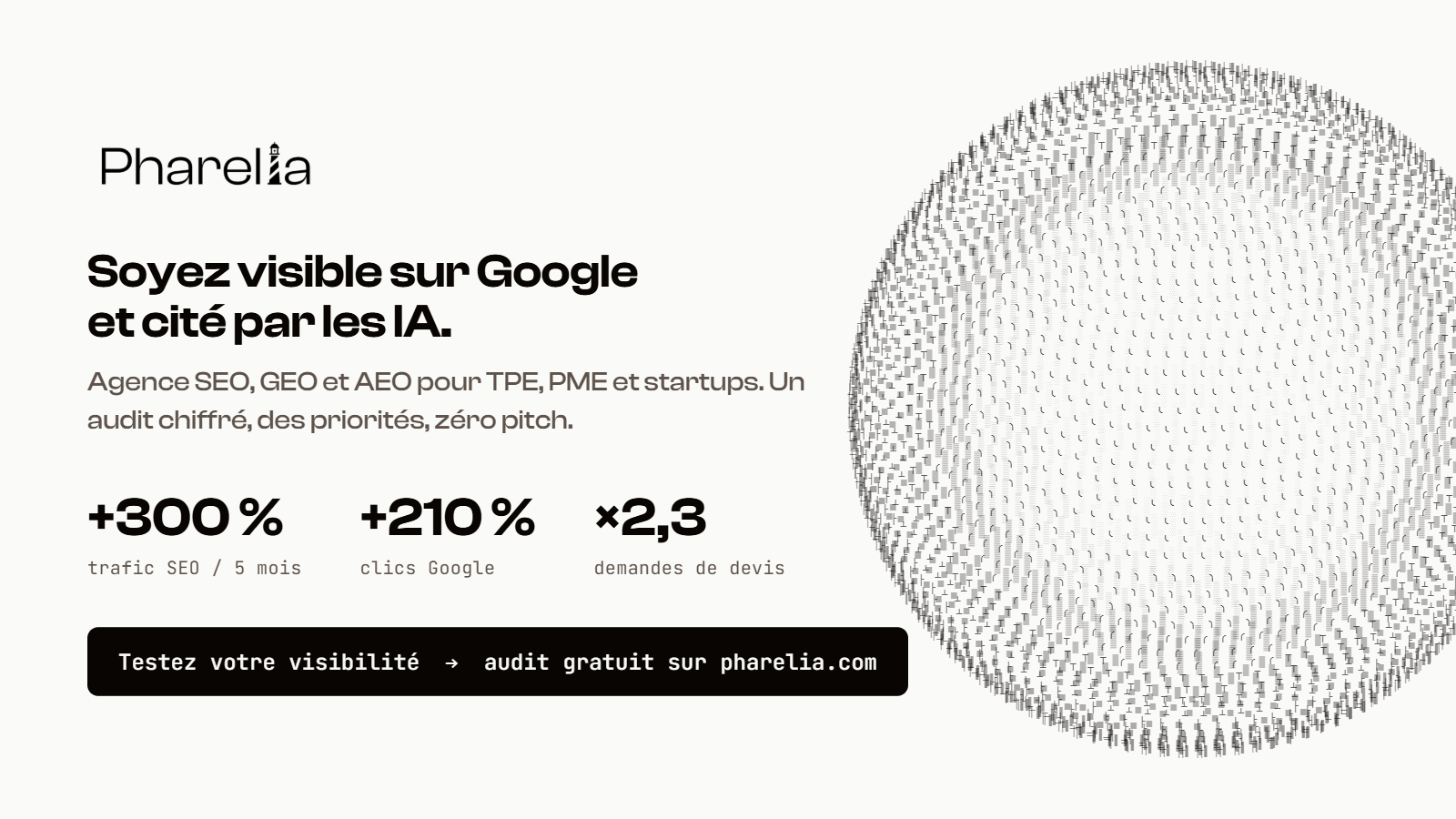
The published results speak for themselves: Applewood improved by 300% in SEO and by 500% in AI citations, while M2A recorded +86% in one month. If you want to align your digital advertising with a lasting visibility strategy, Pharelia offers an initial conversation with no commitment to assess your current situation.
Frequently asked questions
What is a digital advertising agency?
A digital advertising agency creates, manages and optimizes online advertising campaigns on channels such as Google Ads, Meta Ads and LinkedIn Ads. It manages budgets, audiences and ads to maximize its clients' return on investment.
What minimum budget should you plan for?
A minimum monthly budget of €500 is recommended so that advertising algorithms can collect enough data and adjust campaigns effectively. Below this threshold, results remain unstable.
How does AI improve advertising campaigns?
AI automatically reallocates budgets to the best-performing audiences and tests dozens of ad variations in parallel. It improves campaign efficiency, but requires human oversight for strategic alignment.
How do you choose an online advertising agency?
Check Google Ads and Meta Blueprint certifications, ask for quantified references, and make sure the contract states that advertising accounts remain in your name. Transparent reporting is non-negotiable.
Which metrics should you track to measure a campaign's success?
The key metrics are cost per acquisition (CPA), conversion rate and return on investment (ROI). Click volume alone is not enough: a profitable campaign converts at a cost below the unit margin of the product or service sold.
Recommendation
- IÉSEG Conseil · SEO and AI client case study | Pharelia
- Groupe Squadra · SEO and AI client case study | Pharelia
- SEO & AI agency for e-commerce and marketplaces — Pharelia
- SEO, GEO and RevOps digital strategy | Pharelia