
Introduction

At a glance: - Effective multilingual SEO requires optimal URL structure, correct hreflang implementation and strategic keyword localization. - This process improves relevance, prevents cannibalization and helps you get cited in generative engines in every target language.
Effective multilingual SEO rests on three decisions made before writing the first line of translated content: choose the right URL structure, implement hreflang correctly and localize keywords rather than simply translating text. Here are the priority actions to implement.
Immediate action plan:
- URL structure: choose subdirectories (
domaine.fr/en/,domaine.fr/de/) if you want to consolidate authority on a single domain. ccTLDs (domaine.de) are justified only for independent local operations with dedicated teams and hosting. - Reciprocal hreflang: each page must declare all its language versions, reference itself and include an
x-defaulttag for users outside the target locales. - Editorial priorities: localize high-impact product and service pages first, rather than corporate pages. Local keyword research comes before translation.
- Indexing control: any page that has not been reviewed by a native speaker stays in
noindexuntil approved. Publishing raw machine translation harms rankings. - 30–90-day plan: audit hreflang and canonicals (D0–D30), localize the 20 priority pages (D30–D60), complete technical implementation and Google Search Console / GA4 monitoring (D60–D90).
Table of contents
- Why investing in multilingual SEO is worth the effort
- Multilingual or multiregional: how should you choose your structure?
- Which URL structure should you actually use?
- How do you implement hreflang without mistakes?
- Translation or localization: what is the difference for SEO?
- Technical aspects to check before launching a locale
- How should you organise editorial governance for a multilingual website?
- Which KPIs and tools measure success by locale?
- Pharelia's method for multilingual SEO (E-E-A-T)
- Mistakes that undermine a multilingual rollout
- A 30–90-day launch checklist
- Key takeaways
- What practical experience changes about the theory
- Pharelia supports your multilingual rollout from start to finish
- Useful sources and technical documentation
- Frequently asked questions
Why investing in multilingual SEO is worth the effort
Reaching a market in its native language is more than a marginal advantage. Conversion rates increase noticeably when content matches local intent, terminology and social proof. An e-commerce or SaaS website operating only in French inevitably misses queries made in English, Spanish or German by potential buyers.
The opposite risk is just as real. Poorly signalled language versions create cannibalization: Google hesitates between two similar pages, dilutes authority and may index the wrong version. Missing or incorrectly configured hreflang is one of the most common causes of traffic regression after a multilingual rollout.
AEO/GEO now adds another dimension. ChatGPT, Perplexity and Gemini draw on indexed, structured pages to formulate their answers. Careful localization, with extractable formats (FAQs, definitions) and topical consistency, is necessary to be cited by generative engines in every target language. For more on this topic, the resources on AI search optimization explain how citations work in generative AI.
Remember when planning scale: each locale adds pages to crawl, index and maintain. On a website deployed in several languages, Google must crawl and index a number of URLs proportional to the number of locales, increasing the crawling and indexing workload. Crawl budget and consistent internal linking become critical variables as soon as you add a second locale.
Multilingual or multiregional: how should you choose your structure?
The distinction is technical as well as strategic. A multilingual website targets audiences by language (fr, en, de); a multiregional website targets distinct geographical markets (fr-FR, fr-BE, en-GB). The two approaches can be combined.

| Criterion | Subdirectories | Subdomains | ccTLD |
|---|---|---|---|
| Authority consolidation | Maximum (a single domain) | Partial | None (separate domains) |
| Geographic targeting in GSC | Through a targeting setting | Through a targeting setting | Native and strong |
| Technical complexity | Low to moderate | Moderate | High |
| Infrastructure cost | Low | Moderate | High (multiple hosting arrangements) |
| Editorial independence | Limited | Moderate | Complete |
| Recommended by Google | Yes (in most cases) | Acceptable | For strong geographic targeting |
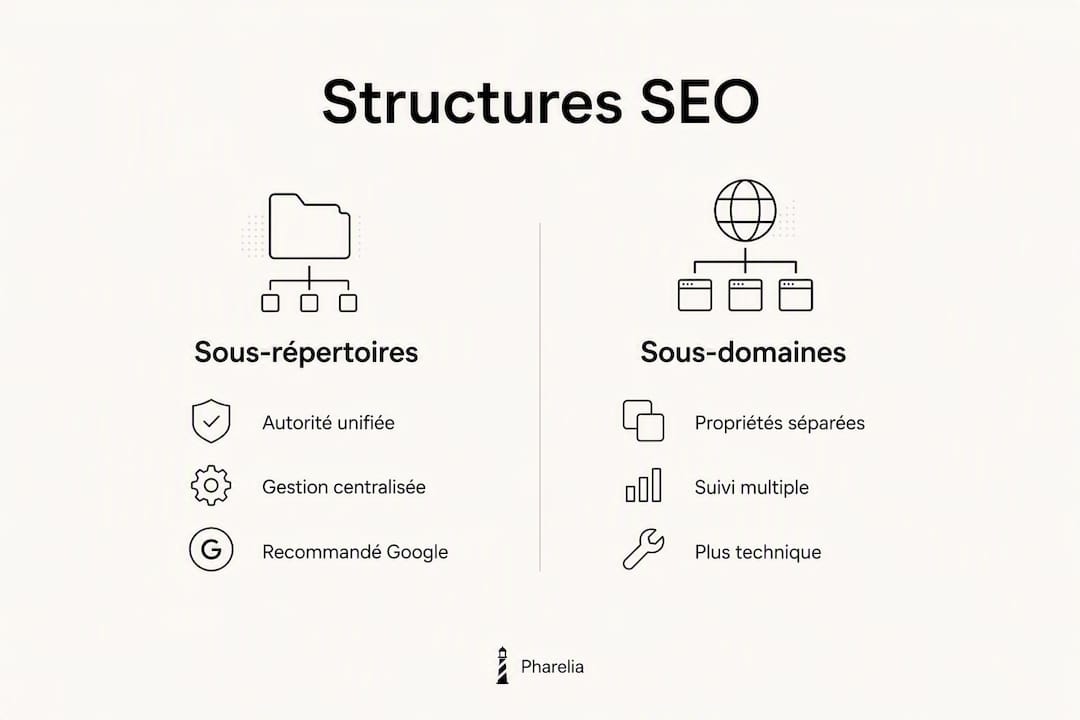
Google recommends subdirectories for most websites seeking to consolidate their main domain's authority. ccTLDs are justified only when a local market requires an independent presence: local hosting, a local team, and distinct local contact details and mentions.
Pro tip: Start with subdirectories. If a particular market generates enough volume and justifies an independent operation, migrate to a ccTLD at that point, with a clean 301 redirect and an authority transfer plan. Reversing this approach costs much more.
Which URL structure should you actually use?
There are three models, each with its own technical implications.

Subdirectories (recommended)
domaine.fr/en/nos-services/ domaine.fr/de/unsere-dienstleistungen/ domaine.fr/es/nuestros-servicios/The main domain's authority benefits every locale. CMS management is centralised. Redirects from the root (domaine.fr/) to the default locale (domaine.fr/fr/) should use 302 (temporary) while testing and 301 (permanent) once the structure is approved.
Subdomains
en.domaine.fr/our-services/ de.domaine.fr/unsere-dienstleistungen/Technically separate in Google's eyes, subdomains require a distinct Search Console property for each locale. Authority transfers partially, but not completely. Reserve them for architectures where technical teams manage different stacks for each market.
ccTLD
domaine.de/unsere-dienstleistungen/ domaine.es/nuestros-servicios/The strongest geographical signal, but every domain starts from zero in authority. High acquisition and maintenance costs.
Shared best practices:
- Translate slugs into the target language (
/nos-services/becomes/our-services/in English, rather than retaining/nos-services/unchanged). - Configure a language switcher that points to the equivalent page's canonical URL, not the locale root.
- Add a self-referencing canonical to every page (
<link rel="canonical" href="[URL de la page elle-même]">). - Never let the domain root serve an unlocalized page without a redirect.
How do you implement hreflang without mistakes?
The hreflang tag tells Google which version of a page to serve according to the user's language and region. Its implementation must be reciprocal, include a self-reference on every page, and provide an x-default value for users not covered by the declared locales.
Example HTML snippet (in `<head>`):
<link rel="alternate" hreflang="fr-FR" href="https://domaine.fr/fr/page/" /> <link rel="alternate" hreflang="en-GB" href="https://domaine.fr/en/page/" /> <link rel="alternate" hreflang="de-DE" href="https://domaine.fr/de/seite/" /> <link rel="alternate" hreflang="x-default" href="https://domaine.fr/en/page/" />The same declaration must appear on all referenced pages. If /fr/page/ declares /en/page/ as an alternative, /en/page/ must reciprocally declare /fr/page/. This is reciprocity.
XML sitemap example:
<url> <loc>https://domaine.fr/fr/page/</loc> <xhtml:link rel="alternate" hreflang="fr-FR" href="https://domaine.fr/fr/page/"/> <xhtml:link rel="alternate" hreflang="en-GB" href="https://domaine.fr/en/page/"/> <xhtml:link rel="alternate" hreflang="x-default" href="https://domaine.fr/en/page/"/> </url>| Common mistake | Consequence | Fix |
|---|---|---|
| Missing self-reference | Google silently ignores the signal | Add hreflang pointing to the page itself |
| Canonical pointing to the source version | The locale is ignored or duplicated | A self-referencing canonical on every locale |
Missing x-default | Users outside the locales are poorly served | Add x-default pointing to the main version |
| Incomplete reciprocity | Inconsistent signal, unpredictable indexing | Check every pair in GSC > Coverage |
| Root without a redirect | Duplicate content on / and /fr/ | A 301 or 302 redirect from the root |
These mistakes are among the most common causes of duplicate content and signals being silently ignored by Google during a multilingual rollout.
Translation or localization: what is the difference for SEO?
Translating text and localizing a page for search are two distinct operations. Translation transfers meaning from one language to another. SEO localization adapts search intent, query terminology, content formats and local evidence to the target market.
A linguistically perfect translation can undermine rankings if local keywords are unsuitable. A German user does not search with the same terms as a French-speaking user for the same product. Volumes, competition and intent vary by market.
Recommended six-step process:
- Content audit: identify existing pages, their organic traffic and their conversion potential for each target locale.
- Prioritisation: concentrate resources on high-impact product, service and conversion pages — not legal notices or corporate pages.
- Local keyword research: use Ahrefs or Semrush to identify actual queries in every target language, with their own volumes and difficulty.
- Create a shared glossary: document approved terms for each market to ensure consistency between translators, writers and SEO teams.
- Native-speaker post-editing: machine translation (DeepL, Google Translate) can provide a working draft, but requires review by a native speaker before indexing.
- SEO checks: check
<title>,<meta description>, slugs,altattributes and structured data in the target language.
Pro tip: Have a native speaker with SEO expertise approve the 20 pages with the greatest commercial impact before allowing them to be indexed. This batch generally represents 80 % of a locale's traffic potential. The rest can follow on a regular schedule.
For teams managing SEO content at scale, the resources on optimized content production explain suitable editorial workflows.
Technical aspects to check before launching a locale
Technical configuration determines everything else. Perfectly localized content on a poorly configured page will neither be indexed correctly nor served to the right audience.
Technical checklist by locale:
- The correct
langattribute in the<html>tag (lang="de"for German,lang="ar"+dir="rtl"for Arabic). - A self-referencing canonical on every page in the locale.
- Complete, reciprocal hreflang (see the previous section).
- A dedicated sitemap for each locale (
sitemap-fr.xml,sitemap-de.xml) referenced in a sitemap index. - Verified
robots.txtrules: no locale should be blocked unintentionally. - Unreviewed pages in
noindexuntil approval.
Using locale-specific sitemaps simplifies diagnosis and monitoring in Google Search Console. A sitemap index combining sitemap-fr.xml, sitemap-en.xml and sitemap-de.xml lets you identify indexing errors by market at a glance.
Performance and Core Web Vitals:
LCP, CLS and INP scores can vary by locale if font bundles, images or scripts differ by language. Measure Core Web Vitals separately for every locale in Google Search Console, and consider hosting close to the target market for high-volume locales.
| Tool | Main use | Required expertise |
|---|---|---|
| Screaming Frog | Checking hreflang, canonicals and HTTP codes | Intermediate |
| Oncrawl | Crawl budget and server log analysis | Advanced |
| Google Search Console | Debugging hreflang and index coverage by locale | Beginner to intermediate |
| Ahrefs / Semrush | Rank tracking by locale and backlink audits | Intermediate |
| GA4 | Traffic segmentation by language and market | Intermediate |
These tools cover the essentials of a multilingual technical audit, from tag checks to crawl budget analysis.
Pro tip: Set up a GSC alert for hreflang errors at launch. Google reports inconsistencies in the ‘International Targeting’ report within 48 to 72 hours, allowing you to fix them before indexing settles into the wrong state.
How should you organise editorial governance for a multilingual website?
Without clear governance, a multilingual website quickly drifts: source pages are updated without the locales following, internal links point to the default version, and glossaries are not maintained. Governance is not a luxury; it keeps everything consistent over time.
Roles to define explicitly:
- Localization lead: approves every locale's linguistic and SEO quality before publication.
- Developer or CMS integrator: implements hreflang tags, configures canonicals and manages sitemaps.
- Analytics lead: configures GSC by URL prefix and GA4 by language audience, and tracks KPIs by locale.
- Native writer or translator: creates or post-edits content in the target language.
Governance tools:
- Translation memory (TM): a tool such as SDL Trados or memoQ centralises approved segments and prevents inconsistencies between translators.
- Shared glossary: a collaborative document (Notion, Confluence) listing approved terms for each market.
- Pre-publication checklist: hreflang implemented, canonical checked, slug translated, meta tags localized,
noindexremoved after approval.
Typical workflow:
- Audit source content and prioritise pages.
- Research local keywords and update the glossary.
- Translation or post-editing by the native speaker.
- SEO review (titles, meta tags, slugs, structured data).
- Test hreflang and canonicals in staging.
- Go live with temporary
noindex. - Final approval and removal of
noindex. - Monitor GSC and GA4 during the first 30 days.
To structure internal linking between locales, the basic rule is simple: every page must link to its equivalents in other languages through the language switcher, and contextual links in the body must point to the correct locale, never systematically to the default version.
Multilingual SEO is a continuous process: every new piece of source-language content must be localized promptly to prevent fragmented authority and inconsistent linking.
Which KPIs and tools measure success by locale?
Measuring a multilingual website requires rigorous segmentation. A global dashboard hides differences between locales and delays the detection of regressions.
KPIs to track by locale:
- Average rankings on local target keywords (Ahrefs or Semrush, segmented by market).
- Organic traffic by locale (GA4, segmented by browser language or locale URL).
- Indexed pages by locale (GSC, Coverage report filtered by URL prefix).
- Conversion rate by locale (GA4, segmented conversion events).
- Active hreflang errors (GSC, International Targeting report).
- Crawl budget used by locale (server logs through Oncrawl).
| Dimension | Tool | Monitoring frequency |
|---|---|---|
| Rankings by locale | Ahrefs / Semrush | Weekly |
| Organic traffic | GA4 | Weekly |
| Index coverage | Google Search Console | Weekly |
| Hreflang errors | Google Search Console | At every deployment |
| Core Web Vitals | GSC / PageSpeed Insights | Monthly |
| AI citations by locale | Mention tracking (Pharelia) | Monthly |
For reporting, build a dashboard for each market with alert thresholds: an organic traffic drop of more than 15 % in one locale over two weeks triggers a priority check of hreflang and canonicals. AI visibility measurement now supplements the standard dashboard for websites targeting generative engines.
Pharelia's method for multilingual SEO (E-E-A-T)
Pharelia manages multilingual SEO in five sequential phases, with defined deliverables at every stage, to avoid partial rollouts that create more problems than they solve.
Phase 1 — Audit: crawl the entire website with Screaming Frog and Oncrawl, extracting hreflang errors, incorrectly implemented canonicals and unindexed pages. Deliverable: an audit report with a prioritised list of fixes.
Phase 2 — Prioritisation: identify the 20 to 30 pages with a strong commercial impact (product pages, service pages, conversion landing pages). These are the only pages given absolute priority for localization.
Phase 3 — Localization: local keyword research, glossary creation, translation or post-editing by a native speaker, and an SEO review of tags and slugs. Deliverable: localized pages with a completed approval checklist.
Phase 4 — Technical implementation: implement hreflang, configure canonicals, generate sitemaps by locale and check everything in staging. Deliverable: a hreflang test report and confirmation of indexing in GSC.
Phase 5 — AEO/GEO monitoring: track Google rankings by locale and citations in ChatGPT, Perplexity and Gemini for every language market. Deliverable: a monthly rankings + AI mentions report.
A correctly configured multilingual website is not merely visible on Google in several languages. It is also a source that generative engines can cite confidently, because every locale provides local evidence, an extractable structure and topical consistency. Localization has become the entry requirement for the AI discovery funnel.
Pharelia's results on comparable projects: +300 % SEO traffic and +500 % GEO-AI citations for Applewood, +86 % organic traffic in one month for M2A, and +50 % for Groupe Squadra in two months. These figures reflect deployments where technical work and localization were handled together, not sequentially.
Mistakes that undermine a multilingual rollout
Most traffic regressions after a multilingual launch have an identifiable technical cause. Here are the most common.
- Missing hreflang self-reference: Google ignores the signal if the page does not declare itself in its own hreflang block. This is the number one mistake, and it is invisible without an audit.
- Canonicals pointing to the source version: a German page whose canonical points to the French version will be treated as a duplicate of the French page, not an independent page.
- Internal links to the default version: contextual links systematically pointing to
/fr/from/de/pages dilute the German locale's relevance signal. - Untranslated slugs: retaining
/nos-services/in the English version sends an inconsistent signal to Google and reduces click-through rates in English-language SERPs. - Machine translation published without review: publishing without human post-editing harms rankings and exposes the website to content-quality penalties.
- Domain root without a redirect: if
domaine.fr/serves an unlocalized page alongsidedomaine.fr/fr/, Google sees duplicate content.
Pro tip: Before every new locale goes live, run Screaming Frog on the staging environment with hreflang mode enabled. Any error detected at this stage costs ten times less to fix than after indexing.
For redesign projects involving multilingual restructuring, the SEO redesign guide explains the precautions needed to preserve existing rankings.
A 30–90-day launch checklist
A multilingual rollout organised into three stages reduces the risk of regression and lets you approve each stage before moving to the next.
D0–D30: audit and foundations
- A complete Screaming Frog crawl: hreflang, canonicals, HTTP codes.
- Identify and fix critical errors (self-reference, reciprocity, canonicals).
- Choose and approve the URL structure.
- Configure GSC properties by locale (URL prefix or subdomain).
- Prioritise the 20 high-impact pages.
D30–D60: localize priority pages
- Local keyword research for the 20 priority pages.
- Create the glossary and translation memory.
- Translation + native-speaker post-editing + SEO review.
- Pages published in
noindexuntil final approval. - Test hreflang in staging.
D60–D90: go live and monitor
- Remove
noindexfrom approved pages. - Generate and submit sitemaps by locale in GSC.
- Configure GSC alerts (hreflang errors, coverage).
- Set up the GA4 dashboard by locale.
- The first rankings and index coverage report.
| Stage | Key deliverables | Resources involved |
|---|---|---|
| D0–D30 | Audit report, approved URL structure, configured GSC | Technical SEO, developer |
| D30–D60 | 20 localized and approved pages, glossary, TM | Native translator, editorial SEO |
| D60–D90 | Submitted sitemaps, active dashboard, initial report | SEO, analytics |
The complete SEO audit covers the pre-launch checks applicable to any multilingual rollout.
Key takeaways
Effective multilingual SEO relies on localizing search intent, flawless hreflang implementation and a URL structure that consolidates domain authority.
| Point | Details |
|---|---|
| URL structure | Prefer subdirectories to consolidate authority; reserve ccTLDs for independent markets. |
| Reciprocal hreflang | Every page must reference itself, declare all its variants and include x-default. |
| Localization before translation | Research local keywords before translating; intent varies by market. |
| Indexing control | Keep noindex on any page not reviewed by a native speaker with SEO expertise before going live. |
| Pharelia | Pharelia handles the audit, hreflang implementation, SEO localization and AEO/GEO monitoring under one monthly contract. |
What practical experience changes about the theory
Multilingual SEO is one of the areas with the greatest gap between official documentation and operational reality. Google documents hreflang precisely. What the documentation does not say is that most errors stem not from misunderstanding the specification but from poor governance: a developer implementing hreflang without consulting the SEO specialist, a translator leaving slugs untouched, or a launch removing noindex before linguistic approval.
The priority Pharelia advocates is not immediate technical perfection. It is a controlled schedule: a small batch of high-impact pages, properly localized and configured, launched with active monitoring. This batch generates signals, data and confidence before the rollout expands. Waiting until 200 pages have been perfectly localized before launching anything means losing six months of rankings.
Machine translation with post-editing is an acceptable shortcut for pages with little commercial significance. It is not acceptable for product pages, conversion landing pages or content intended to be cited by generative engines. On these pages, linguistic quality and precise local terminology are directly correlated with conversion rates and the likelihood of extraction by an LLM.
Finally, governance separates a rollout that lasts from one that deteriorates as soon as source content is updated for the second time. Treat multilingual work as an ongoing editorial process, not a one-off project.
Pharelia supports your multilingual rollout from start to finish
Deploying a multilingual website without losing existing rankings requires precise coordination between technical work, editorial work and analytics. Pharelia delivers this complete arrangement under one monthly contract, without an annual commitment.
The support covers hreflang and canonical audits, SEO localization of priority pages with native-speaker approval, technical implementation (sitemaps, canonicals, language switcher), GSC/GA4 reporting by locale, and citation monitoring in generative engines (ChatGPT, Perplexity, Gemini). For teams wanting to go further with visibility in generative AI, Pharelia includes AEO/GEO tracking from the first locale deployed.
Every engagement starts with a free visibility audit. Contact us for a diagnosis of your current multilingual configuration and a prioritised list of fixes.
Useful sources and technical documentation
- Google Search Central — Managing multilingual and multiregional sites: official documentation on hreflang, URL structure and geographical targeting. The essential starting point for any implementation.
- Screaming Frog SEO Spider: a technical audit tool for checking hreflang tags, canonicals and HTTP codes across the website.
- Oncrawl: a platform for analysing crawl budget and server logs, useful for diagnosing crawling problems on high-volume multilingual websites.
- AlTraductions — Multilingual SEO web localization: a reference article on the distinction between translation and SEO localization, and generative engines' requirements.
- SwissTranslate — Translate your website without losing search visibility: a practical guide to post-editing and combined linguistic + SEO checks.
- M21Global — SEO translation without losing rankings: a method for prioritising pages to localize and the approval process.
- Gautam Khorana — Multilingual SEO checklist: a detailed technical checklist covering hreflang, sitemaps by locale and common rollout mistakes.
- IANA — ccTLD database: the official reference for checking ccTLD availability and registration rules by country.
Frequently asked questions
What is multilingual SEO?
Multilingual SEO means optimizing a website to be visible in search engines in several languages, adapting its URL structure, hreflang tags and content to the search intent of every language market.
What are the 3 types of SEO?
The three types of SEO are technical SEO (indexing, Core Web Vitals, structured data), on-page SEO (content, keywords, tags) and off-page SEO (backlinks, domain authority). In a multilingual context, all three dimensions apply independently to each locale.
What is the difference between a multilingual and a multiregional website?
A multilingual website targets audiences by language (French, English, German), while a multiregional website targets distinct geographical markets (fr-FR, fr-BE, en-GB). The two approaches can be combined, and both require hreflang configuration with the appropriate language and region codes.
Why is machine translation alone not enough for SEO?
Unreviewed machine translation may be linguistically correct but use keywords unsuitable for the target market, harming rankings. Post-editing by a native speaker with SEO expertise is necessary before indexing, particularly for pages with significant commercial value.
How does Pharelia manage multilingual SEO?
Pharelia handles hreflang audits, SEO localization of priority pages, technical implementation and monitoring of rankings and AI citations by locale under a monthly contract without an annual commitment. Every engagement begins with a free visibility audit.