
Introduction

Analyses indicate that consumers trust recommendations from their peers more than brand messages, and that product pages enriched with customer content convert significantly better. User-generated content (CGU in French, or user generated content in English) means any content created by your customers, followers or partners and published online: reviews, photos, videos, testimonials and social media posts. Unlike brand content, it is not produced by the company itself, which gives it immediate credibility with buyers and search engines.
To get started within seven days:
- Identify five pieces of customer content already published (Google reviews, Instagram photos, email testimonials).
- Obtain simple written permission before any commercial reuse.
- Include a customer testimonial or photo on a priority product page, with
Reviewmarkup in JSON-LD. - Measure the impact in Google Search Console and GA4 from the following week.
Despite this potential, only 16 % of brands have a dedicated UGC strategy. This is precisely where the competitive advantage lies for a microbusiness or SME that gets organized.
Table of contents
- Why content generated by your customers improves SEO, GEO and AEO
- Organic or managed UGC: which should you choose for your objective?
- What French law requires before reusing customer content
- How to integrate and mark up UGC so Google and AI can read it
- Which indicators should you track to measure UGC's real impact?
- 6-step action plan to launch your UGC strategy in 8 weeks
- How to manage problematic content without damaging your reputation
- Client results: what UGC integrated into an SEO/GEO/AEO strategy actually delivers
- Key takeaways
- UGC in 2026: what microbusinesses/SMEs still underestimate
- Pharelia manages your UGC strategy from start to finish
- Useful sources for further reading
- Frequently asked questions
Why content generated by your customers improves SEO, GEO and AEO
UGC acts on three dimensions of online visibility, each with its own mechanisms.

SEO (Google search visibility). Each review or testimonial published on your site adds fresh indexable content, broadens long-tail coverage and enhances rich snippets if you mark up structured data correctly (Review, AggregateRating). Google values engagement signals: a user who reads several reviews before buying increases time spent on the page, a favorable signal for the algorithm.
GEO (geolocated presence). Google Business Profile reviews, local mentions and geotagged photos strengthen your listing's relevance for nearby searches. A tradesperson or local shop accumulating recent, detailed reviews improves its position in the local pack, where a growing share of qualified traffic is won.
AEO (optimization for AI answers). ChatGPT, Perplexity and Gemini rely on pages indexed by Google to build their answers. Structured testimonials, real FAQs drawn from customer questions and content marked up with structured data increase the probability of being cited in a generative answer. Well-structured customer content becomes a source that large language models (LLM) can extract and cite.
Social platforms amplify the effect: on average, UGC generates more engagement on Meta and TikTok than brand content, translating into greater organic reach and lower advertising costs when that content is reused in ads. To explore how brand content and UGC complement each other, Pharelia's SEO content library provides useful pointers.
Organic or managed UGC: which should you choose for your objective?
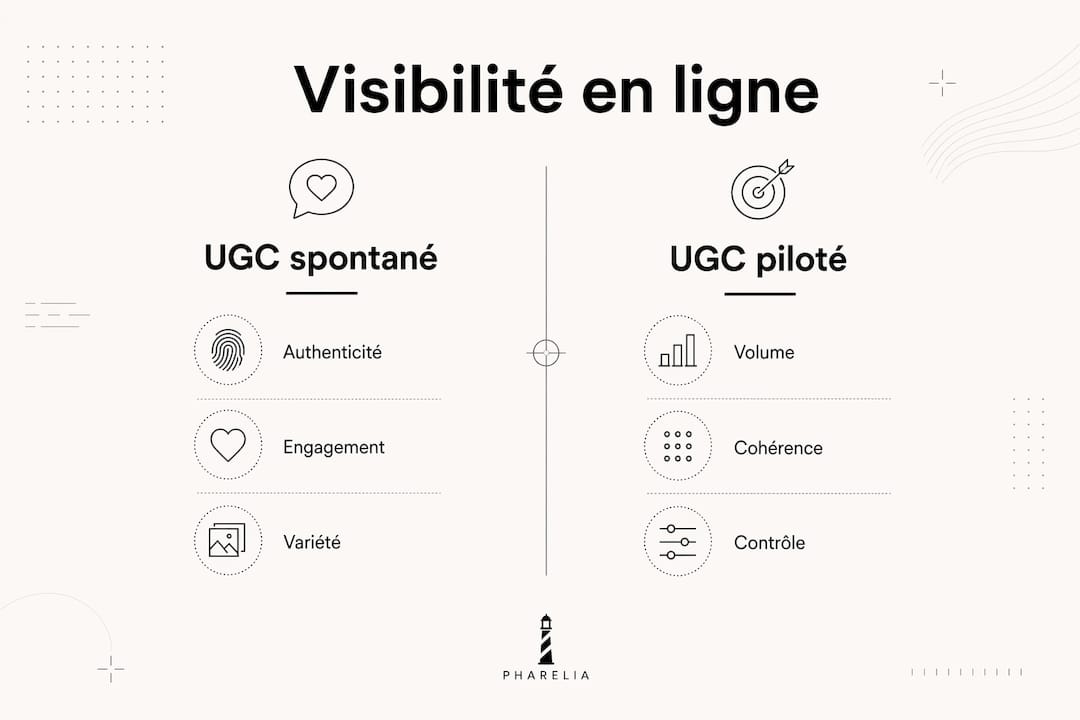
The distinction is operational, not theoretical. Organic UGC brings authenticity; managed UGC brings volume, consistency and creative control. Most successful strategies combine both streams.
| Criterion | Organic UGC | Managed UGC |
|---|---|---|
| Collection effort | Low (mention monitoring) | High (briefing, coordination) |
| Creative control | None | Strong |
| Legal obligations | Permission after creation | Contract or prior agreement |
| Scalability | Limited | High |
| Advertising use | Possible with permission | Planned from the outset |
Three sample briefs to get started:
- 15-second unboxing: ask a satisfied customer to film opening their package, showing the product and saying one sentence about what convinced them. Send by email 48 h after delivery.
- 45-second objection-focused testimonial: ask the customer to answer ‘What was your main hesitation before buying?’ This format directly addresses prospects' concerns.
- Product photo in a real-life setting: a simple brief with a branded hashtag, distributed through a story or a post-purchase email. Asking for a specific format at the right time multiplies quality and participation rates.
For a product launch, favor managed UGC to ensure volume. For an e-commerce product page, organic UGC (verified reviews, customer photos) is often more convincing. For advertising campaigns, managed UGC is essential: some platforms such as TikTok provide technical authorization mechanisms (Spark Ads) that allow a creator's video to run as an ad, provided the authorization code is obtained within the designated window.
What French law requires before reusing customer content
Any commercial reuse of content created by a third party requires explicit, documented permission. This is an obligation, not a recommendation.
Legal checklist (French law):
- Copyright: content belongs to its creator from the moment of creation (French Intellectual Property Code, art. L111-1). Obtain written permission specifying the channels, duration and authorized uses.
- Image rights: any recognizable person in a photo or video must give explicit permission for each commercial use.
- Exchange of value: whenever a gift or discount is involved, the content becomes a materially incentivized recommendation requiring clear disclosure (‘partnership’ or ‘gifted by’), in line with DGCCRF recommendations.
- GDPR / CNIL: if you collect personal data as part of UGC collection (email, first name, location), you must inform the user and retain proof of consent.
- Evidence retention: archive screenshots, message exchanges and agreements in a timestamped folder.
Recommended procedure: publish a public call with a branded hashtag, then confirm agreement by direct message or email using a simple statement: ‘I authorize [Nom de marque] to use this content on [canaux] for a period of [X mois/ans]’. A reply convention (e.g. #OuiVotreMarque) is the most practical way to document consent without a lawyer.
Pro tip: use a shared spreadsheet or a UGC management tool to record each permission with the date, channel concerned and link to the original content. In a dispute, this record serves as evidence.
How to integrate and mark up UGC so Google and AI can read it
Structure UGC as indexable assets, rather than simple page decorations.
Technical checklist:
- Mark up each review in JSON-LD with Schema.org's
ReviewandAggregateRatingschema to trigger stars in Google results. - Add
LocalBusinessschema to your local pages to strengthen GEO signals. - Apply a canonical tag if a customer review appears both on your site and on a third-party platform, to avoid duplicate content.
- Fill in the
altattribute of customer photos with a precise description including the product name and location where relevant. - Enable deferred loading (lazy loading) for customer photo galleries to preserve Core Web Vitals.
Editorial checklist:
- Standardize the caption for each piece of content: first name, city, product purchased, date. This metadata improves GEO and AEO signals.
- Include testimonial excerpts in your page FAQs: a real customer question rephrased as an FAQ is a potential source for generative answers.
- Add geographic context (city, region) during collection to strengthen local relevance.
Pro tip: systematically ask every contributor for their city and a short sentence summarizing their experience. These two elements are enough to improve GEO/AEO signals without making the brief heavier.
For e-commerce sites, Pharelia's sector-specific approach details how to integrate reviews into product pages.
Which indicators should you track to measure UGC's real impact?
Measure organic performance, engagement and commercial impact together. A single dashboard is enough for a microbusiness/SME.
| Metric | Frequency | Indicative objective | Tool |
|---|---|---|---|
| Google rankings for pages enriched with UGC | Weekly | Progress on long-tail queries | Google Search Console |
| Impressions and click-through rate (CTR) | Weekly | Higher CTR on pages with stars | Google Search Console |
| Product page conversion rate | Monthly | Compare pages with/without UGC | GA4 |
| Mentions and citations in AI | Monthly | Appearances in ChatGPT, Perplexity | AI mention tracking |
| Average rating and review volume | Monthly | Steady progress | Google Business Profile |
Recommended tools: Google Search Console for rankings and CTR, GA4 for conversions and on-page behavior, an AI mention tracking tool to measure citations in generative answers. A shared spreadsheet is enough to track permissions and the volume of UGC collected.
6-step action plan to launch your UGC strategy in 8 weeks
- Audit (week 1): inventory existing customer content (reviews, photos, mentions), assess its quality and identify a pilot product page or local page.
- Brief and collection (weeks 2–3): write a short brief, launch a post-purchase request by email and activate a branded hashtag.
- Legal validation (week 3): obtain written permissions for the selected content and archive them in a timestamped folder.
- Technical integration (weeks 4–5): add JSON-LD markup, optimize
altattributes, check canonicals and publish on the pilot page. - Initial measurement (week 6): collect the first data in Search Console and GA4, compare the before/after conversion rate.
- Iteration and scaling (weeks 7–8): if results on the pilot page are positive, roll out to other priority pages and structure a regular collection stream.
| Week | Action | Owner | Deliverable |
|---|---|---|---|
| 1 | Existing UGC audit | Business owner / marketing | List of 5 usable pieces of content |
| 2–3 | Brief + collection | Marketing / customer support | — |
| 3 | Permissions | Business owner | Folder of archived agreements |
| 4–5 | Technical integration | Marketing / Pharelia | Pilot page marked up and published |
| 6 | Initial measurement | Marketing | Search Console + GA4 report |
| 7–8 | Broader rollout | Marketing | 3–5 additional pages enriched |
How to manage problematic content without damaging your reputation
Plan moderation before disputed content appears. A formal policy protects both the brand and users.
Risks to anticipate:
- Defamation or false allegations about your products or team.
- Copyright infringement (music, third-party images in a customer video).
- Privacy violations (visible personal data, people who have not consented).
- Misleading disclosure: content presented as organic when it results from an undisclosed exchange of value.
Moderation procedure:
- Define clear removal criteria (off-topic, illegal content, harm to third parties) and communicate them publicly in your terms of use.
- Set a public response deadline of no more than 72 h for reports.
- For disputed content, respond publicly in a factual, neutral way, then address the substance privately.
- In the event of an established legal risk (defamation, rights infringement), immediately preserve screenshots and metadata before any removal.
Pro tip: capture and timestamp any disputed content as soon as it appears, even if you plan to remove it. This evidence is essential in legal proceedings.
Client results: what UGC integrated into an SEO/GEO/AEO strategy actually delivers
Applewood: +300 % SEO traffic and +500 % visibility in generative engines after integrating a structured content strategy including marked-up customer testimonials and enriched local pages.
Other publishable results illustrate the same logic:
- [M2A](https://pharelia.com/en/client-work/m2a): +86 % organic visibility in one month, partly through structuring customer content and optimizing structured data.
- [Groupe Squadra](https://pharelia.com/en/client-work/groupe-squadra): +50 % visibility in two months on local and sector-specific queries.
These results vary by sector, site maturity and starting traffic volume. A site beginning with no structured reviews and no Review markup has more to gain than a site already well equipped. The common condition in all these cases: customer content structured, marked up and published on indexable pages, rather than merely aggregated on a third-party platform.
Key takeaways
Structured, marked-up UGC is the most direct lever for simultaneously improving SEO, GEO and AEO for a French microbusiness or SME, provided rights are secured and impact is measured from the first pilot page.
| Point | Details |
|---|---|
| Measurable social proof | Product pages enriched with customer content can convert up to +74 % better according to some analyses. |
| Three visibility surfaces | Well-marked-up UGC improves SEO, local GEO and citations in generative AI. |
| Legal obligation | Any commercial reuse requires documented written permission compliant with French law. |
| Priority measurement | Track GSC rankings, CTR and conversion rates on pages with/without UGC in GA4. |
| Pharelia as a partner | Pharelia manages UGC collection, markup and measurement as part of an integrated SEO/GEO/AEO strategy. |
UGC in 2026: what microbusinesses/SMEs still underestimate
Most guides to user-generated content stop at social proof and conversion. That is reductive. What changes in 2026 is that generative engines (ChatGPT, Perplexity, Gemini) cite sources, and these sources are mainly well-indexed, well-structured pages. A customer testimonial published as plain text on an unmarked-up page has no chance of being extracted by an LLM. The same testimonial, marked up as Review with a location and date, becomes a serious citation candidate.
The other underestimated angle: managed UGC for microbusinesses/SMEs is not reserved for large brands with creator budgets. Ten customers approached effectively, with a precise brief and a request at the right time, often produce more value than an expensive influencer campaign. Structuring two streams (organic and managed) and formalizing briefs turns isolated content into a lasting visibility asset. This is the work Pharelia does daily for its clients, integrating UGC into a coherent SEO, GEO and AEO digital strategy.
Pharelia manages your UGC strategy from start to finish
Collecting, marking up and measuring UGC requires coordination between marketing, technical and legal teams. This is precisely what Pharelia operates for French microbusinesses, SMEs and startups: a free visibility audit, structuring customer content, structured data markup, tracking rankings in Google Search Console and GA4, and measuring citations in generative engines.
Applewood's results (+300 % SEO, +500 % GEO-IA) and M2A's (+86 % in one month) illustrate what an integrated strategy produces, without an annual commitment. Each project starts with a free audit built on your site's crawl, SERP and AI mention data. To get started, consult Pharelia's SEO, GEO and AEO resources or contact us.
Useful sources for further reading
- UGC and content marketing guide — Studio Nextop: performance data and collection best practices.
- Complete UGC marketing guide — Moggo: strategy structuring and sample briefs.
- Encouraging, using and recycling UGC — Socialk: permission procedures and compliance.
- User-generated content — French Wikipedia: reference definition.
- French Intellectual Property Code — Légifrance: reference text for copyright in France.
- CNIL — Applicable GDPR rules: consent obligations and data retention.
- Local SEO in 2026 — Pharelia: practical GEO guide for microbusinesses/SMEs.
Practical tip: keep a timestamped shared folder containing permissions, screenshots of original content and briefs sent. In a dispute or audit, this evidence library is your first line of defense.
Frequently asked questions
What is user-generated content (UGC)?
User-generated content means any content created by a brand's customers or users: reviews, photos, videos and testimonials published online or on social media, as opposed to content produced directly by the company.
Does UGC really improve Google search visibility?
Yes: it adds fresh indexable content, broadens long-tail coverage and enables stars to appear in results through AggregateRating markup, improving click-through rate.
Do you need permission to reuse a customer review in France?
Any commercial reuse requires written permission specifying the channels and duration of use, in accordance with the French Intellectual Property Code and CNIL recommendations.
How does Pharelia integrate UGC into a visibility strategy?
Pharelia structures collection, structured data markup and measurement of UGC's impact as part of an integrated SEO, GEO and AEO strategy, with tracking through Search Console and GA4.
Where should you start when you have no existing UGC?
Identify five satisfied customers, send a request email 48 h after purchase with a precise brief (format, duration, question to answer), obtain written permission and publish the first marked-up testimonial on your priority product page.