
Introduction

In brief: - A Google penalty reduces a site's visibility in search results, whether it is manual or algorithmic. It is important to check Search Console, traffic in GA4 and backlinks quickly to diagnose the cause of the decline. Fixing violations and building a solid evidence file lets you request reconsideration and hope for recovery within a few weeks to several months.
A Google penalty reduces your visibility in search results, either because a human reviewer has imposed a manual action notified in Search Console, or because an algorithm update has recalculated your rankings without telling you. This is an operational distinction: it determines the procedure to follow and the recovery timeframe.
Before anything else, make three checks within the hour:
- Google Search Console: open the ‘Security & Manual Actions’ tab and check whether a violation message appears. No message does not mean there is no problem, but points toward an algorithmic cause.
- Google Analytics (GA4): compare organic traffic week by week and identify the exact date of the drop. A sharp break on a specific day is a strong signal.
- Backlink exports and a quick crawl: run an export through Ahrefs or SEMrush to spot unusual spikes in inbound links, and a Screaming Frog crawl to detect suspicious redirects, thin pages or cloaking issues.
Pro tip: Do not submit any reconsideration request before fixing all identified violations. A partial request is systematically rejected and extends recovery time.
Table of contents
- Manual penalty or algorithmic decline: what is the practical difference?
- How do you detect a penalty on your site?
- What are the most common causes of a Google sanction?
- What practical effects does a penalty have on your business?
- How do you fix a Google penalty, step by step?
- What practices help you avoid penalties over the long term?
- Which tools should you use and which emergency checklist should you apply?
- What Pharelia client cases reveal about SEO recovery
- Key takeaways
- Why prevention costs less than repair
- Pharelia diagnoses and fixes your Google penalty
- Official sources and useful resources
- Frequently asked questions
Manual penalty or algorithmic decline: what is the practical difference?
Google applies two main types of sanctions: manual actions, decided by human reviewers on the anti-spam team and notified in Search Console, and algorithmic declines, triggered automatically when an update rolls out. Understanding this distinction immediately guides the diagnosis.
Manual action
- Explicit notification in Search Console with the nature of the violation and the affected pages.
- Variable scope: it may affect an isolated page, a section of the site or the entire domain.
- Officially listed types: unnatural inbound or outbound links, thin content, user-generated spam, cloaking, deceptive redirects, hidden text, keyword stuffing and a hacked site.
- Recovery depends on Google accepting a reconsideration request.
Algorithmic decline
- No notification: the traffic drop is the only signal.
- Timing correlates with an update rollout (Penguin, Helpful Content Update, Spam Update).
- Automatic recovery at the next update, provided the root causes have been fixed.
- Often a longer timeframe because it depends on Google's recalculation schedule.
Pro tip: Always start with Search Console. If no manual action is reported, check the Google update calendar (available on Search Engine Land or the official Google Search Central blog) and align it with the drop date in GA4. This timing correlation is the basic diagnostic step for any algorithmic decline.
How do you detect a penalty on your site?
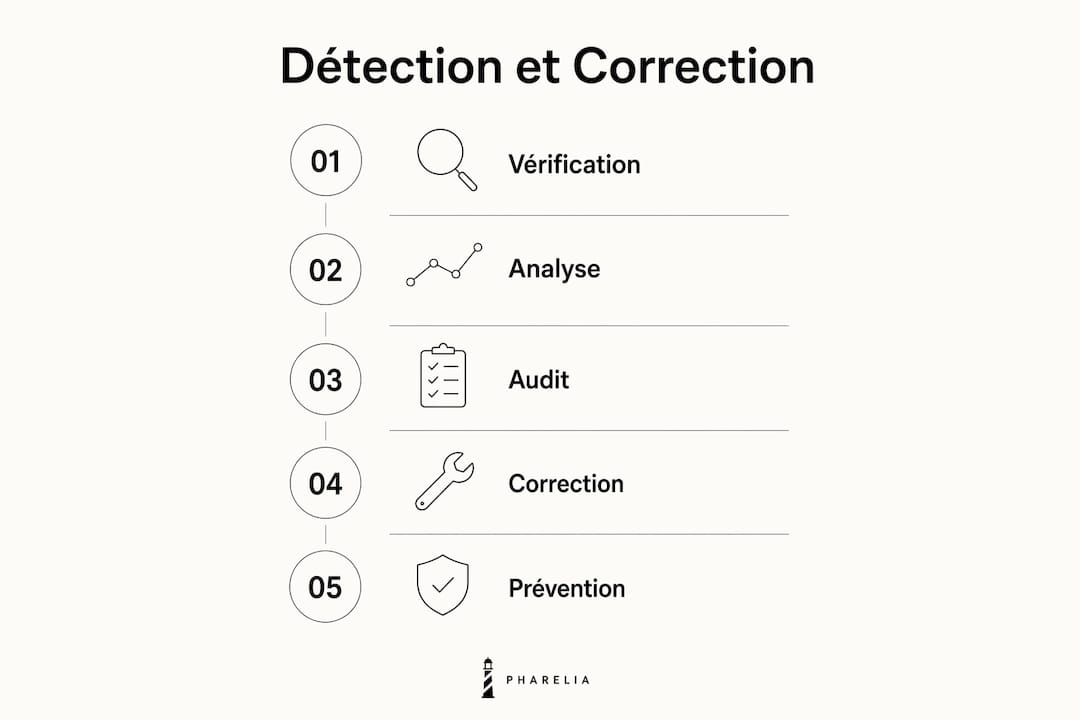
The method relies on three levels of investigation, carried out in the following order.
1. Check Search Console first
Log in to your Google Search Console account and navigate to ‘Security & Manual Actions’. The ‘Manual actions’ report identifies the exact nature of the violation and the affected pages: this is the first check to make. Two possible situations:
- ‘No manual actions’ message: the problem is probably algorithmic or competition-related.
- Violation listed: note the scope (entire site or partial), the violation category and the sample URLs provided.
2. Analyze traffic in GA4 and correlate it with updates
Export organic sessions day by day for the last 12 months. Identify the exact date of the break, then correlate it with the Google update calendar: Penguin targets link profiles, Helpful Content Update targets editorial value, and Spam Updates target automatically generated content.

A break coinciding with a known rollout points toward an algorithmic cause. A gradual decline with no clear correlation may indicate stronger competition or a loss of alignment with search intent rather than an active sanction.
3. Audit backlinks and crawl the site
- Export the link profile from Ahrefs or SEMrush: look for over-optimized anchors, large numbers of low-authority domains and spikes in link acquisition over a short period.
- Run Screaming Frog across the entire domain: identify thin-content pages (fewer than 300 words with no added value), redirect chains, incorrect canonical tags and unintentionally noindexed pages.
- Run a
site:votredomaine.comsearch in Google to check the number of indexed pages and detect partial deindexing.
What are the most common causes of a Google sanction?
The most common triggers fall into four broad categories, each with identifiable signals.
Unnatural link profile
- Buying links, private blog networks (PBN), mass link exchanges.
- Over-optimized anchors mechanically repeating the target keyword.
- Sudden acquisition spikes with no editorial rationale.
Low-value content
- ‘Thin content’ pages with no depth or genuine expertise.
- Automatically generated content with no review or human contribution.
- Internal duplicate content or content copied from other sources.
- No identified author or expertise signals (insufficient E-E-A-T).
Deceptive techniques
- Cloaking: displaying different content to Google bots and users.
- Sneaky redirects to irrelevant pages.
- Doorway pages created to capture traffic on keyword variants without value for the user.
- Hidden text or keyword stuffing in tags.
Spam and security
- User-generated spam in unmoderated comments, forums or forms.
- A hacked site with links or malicious pages injected without the owner's knowledge.
- Shared hosting with neighboring domains associated with spam.
What practical effects does a penalty have on your business?
The impact of a Google sanction goes beyond a ranking decline. It translates directly into measurable business losses.

In terms of traffic, severe cases record major losses in organic traffic: according to several specialist guides, typical losses range between 50 % and 90 % in the most serious situations. A site-wide manual action can cause substantial deindexing, making the domain invisible for many target queries. Strategic pages, those generating inbound inquiries or sales, are the first affected.
Business consequences follow mechanically: fewer contact form submissions, falling revenue from the organic channel, and disruption to campaigns that rely on organic traffic to feed remarketing. For a microbusiness or SME whose main acquisition source is SEO, an untreated penalty can threaten short-term viability.
Priority metrics to monitor: impressions and clicks in Search Console, organic sessions in GA4, number of indexed pages, coverage rate in the indexing report, and volume of URL removal requests.
How do you fix a Google penalty, step by step?
The procedure differs according to the type of sanction, but the logic is the same: fix first, document next, submit last.
For a manual action
- Identify the exact reason in Search Console's ‘Manual actions’ report and note all affected URLs.
- Fix all violations: remove or disavow unnatural links, rewrite or merge low-value pages, correct cloaking and redirects.
- Try removing links manually before using the disavow tool. Link disavowal should be used only as a last resort, after contacting the webmasters concerned.
- Document each correction: before/after screenshots, copies of emails sent to webmasters, list of corrected URLs with the intervention date.
- Build the reconsideration file: complete list of corrections, evidence of link removals, description of preventive measures implemented.
- Submit the reconsideration request through Search Console, clearly explaining the actions taken. Complete documentation significantly increases the chances of acceptance.
For an algorithmic decline
- Identify the pages that have lost the most rankings and traffic.
- Fix the root causes: improve editorial depth, strengthen E-E-A-T signals, clean up the link profile.
- Prioritize pages with high commercial value.
- Wait for the next update rollout so Google can reassess the site.
Pro tip: Do not write a generic reconsideration request. Detail what was corrected action by action, include the affected URLs and attach evidence. Google evaluates the sincerity and completeness of the process.
| Type of sanction | Typical recovery timeframe | Action priority |
|---|---|---|
| Manual action (links) | 4–12 weeks after reconsideration is accepted | Link cleanup + reconsideration request |
| Manual action (content) | 4–8 weeks after reconsideration is accepted | Page rewriting + reconsideration request |
| Algorithmic decline (links) | several months (next update) | Link profile audit and cleanup |
| Algorithmic decline (content) | several months (next update) | Editorial overhaul + E-E-A-T |
| Hacked site | a few weeks after cleanup | Security improvements + reconsideration request |
What practices help you avoid penalties over the long term?
Prevention rests on three operational pillars that any team can incorporate into its usual processes.
E-E-A-T in content production
- Identify an author for every article or service page, with a verifiable biography.
- Support every claim with cited, verifiable sources.
- Produce content based on the team's real experience, not solely on rephrasing third-party sources.
- Systematically review any content generated by an artificial intelligence tool before publication.
Governance and security
- Moderate user-generated content (comments, reviews, forums) through a validation process before publication.
- Apply CMS security updates (WordPress, Shopify, etc.) as soon as they become available.
- Audit administrator access and remove inactive accounts.
- Set up server file monitoring to detect any malicious injection.
Responsible link building
- Favor links earned naturally through reference content rather than link-buying campaigns.
- Diversify inbound link anchors: a single-anchor profile using the target keyword is a warning signal.
- Monitor the link profile monthly through Ahrefs or SEMrush and flag suspicious domains.
Pro tip: The most sustainable strategy is to build genuine authority through E-E-A-T rather than trying to manipulate ranking signals. Sites investing in editorial quality withstand algorithm updates better.
Which tools should you use and which emergency checklist should you apply?
Essential tools
- Google Search Console: manual actions report, indexing coverage, search performance.
- Google Analytics (GA4): organic traffic analysis by segment, identification of the break date.
- Screaming Frog: full site crawl, detection of thin content, redirects, 404 errors, duplicate tags.
- Ahrefs or SEMrush: backlink profile audit, detection of over-optimized anchors, ranking tracking.
- Hosting and security tools: server logs, malware scanner (Sucuri, Wordfence for WordPress).
Emergency checklist: 10 checks in under an hour
- Open Search Console and check the ‘Manual actions’ tab.
- Check the ‘Security’ tab for a hack reported by Google.
- Export GA4 organic sessions over 12 months and identify the break date.
- Correlate that date with the Google update calendar.
- Check the
robots.txtfile: no directive should block indexing of strategic pages. - Check the XML sitemap: are all important pages listed and accessible?
- Run a Screaming Frog crawl on the first 500 URLs to detect critical errors.
- Export the backlink profile from Ahrefs or SEMrush and filter low-authority domains.
- Run a
site:votredomaine.comsearch to estimate the number of indexed pages. - Check server status and access logs to detect unusual activity.
For the reconsideration request, build a structured file: list of corrected URLs with dated screenshots, copies of emails sent to webmasters requesting link removal, and a description of the preventive measures implemented. Exhaustive documentation is the most decisive factor in acceptance of the request.
What Pharelia client cases reveal about SEO recovery
Pharelia's interventions on penalized sites or sites losing visibility follow a repeatable methodology: crawl and link profile audit, identification of root causes, correction plan prioritized by impact, then post-intervention monitoring through Search Console and GA4.
Observed results:
- Applewood: +300 % organic traffic and +500 % citations in generative AI answers after a complete technical and editorial overhaul.
- M2A: +86 % organic visibility in one month, achieved by correcting technical indexing obstacles and restructuring content.
- Groupe Squadra: +50 % in two months after an audit and bringing E-E-A-T signals into line.
These results vary by sector, competition, initial site condition and the nature of the sanction. They illustrate what a structured intervention can produce, without guaranteeing an identical result.
The methodology applied in each case includes a full Screaming Frog crawl, a backlink audit with Ahrefs, rewriting low-value pages, removing or disavowing toxic links, submitting a reconsideration request with a documented file, and monthly monitoring of rankings and indexing. For microbusinesses and SMEs providing local services, this approach adapts to constrained budgets and timelines by prioritizing the pages generating the most inbound inquiries.
Key takeaways
A Google penalty can be fixed through a documented, exhaustive process: check Search Console, fix every violation, then submit a complete reconsideration request.
| Point | Details |
|---|---|
| Distinguish the two types | A manual action is notified in Search Console; an algorithmic decline is not. |
| Correlate before concluding | Align the GA4 drop date with the Google update calendar before diagnosing. |
| Document each correction | Screenshots, link removal emails and a URL list are essential for the reconsideration request. |
| Recovery timeframes | From 4 to 12 weeks (corrected manual action), 2 to 6 months (algorithmic decline), depending on the nature of the sanction. |
| Pharelia | Free visibility audit, Search Console/GA4 diagnosis and remediation plan for microbusinesses and SMEs in France. |
Why prevention costs less than repair
The question is not philosophical. Every week spent under a penalty represents measurable lost earnings: absent organic traffic, leads not generated, remarketing campaigns deprived of their natural supply. For an SME whose SEO accounts for a substantial share of business inquiries, an untreated penalty can wipe out several quarters of progress.
What I consistently observe is that sanctioned sites have almost always neglected two simple things: moderation of third-party content and CMS security. No deliberate manipulation, no conscious spam strategy. Just unmoderated comments accumulating toxic outbound links, or an outdated WordPress plugin opening a breach for malicious page injection. Fixing these two points takes a few hours. Recovery after a sanction takes dozens of hours, excluding business losses during the remediation period.
The other underestimated angle concerns AI-generated content and its marketing strategies. Publishing automatically produced content without review or genuine expertise directly exposes a site to updates targeting low-value content. The tool is not the problem; the absence of a human validation process is. An article written with an AI tool's help, reviewed, enriched with the team's experience and properly sourced meets E-E-A-T criteria. The same article published raw does not, and Google is getting better at distinguishing the two.
Technical transparency, security and editorial governance are not optional for sites that depend on organic search. They are basic conditions. If you have not yet carried out a visibility audit, it is the logical starting point before the problem appears.
Pharelia diagnoses and fixes your Google penalty
Losing visibility without knowing the precise cause is the most costly situation for a site. Pharelia offers a free visibility audit covering Search Console analysis, GA4 diagnosis, technical crawling and a link profile audit, with a remediation plan prioritized by impact.
For sites under a manual action, support includes building the reconsideration file, documenting corrections and monitoring after the action is lifted. For algorithmic declines, the intervention focuses on an editorial and technical overhaul of strategic pages, with monthly monitoring of rankings and indexing. Packages are monthly, with no annual commitment, and adapted to microbusiness and SME budgets.
Pharelia works with WordPress, Shopify, Webflow, Framer and any custom environment. Results are measured and communicated through Search Console, GA4 and citation tracking in generative engines such as ChatGPT, Perplexity and Gemini.
Contact us to get a complete diagnosis of your situation in under 48 hours.
Official sources and useful resources
The resources below allow you to check official procedures and explore each stage of diagnosis and remediation in greater depth.
| Source | Use |
|---|---|
| Google Search Console — Manual actions | Official detection and reconsideration request procedure |
| Google Search Console — Disavow tool | Conditions of use and limitations of link disavowal |
| Creating helpful content — Google Developers | Official content quality and E-E-A-T criteria |
| Abondance — Google penalty definition | French-language reference on penalty types and causes |
| Ahrefs — Google penalties guide | Timing correlation method and backlink audit |
| FormAlive — Google penalty guide | Practical summary of causes and recovery procedures |
Check the official Google Search Central blog regularly to follow update rollouts: each major update announcement is an opportunity to check whether a recent traffic decline coincides with it.
Frequently asked questions
What exactly is a Google penalty?
A Google penalty is a reduction in visibility imposed on a site violating Google's guidelines, either through a manual action notified in Search Console or through an automatic algorithmic recalculation during an update.
How do I know whether my site has been penalized?
Check the ‘Manual actions’ tab in Google Search Console. If no notification appears but organic traffic has dropped sharply, correlate the drop date with the Google update calendar to identify an algorithmic cause.
How long does recovery after a penalty take?
A manual action that has been corrected and accepted by Google is generally lifted within 4 to 12 weeks. An algorithmic decline requires waiting for the next update, or 2 to 6 months depending on rollout frequency.
Does Google impose financial fines on penalized sites?
No. A Google penalty is a search visibility sanction, not a financial fine. It reduces or removes the site's visibility in search results, without any monetary penalty. Fines mentioned in the news concern European Commission antitrust proceedings against Google as a company, unrelated to third-party sites' search visibility.
Can Pharelia help lift a manual action?
Yes. Pharelia carries out a free visibility audit including Search Console and GA4 diagnosis, then supports the preparation of a reconsideration file and monitoring after the action is lifted for microbusinesses and SMEs in France.
Recommendation
- Local SEO & AI agency for tradespeople and neighborhood services — Pharelia
- SEO & GEO agency for SaaS businesses and startups — Pharelia
- SEO & AI visibility for lawyers and law firms — Pharelia
- Applewood · SEO and AI client case | Pharelia