
 Add to preferred sources on Google
 ChatGPT
 Claude
 Perplexity

Introduction
International SEO services make one website, or a group of sites, findable in several countries and languages. The work is mostly decisions: which markets, which languages, which URL structure, and who owns each page. A good provider settles those decisions first and sells production second. If a proposal opens with a translation volume or a list of hreflang tags, it has skipped the part that decides whether the rest pays off. This article gives you the scope, the questions, the cost logic and a measurement frame, so you can judge any proposal, ours included. Where something is our opinion, it is labeled as our analysis.
We are an agency, so the practical point is this: international SEO is a coordinated, managed piece of work, not a plugin and not a translation order. At Pharelia we scope it with each client through technical and international SEO, alongside strategy, production and measurement, with the scope, languages, responsibilities and budget defined in the proposal.
TL;DR
- International SEO means optimizing a multilingual or multinational site for visibility across countries and languages, and it adds legal, language and infrastructure questions that single-market SEO does not have.
- A credible service covers market selection, site structure, hreflang, local keyword research, localized content, and measurement by market, in that order.
- Fix single-market fundamentals first: site speed, architecture and metadata. Multiplying a weak site multiplies its problems.
- Judge proposals on scope, access, ownership and reporting by country and language, not on promised rankings. Nobody can guarantee them.
- Surveyed SEO pricing in USD is wide, and monthly retainers are the most common model, so compare scope line by line, never headline price.
What international SEO services actually cover
Search Engine Land defines international SEO as optimizing a multilingual or multinational website for visibility, organic traffic and performance across several countries and languages. The same guide notes how it differs from ordinary SEO: you manage different languages, possibly several websites, legal restrictions, varied infrastructure and search engines that are not Google.
Google itself separates two cases, and the distinction matters for what you buy. In its documentation on multi-regional and multilingual sites, a multilingual site offers content in more than one language, such as a Canadian business with English and French versions. A multi-regional site explicitly targets users in different countries, such as a manufacturer shipping to both Canada and the United States. Many sites are both.
That gives you a practical test. Before you talk to any provider, write one sentence per market: “We want [language] speakers in [country] to find [product line].” If you cannot write it, the first service you need is strategy, not implementation.
Who needs it and who does not yet
You likely need it if you sell in more than one country, publish in more than one language, or run several brand sites that should not compete with each other. Typical cases are a SaaS company opening a German-speaking market, an industrial group with a product catalog per region, or a consultancy with offices in several countries.
You likely do not need it yet if your single-market site has weak foundations. The U.S. Department of Commerce, in its guide Understanding International SEO, advises getting sound fundamentals in place first: site speed, clear architecture, metadata and appropriate keywords. International work adds another layer of complexity to the digital strategy. Our view, as analysis: a site that cannot rank in its home market with its best content rarely gains from being copied into five languages.
The seven components of a complete service
Proposals vary in wording, but a complete service touches the same seven areas. Use this as a checklist when you read one.
- Market and language decision. Which countries, which languages, in what order, based on demand, revenue potential and your ability to serve customers there.
- Site structure. Country-code domains, subdirectories or subdomains, chosen for what your team can maintain.
- Language and region annotation. Hreflang and related signals that tell search engines which version fits which user.
- Local keyword research. Done per market, not translated from a master list.
- Localized content and page mapping. Which pages exist per market and which local intent each one answers.
- Technical health. Crawling, indexing, speed and rendering across all versions.
- Measurement by market. Reporting that separates countries and languages instead of blending them.
The next sections take the four that most often go wrong.
Structure and targeting: the decisions that are expensive to reverse
The first real decision is whether you target a language, a country, or both. A Spanish-language page can serve Spain, Mexico and the United States, or you can write a separate version for each. More versions mean more localization and more maintenance. The Stepes multilingual SEO guide describes the same set of choices: language, country or both, then a maintainable structure of country-code domains, subdirectories or subdomains.
Our analysis of how to choose: pick the structure your team can actually keep consistent for years. A theoretically ideal structure that nobody maintains loses to a simpler one that is kept clean. Subdirectories keep everything on one domain and one set of operations. Country-code domains give a strong local signal but multiply hosting, analytics and governance. This is also where a site redesign can quietly break things, so if a rebuild is on the roadmap, read our guide to preserving rankings in an SEO redesign before locking the new structure.
Hreflang without the mythology
Hreflang is the annotation that says “this page has an equivalent for another language or region.” It is the most discussed and most misconfigured part of the work, so a provider’s answer on it is a fair quality signal. The rules are documented by Google in Localized Versions of your Pages:
- Each localized version must reference itself and all the other relevant versions, using fully qualified URLs.
- References must be reciprocal. Annotations that are not confirmed from the other page may be ignored.
- You can implement hreflang in HTML, HTTP headers or sitemaps. Google describes them as equivalent, says to choose the most convenient one, and notes that using all three has no Search benefit and may be harder to manage.
The Stepes guide adds that codes should be valid and language-first (for example, language, then optional region). Put these into a review of any proposal: does the provider say which of the three methods it recommends for your stack and why? If the answer is “all of them to be safe,” that contradicts Google’s own guidance.
One point for users, not crawlers: the W3C recommends visible navigation to localized versions from any page where an alternative exists, with each language named in its own language and script. Search signals and visible switchers should agree.
For the full technical detail, our multilingual SEO technical guide goes further than this overview does.
Local keywords and intent: where translation fails
The cheapest way to build a multilingual site is to translate the existing pages. It is also the most common reason localized pages attract no traffic. The Stepes guide makes the point that keyword research should be conducted in the target language and market, because regional vocabulary and commercial phrasing differ. Search Engine Land likewise says an effective service helps search engines identify the targeted countries and languages so users receive the most relevant version, which presupposes that the versions are genuinely different.
In practice, ask any provider how they would handle three situations:
- Same language, different markets. English-speaking buyers in the US, UK and Australia may use different words for the same product, and different currencies, units and compliance terms.
- Different intent for the same topic. A buyer in one country may want a comparison page where another wants a price list or a regulation explainer.
- No local equivalent. Some of your pages should not be translated at all, because the question they answer does not exist in that market.
Our analysis: the best sign of a serious provider is a willingness to tell you that a market is not worth entering yet. A provider paid per translated page has no incentive to say it.
A worked example (illustrative)
The figures below are invented to show the reasoning. They are not measured data.
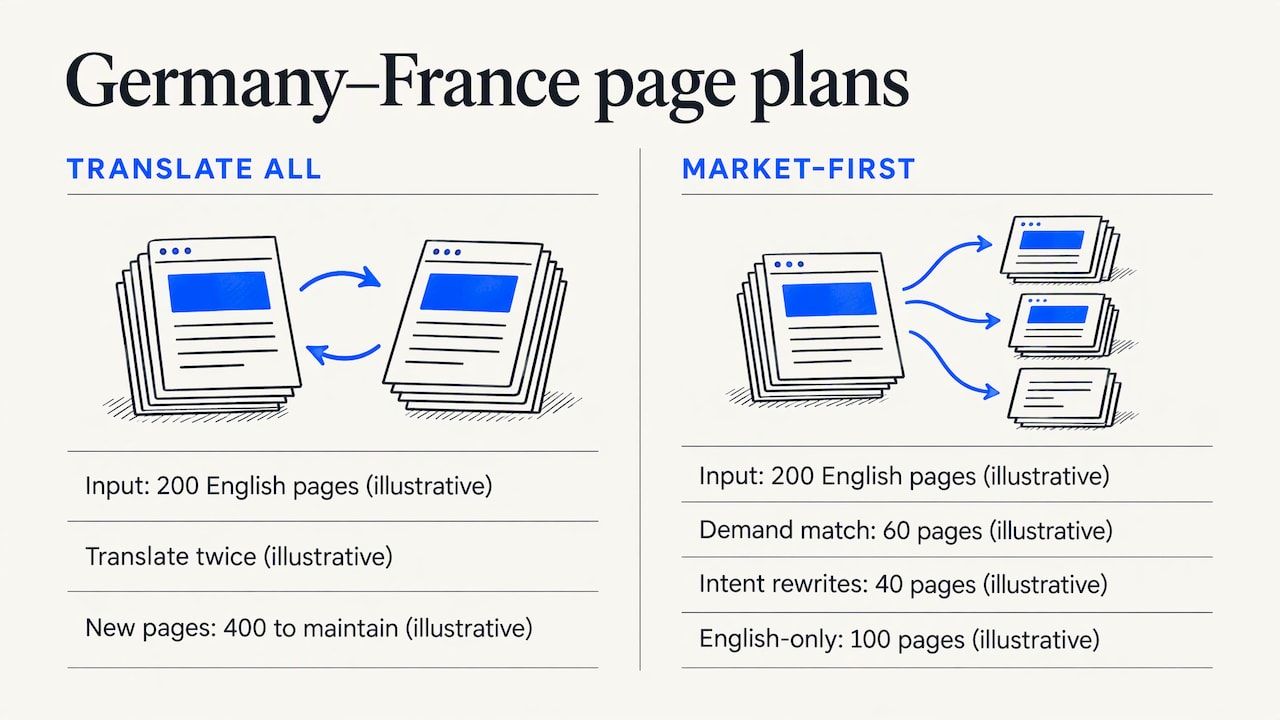
Imagine a B2B software company with 200 English pages that wants to enter Germany and France. A naive plan translates all 200 pages twice: 400 new pages. A market-first plan starts with a keyword and intent review per country and might find, for illustration, that 60 pages match real local demand, 40 need rewriting around a different local intent, and 100 should stay English-only for now. The first plan produces 400 pages to maintain. The second produces roughly 100 pages built from local research, leaves 100 untouched, and gives you a clear order of work. The point is the sorting step, not the numbers.
Scoping the engagement: what to agree before work starts
Most disappointments in agency work are scoping failures, not skill failures. Contractable’s 2025 guidance on SEO contracts recommends defining technical audits, on-page work, content strategy, production, digital PR, analytics, reporting and meetings. It also recommends stating explicitly which items are excluded or assigned elsewhere: development, hosting, paid media, legal review and translation, where applicable. It adds that you should specify access to the CMS, Search Console, Analytics and log files, name who implements recommendations, and explain how approval or deployment delays affect timelines.
For an international engagement, we would add the market layer. Use this table as a template for any proposal you receive:
| Item to agree | Question to answer in writing | Common failure |
|---|---|---|
| Markets and languages | Which countries and languages, in what order? | A vague “global” scope with no sequence |
| Deliverables | Audit, structure plan, keyword research per market, content, reporting? | Deliverables described as activities, not outputs |
| Responsibilities | Who writes, who translates, who reviews legally, who deploys? | Recommendations that nobody on your side can implement |
| Access | CMS, Search Console, Analytics, logs? | Work starts without access, then stalls |
| Cadence | How often are reviews, reports and publishing cycles? | Reports that arrive but do not drive decisions |
| Approvals | How are delays on your side handled in the timeline? | Missed milestones blamed on the agency |
| Budget | Retainer, project or hybrid, and what is excluded? | Out-of-scope items discovered after signing |
We set these items out in the proposal. At Pharelia, the proposal defines the work, deliverables, responsibilities, languages, cadence, access and budget, and pricing is available on request because the scope is tailored. That is a deliberate design: a fixed menu would not fit a three-market SaaS company and a twelve-brand industrial group equally well.
What international SEO services cost
The honest answer is a range, and the range is wide. The best-known public data is the Ahrefs survey of SEO providers, published in 2023. It reports that SEO costs usually range from $250 to $10,000 per month, with 63% of businesses spending between $500 and $5,000. Common models are monthly retainers, hourly billing and per-project pricing. Note the limits: this is a general SEO survey of US dollar prices, not an international-specific one, and it reflects 2023. Treat it as a sense of scale, not a quote.
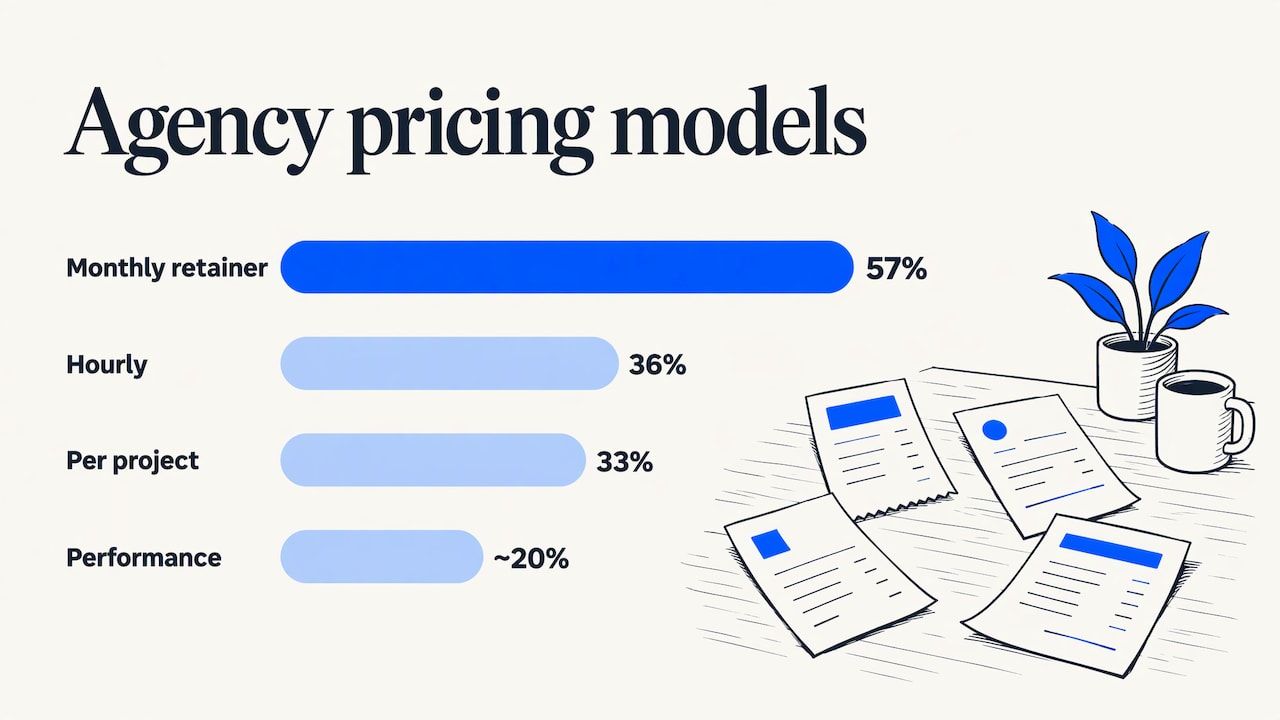
A summary of the same research by Xamsor reports an average of $2,917 per month across 439 providers, and says monthly retainers are used by 57% of agencies, hourly pricing by 36%, project pricing by 33% and performance pricing by roughly 20% (providers can use more than one model).
Those are sector averages. They say nothing about what your project should cost. What moves the price in international work is, in our analysis:
- Number of markets and languages. Each adds research, content and maintenance.
- Site complexity. A catalog with thousands of product pages differs from a 40-page services site.
- Who does the localization. Native writers, in-house reviewers or machine translation with editing all have different cost and risk.
- Technical debt. Fixing indexing and structure before expansion is often a first phase.
- Measurement depth. Dashboards by country and language take setup and upkeep.
Our view on pricing models: a retainer fits continuous publishing and measurement, a project fits a structural change such as a migration or a new market launch. Be cautious of performance pricing tied to rankings alone, since rankings differ by country, device and query, and no one controls them.
Measuring results by market
A single blended number hides everything that matters in international work. A strong home market can mask a failing new one. Several sources agree on the shape of good reporting.
Bright SEO Tools recommends tracking organic sessions, visibility, indexing, click-through rate, conversions and revenue by country and language, and monitoring hreflang errors and Core Web Vitals. Its 2026 guide suggests combining visibility, traffic and conversion KPIs with diagnostic measures such as indexing and crawl health, then breaking the same set down by market. Search Engine Journal points to country, region, language and language code as useful GA4 dimensions, and notes that Search Console data can be filtered by country. Search Engine Land recommends segmenting audiences by market tier and language, tracking market-specific conversions and customer lifetime value, and normalizing currencies so markets can be compared.
Keep the funnel stages separate
With AI answer engines now part of discovery, we would split the reporting ladder into distinct stages and never blend them:
- Impressions and AI mentions (your brand appears).
- Citations (your page is the named source).
- Clicks and visits.
- Enquiries or sign-ups.
- Revenue.
A rise at the top does not prove a rise at the bottom. This is our analysis, not a measured law, but it protects you from a report that celebrates mentions while pipeline stays flat. Our GEO and AI answer visibility work and measurement and performance tracking are scoped to keep these stages apart, and our overview of AEO, SEO and GEO explains how they relate.
A reproducible check: the market scorecard
Build one row per market and one column per stage. For each market, record the same six values every month: indexed localized pages, hreflang errors, organic clicks, conversions, conversion value in a single normalized currency, and the change from the previous period. Any market with growing impressions but flat conversions is a content-intent problem. Any market with flat impressions and rising hreflang errors is a technical problem. The diagnosis tells you which service to buy next.
How to evaluate an international SEO provider
Agency roundups dominate the search results for this topic. Most rank agencies by criteria that are not disclosed, and many are published by agencies themselves. As a reader, you are better served by applying your own criteria. Here is a decision matrix to use with any shortlist, including us.
| Criterion | What a good answer looks like | Red flag |
|---|---|---|
| Market selection | Explains how markets are prioritized and which to delay | Agrees to every market you name |
| Structure advice | Recommends a structure tied to your team’s capacity | One-size-fits-all recommendation |
| Hreflang | Picks one implementation method and explains reciprocity | “We add all methods to be safe” |
| Keyword research | Done natively per market | Translated master list |
| Localization | Names who writes and who reviews | Unspecified “translation” |
| Reporting | By country and language, with funnel stages separated | One blended traffic chart |
| Claims | No guaranteed rankings or citations | Promised positions or timelines |
| Scope | Written deliverables, access, cadence, exclusions | Activities with no outputs |
We also suggest separating vendor claims from tests. A case study on an agency’s own site is a vendor claim. A published methodology with dates, markets and measured outcomes is closer to evidence. Ask for the second, and be wary of the first used as proof.
If you are comparing agency types more broadly, our guide to choosing an SEO/GEO agency lays out the same questions for smaller and B2B buyers. And before any expansion, a technical SEO audit checklist shows what foundations should be in place.
Who should choose which kind of provider
Our analysis, by use case rather than a ranking:
- One or two adjacent markets, a small site, an engaged in-house team: a project-based engagement focused on structure and local keyword research can be enough.
- Several markets, continuous publishing, a need for reporting by country: a managed, ongoing engagement fits, because the work does not end at launch.
- A group with several brands or sites that must share a structure: you need governance first. Our work for Groupe Squadra is an example of giving a group website a shared structure.
- A large ecommerce catalog: the category and product page logic dominates. See our e-commerce SEO page.
A short note on our approach
If you want this handled as a managed service, we connect strategy, AI content operations, production, optimization and measurement in one tailored remit, for B2B and ecommerce readers worldwide, without guaranteed results. You can see the technical and international SEO scope or contact us through the main site to define yours.
Our perspective
International SEO is mostly a governance problem wearing a technical costume. The hreflang syntax is learnable in an afternoon. What takes judgment is deciding which markets deserve real local content, who owns each page after launch, and how you will know in six months whether a market is working. We think the strongest international programs are narrower than their roadmaps. They enter fewer markets, with local research and local editing, and they measure each market separately. That is our analysis, not a measured law, and it is why we scope engagements around your markets, languages and team rather than around a standard package. This is also why we combine strategy, content operations, production, optimization and measurement in one managed engagement. Splitting them across vendors is how a clean hreflang setup ends up pointing to pages nobody maintains. We make no promise on rankings or AI citations: no one controls them, and anyone who does promise them is selling something other than SEO. Louis Choquet
FAQ
What is the difference between international SEO and multilingual SEO?
Multilingual SEO concerns offering content in more than one language. International SEO is broader: it covers targeting different countries, which may share a language, and it includes legal, currency and infrastructure differences. Google describes the two cases separately in its guidance on multi-regional and multilingual sites, and many sites need both.
How long does international SEO take to show results?
There is no reliable universal timeline, and any provider that gives you one is guessing. Timing depends on your site’s starting health, the competitiveness of each market, and how quickly your team approves and deploys changes. Agree on leading indicators such as indexing and hreflang coverage first, then on traffic and conversions per market.
Should I use country domains, subdirectories or subdomains?
Choose the structure your team can keep consistent. Subdirectories keep one domain and one operation, while country-code domains give a strong local signal but multiply hosting and governance. Whichever you choose, each localized page must reference itself and its alternates with reciprocal hreflang annotations, as Google’s documentation requires.
What should an international SEO proposal include?
It should state markets and languages in order, written deliverables, who implements and who reviews, access to the CMS, Search Console and Analytics, reporting cadence, exclusions and budget. Reporting should be broken down by country and language. If any of these are missing, ask for them in writing before signing.
Sources
- International SEO: Everything you need to know in 2025, Search Engine Land
- Managing multi-regional and multilingual sites, Google Search Central
- Understanding International SEO, U.S. Department of Commerce
- Multilingual SEO Guide: Strategy, Keywords and Hreflang, Stepes
- Localized Versions of your Pages, Google Search Central
- W3C cheatsheet
- Hiring an SEO Consultant: What Your Contract Should Include, Contractable
- SEO Pricing: How Much Does SEO Cost? 439 People Polled, Ahrefs
- Cost of SEO (2024 Statistics), Xamsor
- Track International SEO Performance (2026), Bright SEO Tools
- How To Leverage GA4 For The Analysis Of International SEO, Search Engine Journal
- International SEO: Measure Results & Avoid Costly Mistakes, Search Engine Land