
 Add to preferred sources on Google
 ChatGPT
 Claude
 Perplexity
Introduction
A landing page can rank on Google, but only if you decide before you build it that it is an organic page. It needs a search query it can answer better than the pages already ranking, a URL that is indexable, and a place inside a site that supports it. Most landing pages fail at that first decision, not at meta tags. They are built for a campaign, stripped of text, left unlinked, and then blamed for not ranking.
This guide is for B2B marketing and SEO leads who need landing pages to pull in qualified organic traffic. It covers when a page should be built for search, how to build it, how to keep paid and organic pages from fighting each other, and what to measure afterward.
TL;DR
- A landing page ranks like any other page: it must be indexable, target a real query, and answer it better than what already ranks.
- Decide per page whether it is an organic page or a paid-only page. Paid-only pages that stay indexable can cannibalize your organic pages.
- Target bottom-of-funnel queries with clear commercial intent. Map one main topic to one URL.
- Give the page internal links, real depth, and technical basics (speed, mobile, crawlability). Standalone pages with none of these struggle.
- Measure in stages: impressions, clicks, engagement, then leads and revenue. Do not treat a ranking as a result.
Can landing pages rank on Google?
Yes. A landing page is an ordinary web page to Google. According to one agency’s analysis from June 2026, the pages that cannot rank are the ones blocked by a noindex tag or robots rule, or too thin to deserve a place in results. We treat that as a useful summary rather than a rule from Google, but it matches what Google documents: to keep a page out of its index, you use the noindex robots rule while still allowing crawling, as Google Search Central explains.
Two conditions have to hold at once:
- The page is indexable. No noindex tag, no robots block, and it can be rendered and crawled.
- The page targets a real query and answers it better than the current results. A page built around a slogan or a product name nobody searches for has nothing to rank for.
The second condition is where B2B landing pages usually break. A campaign page is written around an offer: a demo, a download, a consultation. A search page is written around a question or a need the searcher has typed. The two can be the same page, but only when you plan it that way.
There is also a structural handicap. AWeber’s guide from December 2023 notes that thin or standalone landing pages have a hard time ranking because they lack site authority and internal linking. This is our reading of that: the page is not the unit that ranks. The page plus the site around it is.
Decide first: organic page or paid-only page
Before any optimization, sort your landing pages into two groups. This is the decision most checklists skip, and it determines everything else.
Organic landing pages exist to rank and convert. They target a query, carry enough content to satisfy it, and sit inside your site structure. Their results compound over time as long as they are maintained.
Paid-only landing pages exist for a campaign. Their copy mirrors an ad, their navigation is removed, and their text is minimal. That is legitimate: Search Engine Land’s Sara Taher explains that PPC pages exist so paid managers can work free of SEO constraints, using ad copy as the headline, trimming text and removing distractions.
The trouble starts when a paid-only page is left indexable. In the same article, Search Engine Land warns about two risks: the paid page can cannibalize the organic page it duplicates, and low-word-count pages can drag on overall site performance. Cannibalization means two of your own URLs compete for the same query, so neither performs as well as one strong page would.
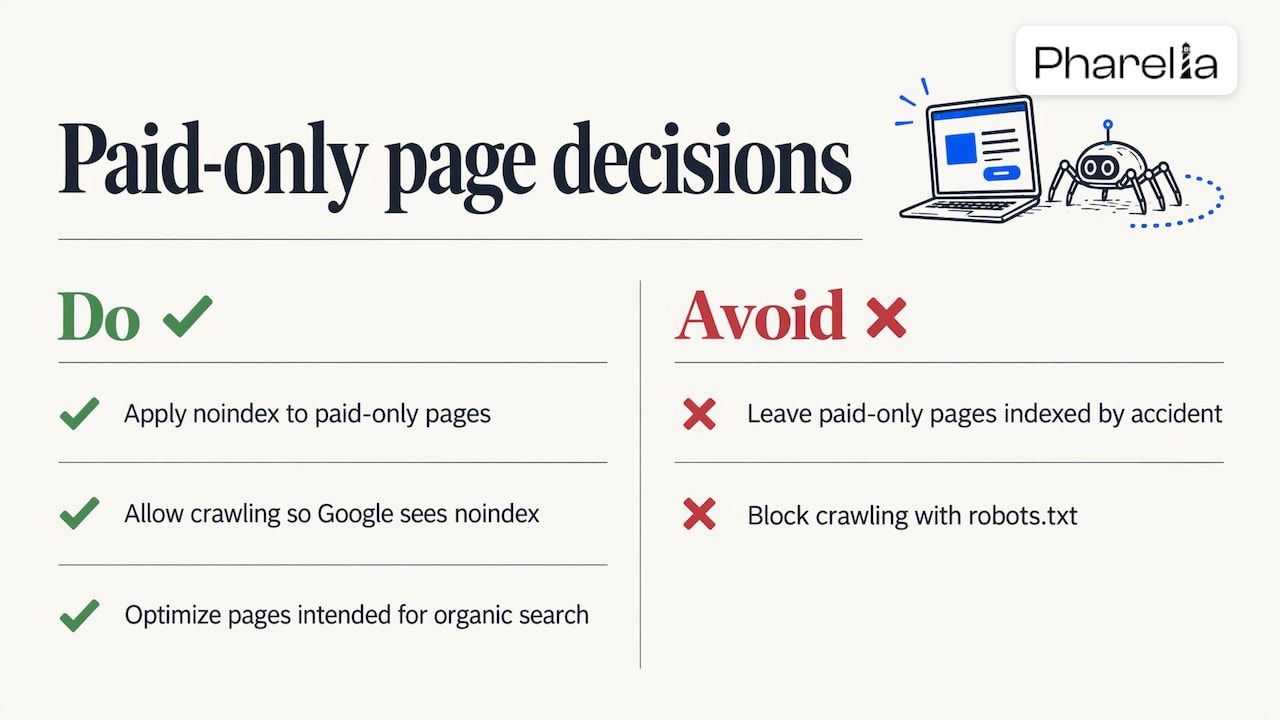
The fix is a deliberate choice for each paid page: keep it out of the index with the noindex rule, or optimize it properly as an organic page. Letting it sit indexed by accident is the one wrong answer. Be careful with the combination of noindex and robots.txt: Google needs to be able to crawl the page to see the noindex instruction, so do not block the page from crawling and expect the tag to work.
A decision matrix you can use today
This matrix is our analysis, not measured data. Score each landing page against the criteria and the pattern usually becomes clear.
| Situation | Likely right choice | Reason |
|---|---|---|
| Searchers already type queries that describe the problem or solution the page addresses | Organic page | There is demand to capture and a query to answer |
| The page exists for one ad campaign with campaign-specific copy | Paid-only, noindex | Prevents duplication and thin pages in the index |
| The page duplicates an existing organic page with new ad copy | Paid-only, noindex, or merge | Avoids cannibalization |
| The offer is new and has no search vocabulary yet | Paid-only first, organic later | There is nothing to rank for until the market names the problem |
| The product has several distinct use cases or industries | One organic page per use case | Each maps to its own query and intent |
| A page is thin, unlinked, and has no query behind it | Rewrite, merge into a stronger page, or remove | Adds nothing to rankings or to leads |
Pick the query before you write the page
Query choice is the highest-leverage step, and it is a business decision as much as an SEO one.
For pages meant to produce leads, aim at queries with commercial or transactional intent, the bottom-of-funnel terms where the searcher is comparing providers or looking for a solution to buy. For a B2B software company that might be “[category] software for [industry]” or “[service] provider”, not a broad definition query. Definition queries belong on guides and articles, which can then link to the landing page. If you want a method for finding these terms, our guide to buyer intent keywords for B2B teams walks through it.
Two practical habits from ClickMinded’s 2026 checklist are worth adopting:
- Map one primary topic to one primary URL. Group keywords by topic and intent, not by exact wording. Slightly different phrasings of the same need belong on the same page.
- Read the search results before writing. Look at the dominant format and what the ranking pages actually provide. If the top ten are all comparison pages and you are building a feature page, you are working against the intent.
That second habit is the cheapest piece of competitive research there is. It costs twenty minutes and prevents months of building the wrong page.
How to build a landing page that can rank
The following sequence works for most B2B landing pages. The weight of each step changes with your market, but the order rarely does.
1. Write the page around the searcher’s job
Start with what the person typing the query wants to decide. A buyer searching for a specific type of provider wants to know: is this the right kind of solution, does it fit my situation, what happens next? Your page should answer those in the order they arise, in plain words.
This is where landing pages differ most from standard SEO articles. The page has to persuade as well as inform, so every section should either answer an objection or move the reader closer to the action. Content that does neither is padding, and it hurts both ranking and conversion.
2. Give the page enough substance
There is no magic word count. The page needs to be as complete as the pages currently ranking for the query, without burying the call to action. A common structure that works for B2B:
- A headline and opening that confirm the page matches the query.
- The problem, described in the buyer’s terms.
- How your solution addresses it, with specifics: process, scope, deliverables.
- Proof relevant to the query: named customer work, figures with sources, case details you are permitted to publish.
- Answers to the questions buyers raise before contacting you.
- One primary call to action, repeated where it makes sense.
The proof item matters. Only publish figures and customer claims you can support. Invented or unsourced numbers damage trust and give nothing to search engines or readers.
3. Optimize the elements searchers and Google read first
The title tag, headings, URL, meta description and image alt text should reflect the topic in natural language. The title tag is the strongest of these. Write it for a human scanning a results page: the topic, the benefit or qualifier, and nothing stuffed. Keep the URL short and descriptive. Use a single H1 that matches the page’s promise.
A caution on meta descriptions: Google may rewrite them. Treat them as a pitch that you control when it is used, not as a ranking lever.
4. Connect the page to the rest of the site
This is the step standalone landing pages skip. Link to the page from relevant articles, resources and category pages with descriptive anchor text. Link from the page to deeper resources, so a buyer who is not ready to act can keep learning. Internal links tell crawlers the page matters and give readers a path.
If your landing pages live on a separate subdomain or builder with no connection to your main site, expect a harder road. Hosting the pages on your own domain, inside the main site, is generally the simpler route to benefiting from the authority you already have.
5. Get the technical basics right
Check that the page:
- is indexable, with no accidental noindex from a template or staging setting;
- has a self-referencing canonical URL, so tracking parameters and variants do not split signals;
- renders its main content for crawlers. If the page depends on heavy client-side scripts, see our JavaScript SEO guide ;
- loads quickly and works on mobile. Google’s Core Web Vitals measure loading, responsiveness and visual stability, and landing pages with large hero videos, chat widgets and tag-manager bloat often fail them;
- is in the XML sitemap and reachable by links, not only by ads.
If you are moving pages or rebuilding the site, protect existing rankings first. Our guide to preserving rankings in an SEO redesign covers the risks.
The quickest way to catch the obvious technical and structural issues on a single page is Pharelia’s free SEO/GEO audit. It automatically assesses one public page, needs no account and no mandatory email, and returns findings, scores and limitations in a report available for seven days. It is a page-level check, not a full website audit, and it does not measure actual AI citations or promise ranking gains. It is a sensible way to test a landing page before you start the larger work.
6. Earn links to the page
Backlinks from respected, relevant sites still matter for competitive queries. For a landing page, the realistic route is usually indirect: publish useful resources that link to the landing page, then earn links to those resources. Asking for links straight to a sales-oriented page is a harder sell than asking for links to a genuinely useful guide or dataset.
7. Set up measurement before launch
Covered in detail below, but the timing matters: tracking should exist before the page goes live, or you will lose the first weeks of data.
A worked example (illustrative)
The following scenario is fictional. Its figures are illustrative and not drawn from a real client or test.
A fictional B2B company sells inventory management software for mid-size distributors in the United States. It has three landing pages:
- A page built for a paid campaign about “warehouse automation”, with a one-line headline, a form and no navigation. It is indexable.
- A page called “Solutions”, with 150 words and no clear query behind it.
- A page for “inventory management software for distributors”, with a short overview and a link from the homepage.
Using the matrix:
- Page 1 is paid-only. The company adds noindex so it does not compete with page 3 or fill the index with thin content. It keeps the page for the campaign.
- Page 2 has no query and no purpose. The company merges its useful lines into page 3 and redirects the old URL there.
- Page 3 is the organic candidate. It gets rebuilt: the opening confirms the match with distributors, a section describes the problems of multi-warehouse stock, a section lists integrations the company really supports, two published customer examples appear, and an FAQ answers the questions sales hears most. Three related blog posts get descriptive links pointing to it.
Nothing here guarantees a ranking. What it does is remove self-competition, give the page a real query to serve, and attach it to a site that supports it. That is the realistic scope of landing page SEO.
Balancing search visibility and conversion
The usual argument is whether an SEO-focused or a conversion-focused page should win. In our view that is a false choice for B2B, with a condition: the page should be readable and credible first, and the conversion design should not remove the content that earns the ranking.
Practical ways to hold both:
- Keep one clear primary action, but do not strip the page to a form. Buyers who are researching need information before they fill anything in.
- Put the call to action above the fold and after the proof, so both a decisive visitor and a careful one find it.
- Keep forms short. Ask only for what the next step needs.
- Use headings that describe real content. Clever headings that name nothing hurt scanning and relevance.
If your team runs paid and organic traffic to the same offer, the clean answer is two pages with distinct purposes, one indexed and one not, or one carefully optimized page that serves both.
What to measure after publishing
Separate the stages. A ranking is not a lead, and a lead is not revenue. This mirrors a common four-stage way of thinking about content measurement, which we adapt here:
| Stage | What to look at | Where |
|---|---|---|
| Visibility | Impressions, average position for the target query | Google Search Console |
| Acquisition | Clicks, organic sessions to the page | Search Console, analytics |
| Engagement | Engaged sessions, scroll, clicks on key elements | Analytics |
| Business results | Form submissions, qualified leads, pipeline, revenue | Analytics, CRM |
Two habits make this useful:
- Look for pages with high impressions and low click-through rate. They already rank. Rewriting the title and meta description can lift clicks without any new content. SEO Rocket’s guide from September 2026 makes the same suggestion.
- Judge lead quality, not only volume. Leadpages’ 2026 optimization guide recommends setting up tracking before launch to capture the path from source through click, form start, submission and confirmation, and assessing lead quality alongside the conversion rate. In B2B, ten qualified leads beat fifty unqualified ones, and only your CRM can tell you which you got.
For teams new to this, our SEO tracking guide lays out a practical setup.
If you also care about appearing in AI answers, keep the metrics separate. Mentions in an AI answer, citations of your page, clicks, visits, enquiries and revenue are different events. Do not merge them into one number.
Common reasons a landing page does not rank
These are patterns, not a diagnosis of your page. Check them in order:
- Noindex or blocked crawling. Often inherited from a staging template.
- No query behind the page. It was written around an offer, not a search.
- Intent mismatch. The results show comparison pages or guides, and you built a product page.
- Thinness. Far less substance than the ranking pages offer.
- No internal links. Nothing on your site points to it, so it looks unimportant.
- Cannibalization. Another indexed page of yours targets the same query.
- Weak site authority for a competitive query. Pick a more specific query first, then expand.
- Slow or unstable loading. Especially on mobile.
Our perspective
Most advice on landing page SEO treats the page as the thing to optimize. We think the unit that matters is the system around it: which query the page owns, which other pages support it, and which pages should stay out of the index. That is why the work does not start with meta tags. It starts with strategy: deciding which pages are organic, which are paid-only, and where the content gaps are. Then comes production of the pages and guides that fill those gaps, optimization of the pages that already exist, and measurement that goes past rankings to leads. This is our analysis, not measured fact, and it is why we describe our SEO/GEO service as connected rather than a set of separate tasks. Strategy, content operations, production, optimization and measurement affect each other. A landing page built without the first and last steps tends to be a page nobody can explain or improve. We do not promise rankings or citations, and no one honest can. What we can do is make the decisions explicit, so you know why each page exists and how you will judge it. Louis Choquet
Where we can help
Pharelia provides managed content and SEO/GEO strategy together with article, guide and page production and optimization of existing content, scoped to your sites and markets. Pricing is available on request after an initial scoping conversation.
FAQ
Should a landing page be SEO optimized?
It depends on its role. If the page is meant to attract organic visitors, yes: give it a target query, real content and internal links. If it exists only for a paid campaign, keep it out of the index with a noindex rule rather than optimizing it, so it does not compete with your organic pages.
What is the difference between PPC and SEO landing pages?
A PPC landing page is tailored to an ad and an immediate conversion, often with minimal text and no navigation. An SEO landing page is built to rank for a query and keep earning traffic over time. Unbounce’s comparison makes the same split between long-term organic sustainability and paid immediacy.
Can landing pages rank on Google?
Yes. They rank like other pages when they are indexable, target a real query and answer it better than the current results. They struggle when they are thin, isolated from the rest of the site, or blocked from indexing.
How long does a landing page take to rank?
No one can promise a timeframe. It depends on the competitiveness of the query, your site’s authority, the quality of the page and how well it is linked. Track impressions and positions in Search Console from the first weeks and judge progress by trend, not by a single day.
Do I need a separate website for landing pages?
Generally not. Pages on your main domain, linked from relevant content, benefit from the authority and structure you already have. A separate site with no links to or from your main site starts from zero.
Sources
- Do Landing Pages Help SEO? A Clear Answer, KeyGrow
- Google Search Central: crawling and indexing documentation
- Landing page SEO best practices, AWeber
- How to handle PPC landing pages for SEO, Search Engine Land
- The Complete SEO Checklist for 2026, ClickMinded
- SEO and Analytics: How to Measure Content That Works, SEO Rocket
- The Complete Guide to Landing Page Optimization, Leadpages
- Landing page SEO: How to rank and convert, Unbounce