Introduction
Buyer intent keywords are the searches people type when they have finished researching and are ready to act: ask for a quote, book a demo, check pricing, buy. For a B2B team, they are the queries closest to a sales conversation. Finding them takes four steps. Read the search results, mine the tools you already have, score each query against your offer, and give every query a page built for that exact moment. This guide covers each step, with examples from the French B2B market.
Pharelia
Turn Buyer Searches Into Useful Pages
Pharelia helps B2B marketing teams prioritize search topics and build content that connects buyer questions with relevant pages.
TL;DR
- Buyer intent keywords signal readiness to purchase. Commercial keywords signal comparison. High-intent keywords cover both, because both sit close to a decision.
- Look for three signals: action modifiers (demo, pricing, quote), evaluation terms (alternative, comparison, reviews) and long, specific phrases that describe a mature need.
- Find them in Google’s own interfaces, in keyword tools and, above all, in what your sales team hears from buyers.
- Score each query on proximity to the decision, fit with your offer, volume, competition and the page format that already exists.
- Map each query type to the right page, then measure qualified inquiries, not just clicks.
What buyer intent keywords actually are
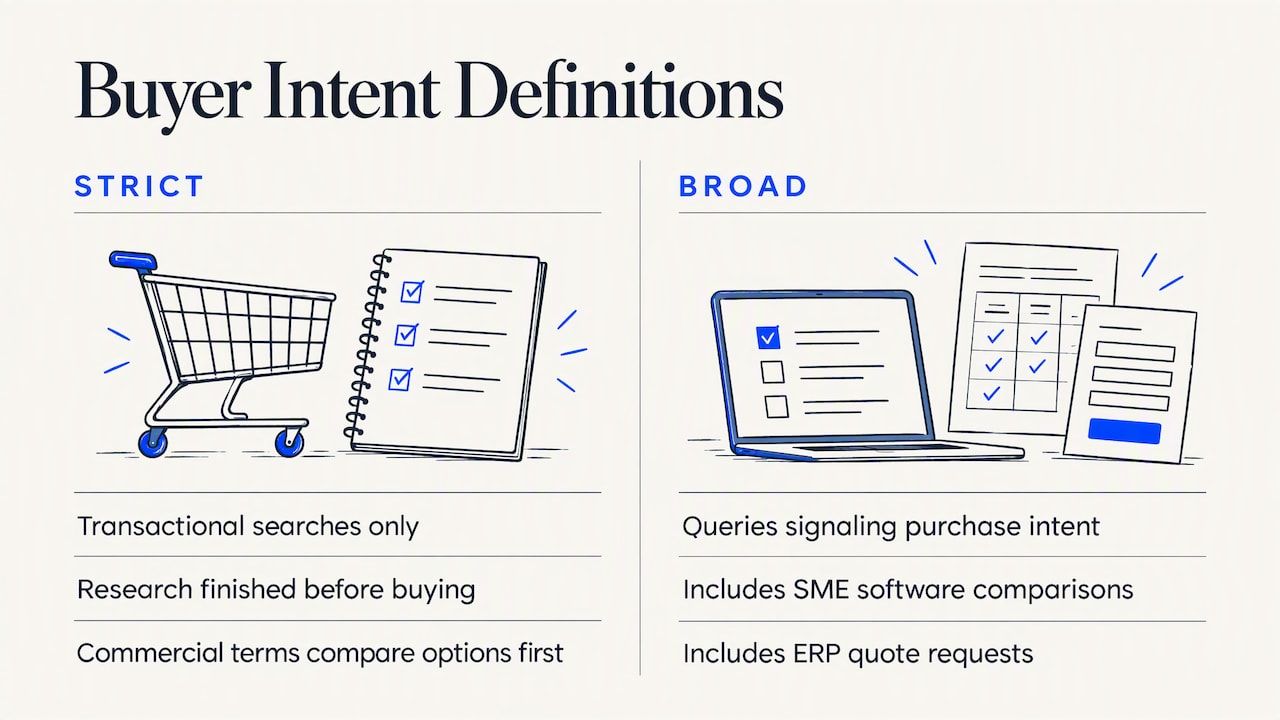
A buyer intent keyword is a search term that shows the person typing it is moving toward a purchase. The strictest definition limits it to transactional searches: the person has finished researching and wants to buy, while commercial keywords are used to compare options first. That same source places them within the four classic intent types: informational, navigational, commercial and transactional.
In practice, most marketers use the phrase more loosely. HubSpot describes buyer intent keywords as expressions typed into a search engine that signal an intention to buy a product or service. Under that wider reading, the term covers everything from “best accounting software for SMEs” to “request a quote for ERP integration”.
The loose and strict readings do not conflict. They describe the same ladder at different heights. What matters for your plan is knowing which rung a query sits on, because that decides what page should answer it.
Buyer intent, commercial intent and high intent: the differences
The three labels overlap, and teams waste hours arguing over them. A working distinction:
| Label | What the searcher is doing | Typical wording | Best page type |
|---|---|---|---|
| Commercial intent | Evaluating or comparing options | “best”, “vs”, “reviews”, “alternative” | Comparison, ranking, review or use-case page |
| Transactional (strict buyer intent) | Taking a direct action | “buy”, “pricing”, “demo”, “quote” | Service page, pricing page, contact or quote page |
| High intent | Close to a business action, either of the above | A mix of both, often long and specific | Whichever page fits the exact query |
HubSpot France draws the same line. Its glossary treats commercial intent as evaluating or comparing, for example “best CRM for SMEs” or “HubSpot vs Salesforce”, and transactional intent as a direct action such as a free trial or a purchase.
Commercial-intent keywords represent an earlier stage where users research products, brands or services, often with modifiers like “best”, “vs”, “reviews” or “top”. High-intent keywords are the umbrella: queries used when a user is close to taking a business action such as a transaction.
So when someone asks whether they should target “commercial intent keywords” or “high intent keywords”, the answer is both. They are two stops on the same road to a signed contract.
The signals that someone is close to buying
No single word guarantees a purchase. The reliable approach is to read the combination. Research on high-intent queries points to three families of signals:
- Action modifiers. Demo, pricing, buy, quote and sign up show a person wants a next step.
- Evaluation terms. Comparison and alternative show a shortlist is being built.
- Reassurance terms. Reviews and results show the person is checking risk before committing.
Two more signals deserve attention in B2B. Branded queries, where someone types your company name plus a word like pricing, are close to the end of the journey. And long, specific phrases tend to reflect a mature, defined need, as the same source on high-intent keywords notes.
That last point changes how a B2B team should read keyword volume. A rare query close to the decision can bring more pipeline than a heavily searched generic term. A search with ten monthly volume, typed by a marketing director comparing agencies for a multilingual SaaS site, can be worth more than a term with ten thousand searches typed by students.
How intent shifts along a B2B buying journey
B2B journeys are longer and involve several people. A rough pattern, drawn from how teams usually map content, helps to organize your thinking:
- Problem stage. The buyer describes a difficulty: “why do our product pages not generate demo requests”. Mostly informational.
- Solution stage. The buyer names a category: “B2B SEO agency”, “content outsourcing for software companies”. Early commercial.
- Evaluation stage. The buyer compares: “agency vs in-house SEO”, “alternatives to X”, “reviews”. Commercial.
- Decision stage. The buyer needs to act or convince colleagues: “SEO agency pricing France”, “request a quote”, “audit offer”. Transactional.
Treat this as a planning model, not a law. Buyers skip stages, and several people in the same company will each type queries from a different rung.
How to find buyer intent keywords
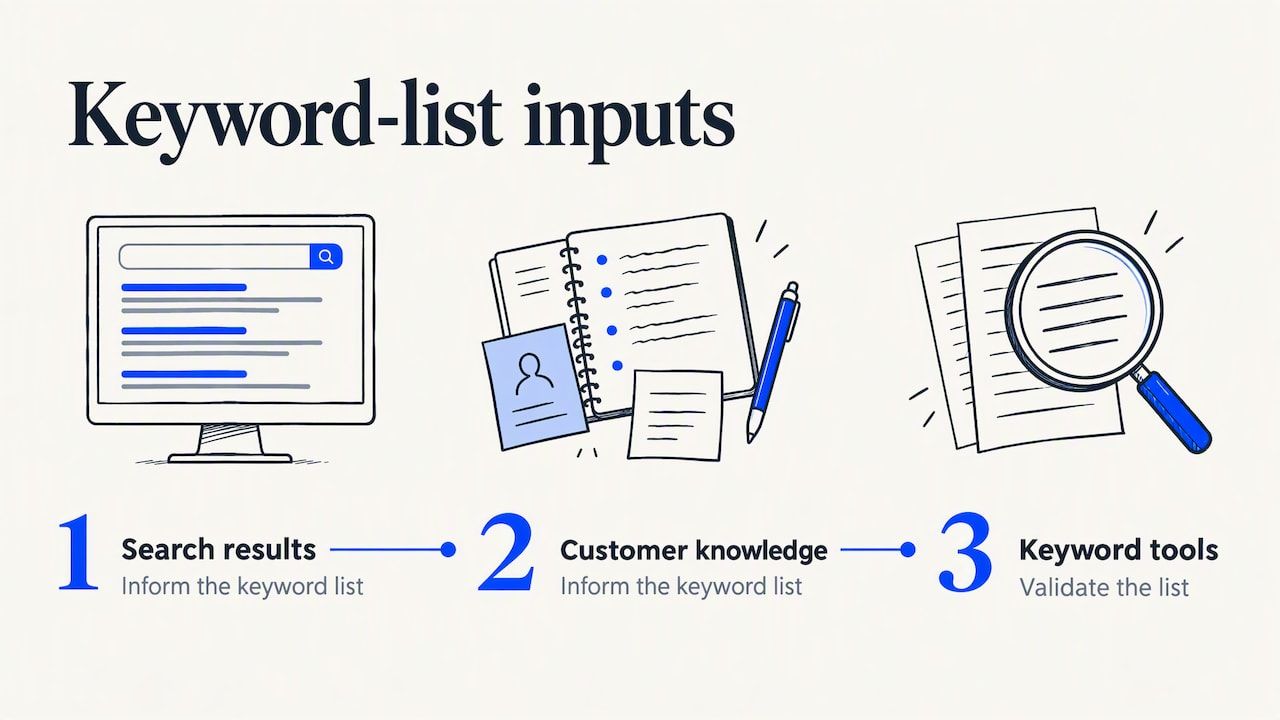
Three sources, used together, give a far better list than any tool export alone.
Start with Google itself
The free interfaces are a good first pass. A team can combine Keyword Planner, Google autocomplete, related searches and People Also Ask, then use keyword tools to validate terms by intent, volume and difficulty.
A practical routine for one service, say a B2B SEO engagement:
- Type the service name and note every autocomplete suggestion that contains a price, comparison or provider word.
- Open the results page and read its shape. Comparisons, rankings and tests generally point to commercial intent, while product and category pages point to transactional intent. This is also the fastest way to know which page format Google already trusts for the query.
- Collect the People Also Ask questions. They reveal the objections buyers raise just before deciding.
- Repeat with your three or four main use cases, then with your industry vertical.
Use keyword tools to validate, not to invent
Keyword tools help you see volume, difficulty and cost per click. They are weaker at telling you who is typing. Use them to check a list you built from the results page and from customer knowledge, then filter. Search volume and ranking difficulty are separate estimates. A low difficulty score does not establish low demand; check the provider’s methodology and inspect both metrics.
Mine your own customer knowledge
This is the source competitors cannot copy. Gather:
- the questions prospects ask in first calls;
- the objections that stall deals (price structure, migration risk, internal workload);
- the words buyers use for your category, which are often not your words;
- the comparisons they bring up (in-house vs agency, one tool vs another type of approach);
- the documents your experts already wrote: proposals, technical notes, FAQs.
Turn each into a query phrased the way a buyer would type it. Then check the results page for it. If Google shows pages that answer it poorly, you have found an opportunity.
How to score and prioritize your list
A list of 200 queries is not a plan. Score each on five points:
- Proximity to the decision. Is this a comparison, a price check or a request for a quote?
- Fit with your offer. Could you honestly sell to this person today?
- Volume. Useful, but secondary for rare B2B queries.
- Competition. Who ranks, and could you provide a more specific and more useful page?
- Page format. Does a page of the right format already exist on your site?
That grid follows the scoring approach described for high-intent keywords. To approximate business value, you can also look at advertising data. Top of Page Bid and CPC act as an external indicator of commercial value, since advertisers pay more for high-intent traffic.
A simple way to apply it is a 1 to 3 score per criterion, with proximity and fit counted double. Work from the top: queries that are near the decision, fit your offer and have no good page yet come first.
Worked example: a B2B software publisher
Imagine a French publisher of inventory software for manufacturers. The raw list might include:
| Query | Intent | Proximity | Fit | Page exists? | Priority |
|---|---|---|---|---|---|
| inventory management software pricing | Transactional | High | High | No | First |
| alternative to [named competitor] for manufacturing | Commercial | High | High | No | First |
| what is inventory turnover | Informational | Low | Medium | Blog post | Later |
| inventory software for SMEs in automotive | Commercial | Medium | High | Partly | Second |
This is an illustrative prioritization, not measured search volume or business value. Confirm demand and fit before assigning these priorities.
Mapping keywords to pages
A keyword only works when the page matches the moment. The logic is simple:
- Commercial queries go to comparisons, rankings, use-case pages or review-style pages.
- Transactional queries go to service pages, pricing pages, booking or quote pages.
- Informational queries that feed your pipeline go to guides that link to the next step.
For French-market pages, write in the buyer’s language and use their vocabulary. A French director searching for an agency will not type the English term your team uses internally. Check this by reading the French results page, not by translating a keyword list.
Two mapping rules save a lot of rework:
- One main intent per page. A page that tries to be a comparison and a pricing page satisfies neither.
- Give the buyer the next step. Every commercial page should point to the transactional page, and every transactional page should make acting easy: a clear offer, a form, a named contact.
Google’s own guidance on quality applies directly here. Content that succeeds offers unique value and depth, such as firsthand experience or expert insight, rather than recycling commodity information. In B2B, that means pages built from your real expertise and documents, not generic descriptions of your category.
Measuring whether the keywords bring buyers
Traffic is not the goal. A visit is not a conversion, and an AI answer that mentions you without a click is not traffic. Track in layers:
- Search behavior. CTR, dwell time, bounce rate and conversions help confirm whether a page matches what searchers want.
- Conversion actions. Demo requests, quote requests, audit requests and contact form submissions, attributed to the landing page and the query group.
- Qualification. Whether those inquiries match your ideal customer profile, where your CRM data allows it.
- Commercial outcome. Opportunities and signed deals, when the data is complete enough to trace.
Report each query group separately. If transactional pages bring few visits but most of the qualified requests, that is a healthy result, not a failure. Be careful with attribution: B2B cycles run for months, and several touchpoints contribute to one deal.
Mistakes that make buyer intent research misleading
- Trusting trigger words alone. “Buy” next to a job-seeker or student query is still not a buyer. Always read the results page.
- Chasing volume. The biggest numbers usually belong to the broadest, least qualified terms.
- Ignoring fit. A high-intent query for a service you do not provide wastes a page.
- One page for every intent. Mixing incompatible intents can make a page less useful. Assess relevance and results for the specific query.
- Copying competitors’ pages. Recycled content gives Google and buyers no reason to prefer you. The helpful-content guidance above points to original expertise as the way forward.
- Stopping at the keyword. A good list with weak pages, slow publishing or no measurement produces nothing.
Our perspective
We recommend matching each keyword to a page that answers the intended query. Publishing articles without that connection can leave the plan incomplete. A buyer who types a comparison or a pricing question wants evidence that you understand their situation. That evidence lives in your experts’ heads and in your documents: how you scope a project, which objections come up, what you do differently. Generic copy cannot carry it. This is why our approach starts from each client’s actual expertise and documentation, and from the specific questions buyers ask, then coordinates research, writing, review, publishing and measurement with the client’s team. We treat content as the means and qualified visibility, qualified traffic and conversion as the end. We also track results from the data available, without promising figures or timelines. Our advice: choose fewer queries, closer to the decision, and give each one a page worth sending to a buyer’s boss. Louis Choquet
Turning the list into published pages
If your team has the keyword list but not the capacity to research, write, review and publish at the pace it needs, this is where we help. Pharelia works with B2B marketing teams on strategy, content production, optimization, technical SEO, AI visibility and measurement, working directly with your experts and sources. It is an agency engagement, not self-service software, and the exact scope is defined in the proposal.
If you want to discuss your content and measurement needs, contact us. For teams in software, consulting or industry, our B2B SEO and GEO approach explains how we work, and our customer stories show the type of work involved.
Sources
- 4 types of keywords in SEO, with examples (Semrush)
- Buyer intent data software (HubSpot France)
- Search intent: definition and tips (HubSpot France)
- High-intent keywords: spot, score and convert them (Incremys)
- How to find buyer intent keywords for organic and AI search (Semrush)
- Commercial intent keywords: what they are and how to rank (Search Engine Land)
- Integrate search intent analysis into your enterprise strategy (Siteimprove)
- Creating helpful, reliable, people-first content (Google Search Central)
Recommended
Frequently asked questions
What is the difference between buyer intent and commercial intent keywords?
Buyer intent in the strict sense means transactional: the person is ready to buy, ask for a quote or book a demo. Commercial intent means the person is still comparing, using words like best, vs, alternative or reviews. Many teams use “buyer intent” for both, because both sit close to a decision.
How do I find buyer intent keywords for free?
Use Google autocomplete, related searches, People Also Ask and Keyword Planner, then read the results page for each query. Add the questions and objections your sales team hears. This costs nothing and often beats a purchased export, because it reflects the language of your real buyers.
Are low-volume keywords worth targeting in B2B?
Often yes. A rare query close to the decision can bring more pipeline than a heavily searched generic term. Judge a query by its proximity to a purchase and its fit with your offer, not by volume alone.
Which pages should target buyer intent keywords?
Match the page to the moment. Comparisons, rankings and use-case pages suit commercial queries. Service, pricing, quote and booking pages suit transactional ones. Keep one main intent per page and link commercial pages to the page where the buyer can act.
How do I know if buyer intent keywords are working?
Look beyond rankings and visits. Track engagement signals such as CTR and conversions, then the number and quality of inquiries from each page. When your data allows it, follow those inquiries through to opportunities and signed deals.