
 Add to preferred sources on Google
 ChatGPT
 Claude
 Perplexity

Introduction
B2B content writing is the production of articles, guides, case studies, white papers and product-adjacent pages that help a business buyer research, justify and make a purchase. It works when each piece is anchored to a buyer question, built from your company’s real expertise and measured against business outcomes, not word count. For most B2B teams the hard part is not drafting. It is getting expert knowledge out of heads and documents, keeping claims accurate, and publishing on a steady rhythm. That is why the strongest setup is usually a coordinated service that owns the whole chain from strategy to measurement, rather than a pool of freelancers who each see only a brief.
This guide covers what good B2B content looks like, the process from research to publication, a brief template you can use today, how to use AI without damaging credibility, what drives cost, and how to judge a provider. It is written for marketing, content and SEO leaders, founders at SaaS and technical companies, and teams at professional services, industrial and multi-brand organizations. Statements marked “our analysis” are opinion, not measured fact.
TL;DR
- B2B content writing is research-led, expert-informed writing aimed at a buying group. Judge it by qualified behavior and business contribution, not traffic alone.
- Buyers want credibility, data and specialist depth. A generic article that any competitor could publish earns none of those.
- A repeatable chain (brief, source pack, draft, claim review, editorial review, publication, measurement, update) matters more than any single writer.
- AI can speed up drafting, but Google asks for accuracy, quality and relevance, so human fact-checking and expert input stay non-negotiable.
- When the bottleneck is expertise extraction and consistency, a managed team that connects strategy, production and measurement beats stitching together freelancers (our analysis).
What B2B content writing is, and what it is not
B2B content writing serves people who buy on behalf of an organization. Those buyers compare options, consult colleagues, need to defend the decision internally and often take months to decide. The content has to survive that scrutiny.
It is easy to confuse with two neighbors:
- B2B copywriting is persuasive writing for a specific action: a landing page, an ad, a sales email. It sits close to the decision.
- B2B content writing educates and builds trust earlier: articles, guides, comparisons, case studies, documentation-style pages. It answers questions a buyer has before they talk to anyone.
- Content strategy decides what to write, for whom, and why. Without it, writing is just output.
The practical consequence: a B2B content writer needs to understand the product category, the buying committee and the claim they are allowed to make, in addition to being able to write clean sentences. Our analysis is that this is why generalist writing at a low price so often produces pages that read fine and convert nothing.
What makes B2B content worth reading
Forrester’s survey of technology buyers, published in 2022, identified technology expertise, credibility, data-backed material, objectivity and a specialized or personalized focus as the qualities that make content worthwhile. The same report found that most buyers valued vendors as a content source, alongside technology news, analyst firms and peers or colleagues. Note the date and scope: it is a 2021 survey of technology buyers, so treat it as a direction, not a universal benchmark.
Turn those qualities into editorial rules:
- Expertise: every piece contains at least one thing only someone who does the work would know, such as a constraint, a trade-off, a threshold or a failure pattern.
- Credibility: claims carry a source, a date and a scope. “Studies show” is not a source.
- Data: numbers are either yours (with method) or cited to the page that states them.
- Objectivity: the page states when your approach is the wrong fit. Buyers detect pure advocacy quickly.
- Focus: one reader, one decision, one page. A piece for “marketers” is a piece for nobody.
A quick test for any draft: remove the company name. If the article could have been published by a competitor, it is not yet B2B content, it is filler with a logo.
Choosing the format: match content to the buying question
B2B teams publish blog posts, white papers, case studies, webinars, videos, podcasts and infographics. Salesforce advises choosing content that addresses audience needs and mapping it to funnel stages. BNP Media’s 2025 guide pairs blogs with visibility and SEO, articles with credibility, white papers with depth and lead generation, and podcasts or webinars with interactive engagement.
A working matrix, which is our analysis rather than a measured result:
| Buyer question | Format that usually fits | What it must contain |
|---|---|---|
| “What is this problem and is it ours?” | Explainer article, guide | A clear definition, a diagnostic, an example |
| “What are our options?” | Comparison page, buying guide | Same criteria for every option, dated facts |
| “Will this work for a company like ours?” | Case study | Context, constraints, what changed, honest limits |
| “How do we justify the spend?” | ROI guide, calculation template | Reproducible math, stated assumptions |
| “How do we implement it?” | Technical guide, documentation-style page | Steps, prerequisites, failure modes |
Start with the question your sales team hears most often. Pages built around buyer intent keywords tend to line up with those questions because the search phrase itself reveals the stage of the decision.
The process: seven steps from idea to a page that keeps working
A practical production chain runs from research and keyword analysis through briefing, outlining, drafting, editing, fact-checking, publishing and distribution, with each step defined and assigned and quality checks before anything goes live, as Backlinko’s scaling guide lays out. Here is the version we would use for B2B, with where each step usually breaks.
1. Define the business goal and the reader
Tie content to an outcome before writing. Salesforce suggests business-aligned goals and KPIs such as traffic, lead generation, social engagement and brand mentions, and Brightspot’s enterprise guide argues that objectives should connect to measurable outcomes such as qualified leads, adoption or retention rather than simply publishing more.
Where it goes wrong: the goal is “more traffic” and the audience is “decision makers”. Neither tells a writer what to include or leave out.
2. Validate the audience and the question
Brightspot recommends checking audience and ideal customer profile assumptions against CRM data, customer interviews, analytics, search behavior and input from sales and service teams. Ten minutes with a sales lead will often reshape a topic list.
Where it goes wrong: topics come from keyword tools alone, so the content answers what people type but ignores what a committee needs.
3. Build the source pack
Before drafting, collect the material the piece is allowed to rely on: accepted claims, sources, definitions, calculations, approved product facts, quote permissions and open questions. A source pack separates evidence from generated or drafted prose, and it gives reviewers something to check against.
Where it goes wrong: the writer “researches” on their own, finds the same top-ranking pages as everyone else and rephrases them. The result is what Google’s guidance warns about: pages without added value.
4. Write the brief
Backlinko’s template for a brief includes primary and secondary keywords, post type, audience level, pain points, angle, goal and format guidance. For B2B we add the points below in the next section.
5. Draft, then review claims separately from style
Two different reviews catch two different failures. A claim review asks “is each fact sourced, dated and in scope?” An editorial review asks “does this read clearly and serve the reader’s decision?” Doing both in one pass means one of them gets skipped.
6. Publish with the page in mind
Publishing includes title, meta description, internal links, structured layout, accessibility of tables and images, and the right place in the site’s architecture. Internal links matter more than most teams expect: a new article that nothing links to is nearly invisible, which is why guides such as SEO internal linking belong in the content workflow, not the technical backlog.
7. Measure, then refresh
Salesforce recommends auditing existing content at least annually to find underperformers, refresh useful assets and improve search performance. In our analysis, refreshing a page that already ranks is often a better use of a week than writing a new one, because the page already has links, history and an audience.
A brief template you can copy
Use this for every B2B piece. Fill in every field or do not start.
- Working title and primary question: the one question the reader arrives with.
- Reader: role, company type, stage of decision, what they already know.
- Business goal: the outcome (for example, qualified demo requests from a specific segment), and the metric that will indicate it.
- Angle: what this page says that the top results do not.
- Expert input: who inside the company supplies the experience, and which documents they will provide.
- Source pack: claims you may make, with links and dates; claims you may not make.
- Approved product facts: features, limits and positioning the writer may state.
- Search targets: primary and secondary queries, and what each implies about intent.
- Format: article, guide, comparison, case study; target length and required elements such as a table or worked example.
- Internal links: pages to link to and pages that should link here.
- Next step for the reader: one, matched to the stage.
- As-of date and refresh trigger: when the page is next reviewed, and what event forces an earlier update.
The last field is the one teams skip. B2B content is read for a year or more. A page with no refresh trigger quietly becomes wrong.
Worked example: from vague topic to a useful brief
This example is fictional and its figures are illustrative.
A software company selling a document-automation tool for law firms wants to “write about automation”. The topic is too broad. Applying the brief:
- Question: “How long does it take to automate engagement letters, and what breaks?”
- Reader: operations manager at a firm with 20 to 50 lawyers, comparing tools.
- Expert input: the customer success lead, who knows the three most common data-mapping failures.
- Format: implementation guide with a checklist and a simple time calculation.
- Calculation (illustrative): 40 letters per month, 25 minutes each by hand, equals 1,000 minutes, or about 16.7 hours a month. If automation covers 70% of the work, the saving is about 11.7 hours. The page states these are example numbers and invites readers to substitute their own.
- Business metric: demo requests from firms in that size band, tracked separately from raw visits.
Notice what changed. The page now has a reader, an expert, a reproducible calculation and a measurable goal. A writer can do that job. A writer handed “write about automation” cannot.
Using AI in B2B content without damaging credibility
Google’s guidance says that generative AI can help with researching a topic and structuring original content, but using it to generate many pages without adding value for users may violate its spam policy on scaled content abuse. The same page tells publishers to focus on accuracy, quality and relevance, and notes that generated output may contain inaccuracies, so manual fact-checking before publishing is critical. For a deeper look at how this plays out in search, see our guide on AI content and Google.
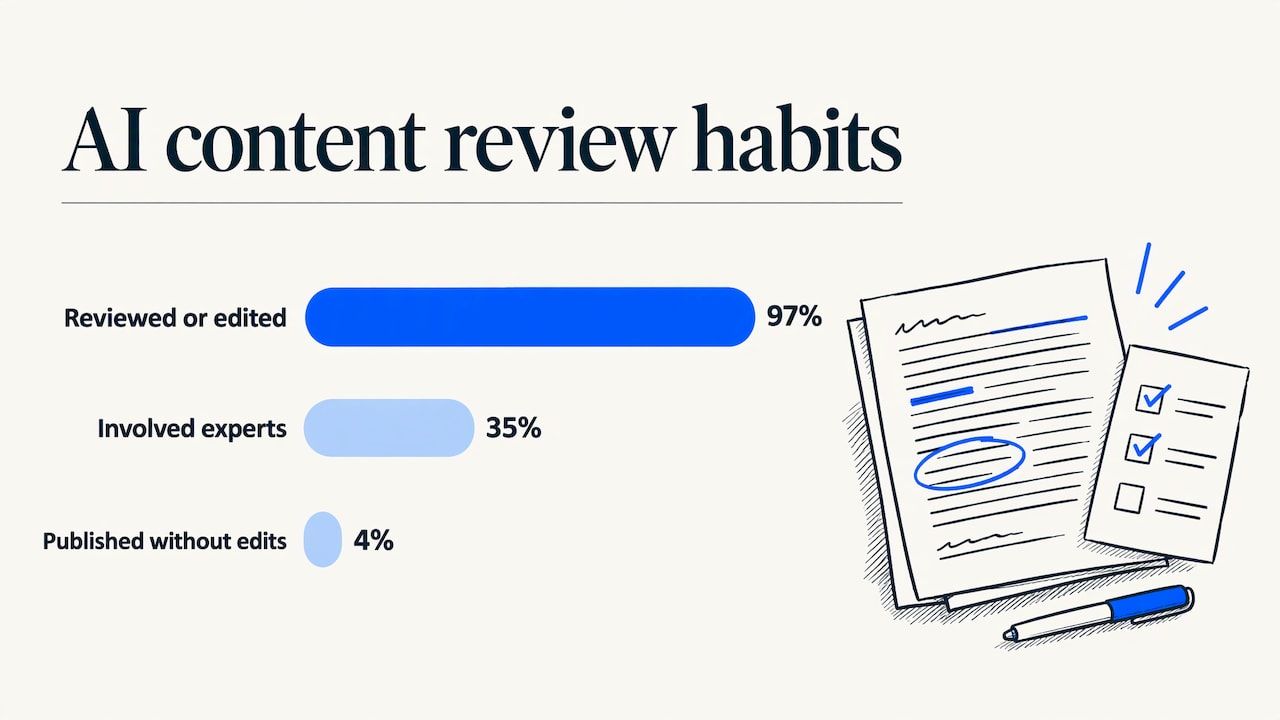
Practice has already moved in that direction. In Ahrefs’ 2025 survey, as reported by CXL, 97% of AI users reviewed or edited their content, 35% involved subject-matter experts and only 4% published AI copy with no edits. Those are survey self-reports from one source, so read them as a description of habits, not proof of quality.
A governed workflow, in our analysis, looks like this:
- Inputs are human and sourced. The brief and source pack come from people and documents, not from the model.
- AI drafts or structures within those limits. It does not invent statistics, quotes or product claims.
- Every number is traced to a page. If a figure cannot be traced, it comes out.
- An expert verifies what only experts can verify. Technical accuracy, edge cases, what the product actually does.
- An editor owns the final text. One accountable person approves publication.
The measure of success is not how much AI was used. It is whether the page tells a buyer something new, correctly.
What affects the cost of B2B content writing
Published rate surveys vary widely by source, scope and market, and many come from sellers of writing, so we do not give a single per-word figure here. Instead, these are the factors that move a quote, and they hold whatever currency or country you buy in:
- Subject depth. Writing about cybersecurity or industrial automation needs more research and expert interviews than a general business topic.
- Funnel position. Comparison and decision pages carry more risk and need more verified facts than top-of-funnel explainers.
- Source material. Content built from your own documents and experts costs less in research but requires internal time from your side.
- Review layers. Claim review, expert review and editorial review each add effort, and each reduces the chance of a published error.
- Languages and markets. Multilingual work involves localization, not translation alone.
- Production beyond the text. Tables, diagrams, CMS publishing, internal linking and structured layout.
- Ongoing cadence. A steady publishing rhythm changes the economics. A programme with a repeatable process is cheaper per page than one-off projects each needing a new briefing.
Our view is that cost per word is a weak metric. A cheap article that needs three rounds of expert correction costs more than a better-briefed one. A more useful way to compare: estimate cost per published, accurate, linked and measured page, then compare it with the business outcome it is meant to support. Our guide to calculating content marketing ROI walks through that arithmetic.
Freelancers, in-house team or a managed service: who fits when
There is no single right answer. This is our analysis on the same criteria for each option.
| Criterion | In-house writers | Freelancers | Managed SEO/GEO and content service |
|---|---|---|---|
| Product and customer knowledge | Highest, from daily exposure | Depends on briefing quality | Built from your documents and experts through the engagement |
| Strategy and SEO/GEO alignment | Needs senior hire or training | Usually outside the remit | Part of the same remit |
| Capacity flexibility | Fixed headcount | High, but coordination falls on you | Defined by the proposal |
| Quality control | Your editor | Your editor, plus rework | Review layers defined in the scope |
| Measurement and updates | Your analytics team | Rarely included | Can be included, depending on engagement |
| Management time on your side | Moderate | High | Lower once scoped |
The in-house team wins when you have a seasoned editor, a stable workload and deep domain knowledge to protect. Freelancers win for a narrow, well-defined piece of work with a strong internal editor. A managed service wins when the bottleneck is joining strategy, writing, optimization and measurement into one system, particularly across several brands, languages or sites.
Who should avoid a managed service? Teams that want a single cheap article, or that want a template-based self-service tool. A scoped engagement is built around a tailored remit, and a one-off purchase gets little from it.
How to judge a B2B content provider
Whatever you choose, put the provider through this checklist. It separates vendor claims from evidence.
- Ask what the process is, in writing. Who briefs, who writes, who checks claims, who approves?
- Ask how expert knowledge is captured. Interviews, documents, review rounds. If the answer is “our writers research”, expect generic output.
- Ask how AI is used. A provider should be able to describe controls for sourcing and review.
- Ask how success is measured. Look for a distinction between mentions, citations, clicks, visits, enquiries and revenue. Anyone who promises rankings or citations is promising something nobody controls.
- Ask what is in and out of scope. Languages, CMS publishing, technical fixes, reporting, access and responsibilities should be explicit.
- Read sample pages for specificity. Do they contain dated facts, sources and reasoned positions, or only confident adjectives?
If you are also deciding how to buy SEO support, the guide on choosing an SEO/GEO agency applies the same logic from the search side.
Measuring B2B content: keep the metrics apart
A frequent mistake is to count everything as success. Keep these layers separate:
- Mentions and citations in AI answers: evidence of visibility, not of demand.
- Impressions and clicks: evidence of reach and relevance to a query.
- Visits and engagement: evidence that someone arrived and stayed.
- Qualified behavior: demo views, pricing page visits, downloads from target accounts.
- Enquiries and pipeline: evidence of commercial contribution.
- Revenue: the outcome, usually influenced by many factors beyond one article.
Measurement should test usefulness, qualified behavior and business contribution, not traffic alone. This also keeps expectations honest: a page can earn citations in AI answers and still produce no enquiries if it is aimed at the wrong reader. For how search and answer engines relate, see AEO, SEO and GEO compared.
Cadence beats bursts
Teams often publish ten articles in a campaign month and nothing for a quarter. Our analysis is that a modest, regular schedule with maintained pages outperforms bursts because it keeps the editorial system alive: briefs get written, experts stay in the habit of contributing, and refreshes happen on time. We explain the reasoning in why a steady publishing schedule beats perfection.
Where we land
Our view on B2B content writing We think the industry talks about writing when it should talk about systems. A good sentence is the cheapest part of B2B content. The expensive parts are deciding which question deserves a page, getting real expertise and approved facts into the draft, checking every claim, and measuring whether the page moved a buyer. That is why we work from strategy through production, optimization and measurement as one connected service, including AI content operations where they fit, using your internal expertise and documents. The scope is tailored, so the proposal defines the work, deliverables, responsibilities, languages and cadence, instead of selling a fixed package. We also say what we cannot promise: no one controls rankings or AI citations, and we do not guarantee them. What a well-run process can do is make each page more accurate, more specific and easier to find, then show you what happened in numbers that separate visibility from revenue. Louis Choquet
If you want help producing it
We handle article, guide and page production and optimization of existing content as part of a tailored SEO/GEO service, scoped to your markets and goals, with pricing on request. To see how this works in practice, the Campus Consulting case shows content connected to business needs.
FAQ
What is the difference between B2B content writing and B2B copywriting?
Content writing educates and builds trust during research, through articles, guides and case studies. Copywriting persuades toward a specific action, such as a landing page, ad or sales email. Most B2B programmes need both, and the content shapes whether the copy gets a fair hearing.
Can AI write B2B content on its own?
Not responsibly. Google’s guidance says generated output can contain inaccuracies and should be fact-checked and reviewed before publishing, and that mass-producing pages without adding value may violate its spam policy. Use AI inside a workflow with a source pack, expert verification and an accountable editor.
How long should a B2B article be?
As long as the buyer’s question requires, and no longer. A definition might need 800 words, while a comparison with a decision matrix or a technical implementation guide may need several thousand. Judge length by whether each section answers something the reader needs to decide or act.
How do I know whether B2B content is working?
Measure in layers: search visibility and AI citations first, then visits, then qualified behavior such as pricing-page views or demo requests, then enquiries and revenue. Keep the layers separate, and connect each piece to the goal in its brief so you know which metric applies.
Sources
- Forrester: The B2B Content Guide, buyers value diverse content sources and elements
- Google Search Central: guidance on using generative AI content
- Salesforce: B2B content marketing best practices
- BNP Media: choosing the right medium for B2B marketing
- Backlinko: how to scale content creation
- Brightspot: content strategy roadmap, enterprise guide
- CXL: how to win with AI-driven B2B content marketing