
 Add to preferred sources on Google
 ChatGPT
 Claude
 Perplexity

Introduction
A B2B content strategy is a documented answer to three questions: which business outcome content is meant to influence, which buying committee it has to persuade, and which topics your company can credibly own. Everything else, including calendars, formats and channels, belongs in a content plan that follows from that answer. Most weak strategies are plans with the “why” missing. This guide gives you the framework, a way to choose between competing priorities, an illustrative worked example and a measurement model that does not confuse visibility with revenue.
TL;DR
- Strategy is the “why” (outcome, audience, positioning, governance). The plan is the “what and when”. Write the first before the second.
- Start from one business outcome and one accountable executive, not from a topic list or a publishing frequency.
- Research the buying committee through customer interviews, sales debriefs and search data, then map topics to role and stage.
- Measure in layers: AI mentions, citations, clicks, visits, enquiries, pipeline and revenue are different things. Report them separately.
- This is our analysis, not original research. Where we cite figures, they come from the linked sources and carry their own dates and scope.
What a B2B content strategy is, and what it is not
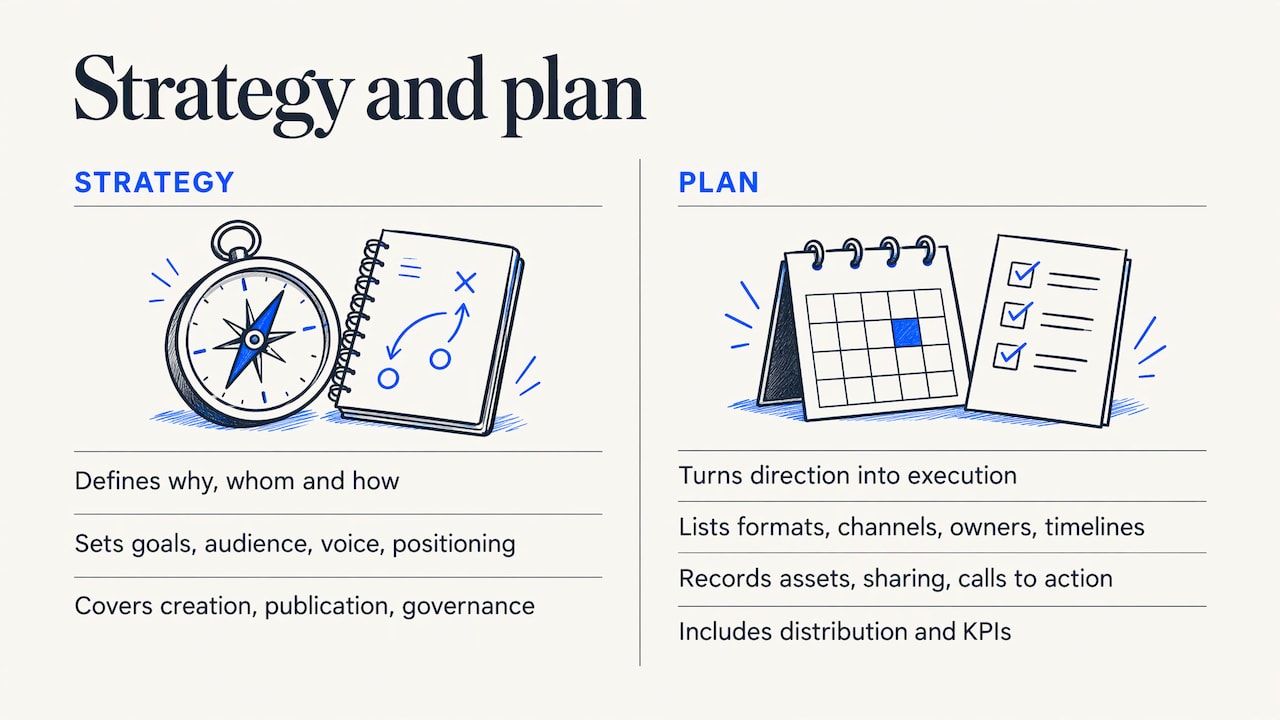
The Content Marketing Institute frames content marketing strategy as the “why”: why you create content, whom it helps and how. Content strategy in the broader sense covers creation, publication and governance. A content plan is the document that records how the strategy gets executed and who handles each task: topic areas, assets, timing, sharing and calls to action.
HubSpot draws the same line in its September 2026 guide to content marketing plans. Strategy sets direction through goals, audience, voice and positioning. The plan turns that into formats, channels, owners, timelines, distribution and KPIs.
Why does the distinction matter in practice? Because a calendar can be filled in an afternoon, and it feels like progress. A team with a calendar and no strategy publishes steadily and cannot say what any single article was supposed to achieve. That is the failure we see described most often in the guides ranking for this topic: lots of steps, little argument about what to leave out.
Our position, labeled as opinion: a B2B content strategy is only as good as the things it forbids. If it cannot tell your team which requested article not to write, it is a wish list.
Why B2B companies need one
B2B buying is slower and involves more people than most consumer purchases. MarTech’s 2025 guide says B2B content supports longer, self-directed buying cycles, educates several stakeholders, builds trust, enables sales and customer-success teams, and keeps messaging aligned across markets.
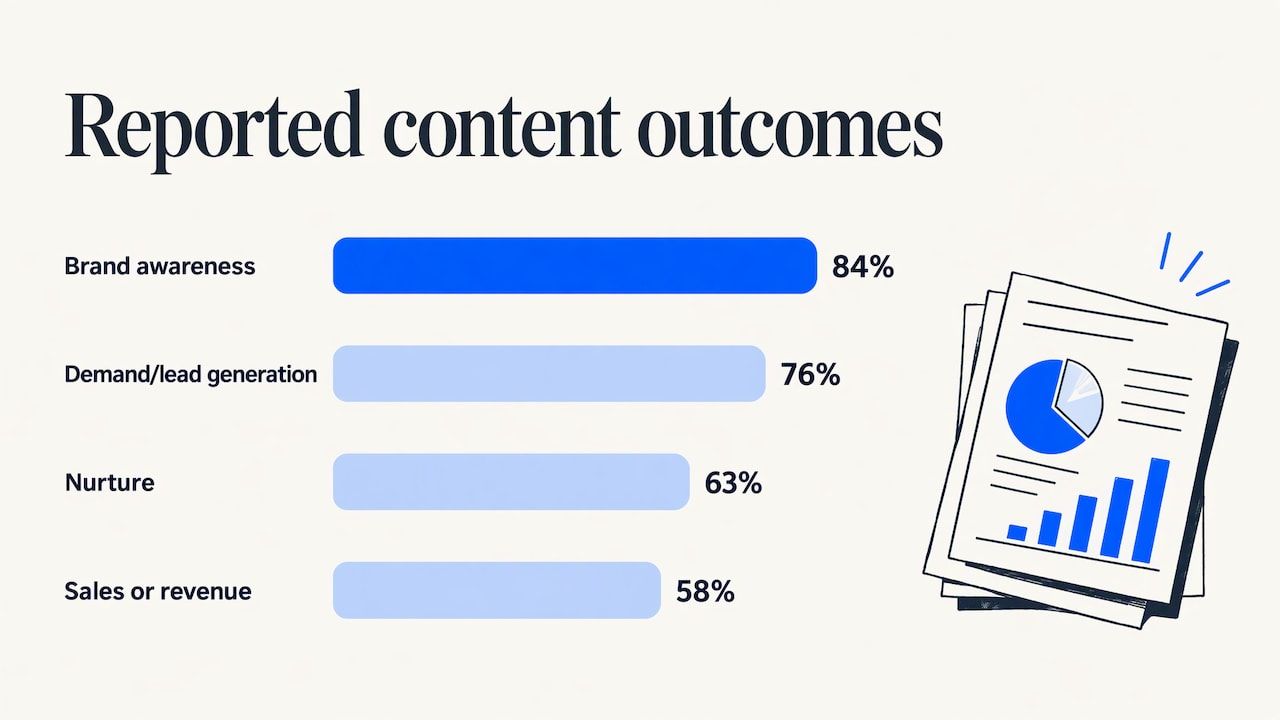
The same guide cites 2024 Content Marketing Institute research in which 84% of B2B marketers said content helped build brand awareness and 76% said it helped demand or lead generation. Fewer, 63%, said it helped nurture, and 58% said it directly contributed to sales or revenue. Read that gradient carefully. Content is credited most for the top of the funnel and least for revenue. That is partly a measurement problem, which we come back to below, and partly a sign that many programs are never designed to reach the bottom of the funnel.
Brightspot lists the outcomes a strategy can support: qualified-lead generation, product adoption, customer retention, entering a new market and reducing service costs. Canva’s October 2026 guide adds the internal benefits of documentation: consistent voice, easier collaboration and more manageable scaling.
Note what is missing from these lists: “more traffic” as an end in itself. Traffic is a signal on the way to an outcome, not the outcome.
The framework: seven components
The Content Marketing Institute’s framework can include a business case, an operations plan for governing, managing and measuring content, purpose and objectives, resources, processes, audience personas, customer journey maps, a brand story and a channel plan. Relato’s B2B framework condenses this into audience, business goals, topics the brand can credibly own, formats, channels and measurement, followed by iterative optimization using performance data.
Our synthesis of those sources into one working structure:
| # | Component | The question it answers | Output you should have |
|---|---|---|---|
| 1 | Business outcome | What must content influence, and who is accountable? | One to three outcomes, each with a named executive |
| 2 | Audience | Which organizations, and which people inside them? | ICP, role-based personas, committee map |
| 3 | Positioning and topics | What can we credibly own that competitors cannot copy? | Topic territories with proof sources (data, experts, documents) |
| 4 | Journey map | What does each role need at each stage? | A role-by-stage content matrix |
| 5 | Formats and channels | Where and how does each asset reach the reader? | Format and distribution rules per topic |
| 6 | Governance | Who requests, writes, reviews, approves, updates, retires? | Workflow, RACI, review paths |
| 7 | Measurement | How will we know it worked, and when do we look? | Baselines, targets, data owners, review cadence |
This is our arrangement, not a standard. Component 3 is the one most guides underweight. “Topics we can credibly own” forces an honest look at what your company actually knows: its customers, product data, internal experts and documents. A generic article on “what is content strategy” cannot be owned by anyone.
Researching the buying committee
B2BNN’s March 2026 guide recommends three inputs: customer interviews, sales-team debriefs and search-behavior analysis. It then maps roles in the buying committee to buying stages and builds a content matrix with a topic and content type at each intersection. It also offers a rule of thumb on search intent: informational queries generally indicate awareness, comparison and review queries indicate consideration, and product-specific or pricing queries indicate decision-stage intent. Treat that as a heuristic, not a law. Plenty of informational searches come from people about to buy.
Brightspot adds a distinction that saves a lot of confusion. An ideal customer profile describes the target organization, while personas describe the people involved in the decision. For each audience, document needs, decision criteria, questions, preferred formats and position in the journey.
A diagnostic you can run this week
- Pull the last ten closed deals, won and lost, from your CRM.
- For each, list the roles that were involved (economic buyer, technical evaluator, end user, procurement, legal or security).
- Ask sales what each role asked before the decision. Write the questions verbatim.
- Check whether your site answers each question on a page the role could find without talking to sales.
- Mark every unanswered question. That list is the raw material of your topic territories.
This costs a few hours and no software. It also tends to surface an uncomfortable fact: some of the most decisive questions (pricing logic, implementation effort, security, integration) are the ones B2B sites avoid answering.
Choosing goals, topics, formats and channels
Brightspot’s sequence is sound: start with the business outcomes content is expected to influence, turn each into a focused objective and name the accountable executive. Then research audience questions, search demand and content gaps, and map content types and channels to objectives and audience needs.
Where teams go wrong is in the middle. They list fifty topics and rank them by search volume. A better filter uses four tests, which is our own analysis:
- Outcome link: can you state, in one sentence, how this topic moves the chosen outcome?
- Ownership: do we hold proof others lack (data, process, documents, expert time)?
- Committee fit: which role and stage does it serve?
- Maintenance cost: who will keep it accurate in twelve months?
A simple decision matrix
Score each candidate topic from 0 to 3 on each test, then add up. The weights below are a starting point; change them to match your outcome.
| Test | Weight | What a 3 looks like |
|---|---|---|
| Outcome link | x3 | Directly tied to the outcome, such as a comparison page for a sales-led product |
| Ownership | x2 | Built on your own data or expert knowledge |
| Committee fit | x2 | Answers a question a named role asked in real deals |
| Maintenance cost | x1 | Low upkeep, or an owner is already assigned |
A topic scoring below roughly a third of the maximum (maximum is 24) does not make the plan. That is the “forbid” function in practice.
Worked example (illustrative)
The following company and figures are fictional, used only to show the arithmetic. A mid-sized B2B software firm sells workflow software to operations teams. Its outcome is more qualified demo requests from companies with 200 to 2,000 employees. Three candidate topics:
| Topic | Outcome link (x3) | Ownership (x2) | Committee fit (x2) | Maintenance (x1) | Total /24 |
|---|---|---|---|---|---|
| “What is workflow automation?” | 1 → 3 | 0 → 0 | 1 → 2 | 3 → 3 | 8 |
| Implementation timeline guide using the firm’s onboarding records | 3 → 9 | 3 → 6 | 3 → 6 | 2 → 2 | 23 |
| Comparison page: build in-house vs buy | 3 → 9 | 2 → 4 | 3 → 6 | 2 → 2 | 21 |
The definitional article would probably win on raw search volume, and it scores 8. The implementation guide scores 23 because it uses material only this firm has and answers a question the technical evaluator asks late in the deal. The scoring is subjective, and that is acceptable as long as the team argues about the scores in the open instead of arguing about taste.
Planning production, distribution and governance
Governance is the part of a content strategy people skip because it sounds administrative. It is also where multi-brand and multi-site organizations lose control. Brightspot recommends documenting the full workflow: request, assignment, drafting, review, approval, publication, localization and retirement. Responsibilities go into a RACI model, with risk-based review paths so that a product-security claim gets a different review than a blog roundup. Distribution rules cover websites, apps, newsletters, partner portals and social channels.
Once the strategy is set, the CMI framework says the plan should specify topic areas, assets, timing, distribution method, calls to action, task ownership and execution details. HubSpot recommends distributing through owned, earned and paid channels and setting KPIs before publication instead of judging success by traffic alone.
Two practical additions from our analysis:
- Retirement is part of the workflow. An outdated comparison page or pricing explanation costs trust with a buyer who finds it. Give every asset a review date and an owner.
- Expert time is the scarce input. In B2B, the difference between content that reads like everything else and content that gets used by sales is access to people and documents inside the company. Schedule that access like any other dependency.
Brightspot also lists operational KPIs worth tracking: editorial cycle time, publishing velocity, content reuse rate, workflow SLA compliance, revision or rejection rate and content freshness. They are health metrics. They tell you whether the machine runs, not whether it works.
Measuring what content contributes
Brightspot suggests tracking organic traffic, conversions, AI citations and content-assisted pipeline or revenue, alongside operational health. It also says to define data sources, owners, baselines, targets and review cadence before production starts. We agree with the last point most strongly. A baseline set after the work begins is a baseline shaped by the work.
The Content Marketing Institute’s guide to strategy in AI search argues for a shift from volume to audience relevance, from traffic to engagement and retention, and from rankings alone toward authority and citations. The Enterprise DXP metrics guide groups measurement into consumption, engagement, SEO performance, conversion, retention and revenue attribution, including content-assisted pipeline and opportunity acceleration.
Keep the layers apart
The most common measurement mistake we would flag is collapsing different events into one “visibility” number. They are not interchangeable:
| Layer | What it is | What it does not prove |
|---|---|---|
| AI mention | Your brand named in an AI-generated answer | That anyone read your content or visited |
| AI citation | Your page listed as a source in the answer | That a click or a decision followed |
| Click | A visit initiated from search or an answer engine | That the visitor is in your ICP |
| Visit | A session on your site, from any channel | Intent or fit |
| Enquiry | A form, demo request or contact | That the lead is qualified |
| Pipeline and revenue | Opportunities and closed deals influenced | That content alone caused them |
No vendor or guide can promise movement in the first two layers, because answer engines change how they select sources. Report them as signals and be clear about the method you used to collect them.
Account-level reporting for long cycles
Clearcue’s 2025 ROI guide recommends account-level reporting, content-assisted conversions, sales-enablement usage and customer expansion or retention metrics. It then compares content-engaged and non-content-engaged deals by deal size, win rate and sales-cycle length. Its perspective is that multiple touches influence a committee over a long cycle, so deals are a better unit than single visits.
Our caution: the comparison is correlational. Deals that engaged with content may be those that were already likely to close. Treat the result as a hypothesis worth testing, for example by checking whether the gap persists within the same segment and deal size band, not as proof of causation.
A minimal reporting setup, our recommendation:
- One page per outcome, with a baseline and a target set before production.
- A monthly view of leading indicators (rankings, citations, visits to priority pages).
- A quarterly view of lagging indicators (enquiries, content-assisted pipeline, win rate and cycle length for engaged versus non-engaged deals).
- A named owner for each data source, including the CRM.
Hollow advice worth retiring
Brief sarcasm, aimed at a practice and not a person: the “publish consistently” mantra is the content equivalent of “eat well”. Nobody disagrees, and it settles nothing. Consistency of what, for whom, toward which outcome?
A few specific cases where the common advice fails, as our analysis:
- “Create valuable content.” Every top-ranking guide says it. Without a named reader, a question and a proof source, it cannot be checked.
- “Pick a topic by search volume.” Volume measures how many people ask, not whether those people are your buyers. A keyword at a few hundred searches a month can matter more than one at ten thousand if it is the question a technical evaluator asks before signing.
- “Repurpose everything everywhere.” Distribution rules should follow where your committee actually reads, which your sales debriefs can tell you.
- “Prove ROI with one number.” Long cycles and committees make single-touch attribution misleading. Use account and deal views and say plainly what they cannot show.
When to use a managed team, and when not to
If you have a content lead, access to internal experts and the capacity to run the diagnostic above, you can build this framework in-house. The framework needs no special software. An outside team is most relevant when the constraint is capacity, expertise in search and AI answer visibility, or coordination across several brands, sites or languages. In those cases a managed engagement can be a reasonable choice; a one-off audit rarely solves a governance problem.
Our perspective We think B2B content strategy has been sold as a publishing problem when it is an alignment problem. The hard part is not producing articles. It is deciding which business outcome a body of content serves, which people in the buying committee it has to reach, and what your company knows that nobody else can credibly say. That is why we treat strategy, production, optimization and measurement as one connected piece of work rather than four separate purchases. A strategy that never reaches the page is a slide deck. Production without a strategy is volume. Optimization without measurement is guesswork, and measurement without a baseline is storytelling. We also think visibility on Google and on AI answer engines should be planned together. Both reward the same underlying asset: clear, well-structured content that a specific audience finds useful and that reflects real expertise. We make no promise of rankings or citations, because nobody controls them. We do think a documented strategy, with owners and a measurement model set in advance, gives a team the best chance of learning quickly from what it publishes. Louis Choquet
How Pharelia can help
Pharelia offers a managed, tailored service that connects content and SEO/GEO strategy, production, optimization and measurement and performance tracking. Scope, deliverables, languages and budget are defined in the proposal, and pricing is available on request. To see how content can be tied to a business need in practice, read the Campus Consulting case page.
FAQ
What is the difference between a content strategy and a content plan?
The strategy defines why you create content, for whom, with what positioning and under what governance. The plan records the execution: topics, assets, timing, channels, owners and calls to action. You write the strategy first and revise the plan as often as performance data suggests.
What should a B2B content strategy framework include?
At minimum: business outcomes with an accountable owner, audience and buying committee research, topics you can credibly own, a role-by-stage content matrix, format and channel rules, a governance workflow and a measurement model with baselines. Sources such as the Content Marketing Institute also add a business case, resources and a brand story.
How do you measure B2B content performance if the sales cycle is long?
Work at account and deal level instead of single visits. Compare deals that engaged with content and deals that did not on size, win rate and cycle length, and treat the result as a hypothesis because the groups may differ already. Report AI mentions, citations, clicks, visits, enquiries and revenue as separate layers.
Does B2B content strategy change for AI search?
The fundamentals hold: know the audience, own a topic credibly, keep content accurate. The emphasis shifts toward relevance, authority and being citable, as the Content Marketing Institute argues. No one can guarantee citations, so plan to measure them as a signal alongside traffic and enquiries.
Is this guide based on original research?
No. The frameworks, matrix and worked example are our analysis built on the cited sources, and the example company is fictional. Figures belong to the linked sources and apply to their own dates and samples.
Sources
- Developing a Content Marketing Strategy, Content Marketing Institute
- How to build a content marketing plan in 7 steps, HubSpot
- Content strategy roadmap: Enterprise guide, Brightspot
- B2B Content Marketing Guide: Strategy for Enterprise Growth, MarTech
- Content strategy for B2B marketers, Canva
- B2B Content Strategy Framework, Relato
- B2B Content Marketing Strategy: The Complete Guide For 2026, B2BNN
- How To Build a Content Strategy That Survives AI Search, Content Marketing Institute
- Metrics for Content Marketing: The Enterprise DXP Guide, Kogifi
- How to prove ROI from B2B content marketing, Clearcue