# SEO tracking: a practical guide for small businesses and SMEs
Explore our practical SEO tracking guide for small businesses and SMEs. Improve your online visibility and analyze performance effectively.
Author: Louis Choquet · Founder, Pharelia
Published on 2026-07-19 · Updated on 2026-08-10
Source: https://pharelia.com/en/resources/tracking-seo-le-guide-pratique-pour-tpe-et-pme
## Introduction

> **At a glance:** - SEO tracking means regularly monitoring a site's Google rankings to optimize visibility. It includes analysis of transactional, informational, and branded keywords, along with metrics such as share of voice and CTR. Monitoring visibility in AI answers is also becoming essential to a complete, effective strategy.
SEO tracking means regularly monitoring your site's search engine rankings to manage online visibility. In practice, the term covers what professionals call “rank tracking”: measuring where your pages appear on Google for each target keyword, analyzing trends, and adjusting strategy accordingly. For a small business owner or an SME marketing manager, this tracking is not optional. [More than 40 % of informational queries](https://seobolt.io/features/rank-tracking/) now display rich features or AI-generated answers in Google results. Tracking only the first ten traditional links gives an incomplete picture of your actual visibility.
## Which metrics should you monitor for effective SEO tracking?
Rank tracking loses value if you measure the wrong metrics. Before configuring a tool, define the keywords and metrics that genuinely reflect your commercial activity.
### Select the right keywords
Three keyword categories structure relevant [rank tracking](https://pharelia.com/en/resources/boost-seo-pour-tpe-et-pme-le-guide-2026):
- **Transactional keywords**: those generating quote requests, purchases, or enquiries. Example: “accountant Paris 15th arrondissement” or “invoicing software SME”. These are your priority keywords.
- **Informational keywords**: those attracting visitors in the research phase. Example: “how to choose a CRM”. They build awareness and feed the discovery funnel.
- **Branded keywords**: your company name and its variants. Tracking them quickly detects reputation or indexing anomalies.
### Key metrics to monitor
[SEO visibility is assessed](https://www.elevaseo.com/blog/seo/suivi-positionnement-seo-guide) through composite metrics such as visibility score, share of voice, and SERP feature tracking. These metrics aggregate position, search volume, and estimated click-through rate to provide a more reliable view than raw position alone.
- **Average position**: your page's rank for a given query.
- **Impressions**: the number of times your page appears in results.
- **CTR (click-through rate)**: the share of users clicking after seeing your result.
- **Share of voice**: the percentage of clicks you capture across a set of keywords, compared with the total available.
- **Presence in SERP features**: rich snippets, “People Also Ask” boxes, AI Overviews.
**Pro tip:** *Segment keywords by search intent when creating your list. This lets you compare like with like during monthly analysis and quickly identify which segment is improving or declining.*
## How should you choose and configure SEO tracking tools?
The market offers two main types of rank tracking tools. Your choice depends on budget, the volume of keywords to monitor, and the desired update frequency.

### Two tool types
**Google Search Console** is the essential starting point. Free, it provides official data on average positions, impressions, and CTR for every query. Google Search Console offers accurate but aggregated data over a 16-month window. It is a solid foundation, but does not allow real-time tracking of specific keywords or competitor comparisons.
**SaaS rank tracking platforms** fill these gaps. They let you configure a list of target keywords, choose a geographic location (city, department, country), and receive automated performance reports. For a small business, an entry-level platform often suffices for tracking 50 to 200 keywords. An SME with multiple product lines or geographic areas needs greater capacity.
### Step-by-step setup
1. **Define the scope**: enter your main domain and add subdomains or multilingual sites separately if you have them.
2. **Choose locations**: configure tracking across France, then narrow it to cities or regions if you operate locally. Separate desktop and mobile tracking is essential, because Google prioritizes mobile versions when indexing sites.
3. **Add direct competitors**: include 3 to 5 competitors in the tool to compare your progress with theirs. This comparison is key to distinguishing a site-specific problem from a Google update affecting the whole sector.
4. **Configure alerts**: set automatic alerts for critical thresholds, such as a drop of 5 positions, leaving the top 10, or a significant competitor move. These alerts let you respond within hours rather than weeks.
5. **Connect Google Search Console and GA4**: cross-referencing ranking data with actual traffic and conversions gives a complete view of SEO's impact on your business.
**Pro tip:** *Before starting any optimization, [record a baseline](https://www.editionslamarque.fr/suivi-positionnement-outils-analyse-serp/), meaning the initial state of your rankings for every keyword. Without this reference, you cannot measure the actual impact of your actions.*
## How should you analyze and interpret SEO tracking data?
Raw ranking data is worthless without interpretation. Reading performance reports requires a method to avoid reacting unnecessarily to every fluctuation.
### Distinguish a site-specific problem from a Google update
Comparing your SEO changes with those of direct competitors helps identify the nature of a fluctuation. If your rankings fall alongside competitors' rankings on the same queries, it is probably a Google algorithm update. If only you lose rankings, the problem comes from your site: content, technical issues, or lost inbound links.
### Spot quick opportunities
Some rankings deserve immediate attention:
- **Pages in positions 4 to 10**: slightly improved content or better internal linking may be enough to move them into the top 3, with a significant traffic gain.
- **Pages with low CTR despite a good position**: the title or meta description is not compelling enough. Rewriting these elements can increase traffic without changing position.
- **Queries with high impressions and near-zero CTR**: your page appears, but nobody clicks. This often signals a mismatch between search intent and the content offered.
### Include generative AI visibility
Tracking visibility in AI model answers is becoming a key concern, because a good Google ranking does not guarantee presence in ChatGPT, Perplexity, or Google's AI Overviews. Modern SEO visibility extends to results mentioned or cited in generative AI models, not just positions in traditional SERPs. For small businesses and SMEs, this means a complete visibility audit must now include mention tracking in these environments alongside traditional rank tracking. Pharelia measures both dimensions simultaneously for clients through Search Console, GA4, and AI mention tracking.
**Pro tip:** *Do not react to a position change over 24 hours. Interpret changes in context by systematically comparing with direct competitors to avoid overreacting to normal algorithmic fluctuations.*
## How often should you track SEO to make progress?
Tracking frequency determines how responsive your strategy is. A poorly calibrated schedule leads either to hasty reactions to insignificant fluctuations or to problems detected too late.
1. **Daily monitoring**: reserve it for your 10 to 20 most strategic keywords, those directly generating enquiries or sales. Tracking the most strategic keywords daily enables quick responses to algorithm updates or technical problems. The aim is not in-depth analysis every day, but anomaly detection through configured alerts.
2. **Weekly review**: analyze trends across your whole keyword list. Compare changes with competitors. Identify improving and declining pages. This review takes 30 to 45 minutes with a properly configured tool.
3. **In-depth monthly analysis**: cross-reference ranking data with actual organic traffic (GA4), conversions, and generated leads. Assess the impact of content published the previous month. Adjust the tracked keyword list to reflect new commercial priorities.
4. **Quarterly review**: compare current rankings with the initial baseline. Measure changes in share of voice on strategic queries. Decide next quarter's SEO projects: new content, technical optimizations, stronger internal linking.
In SEO, [regular consistency beats occasional perfection](https://pharelia.com/en/resources/moteur-de-contenu-cadence). Imperfect but constant tracking produces better results than exhaustive analysis once a year. Update your keyword list at every quarterly review to incorporate new queries identified during an [SEO audit](https://pharelia.com/en/resources/audit-seo-checklist) or through sales feedback.
## Key takeaways
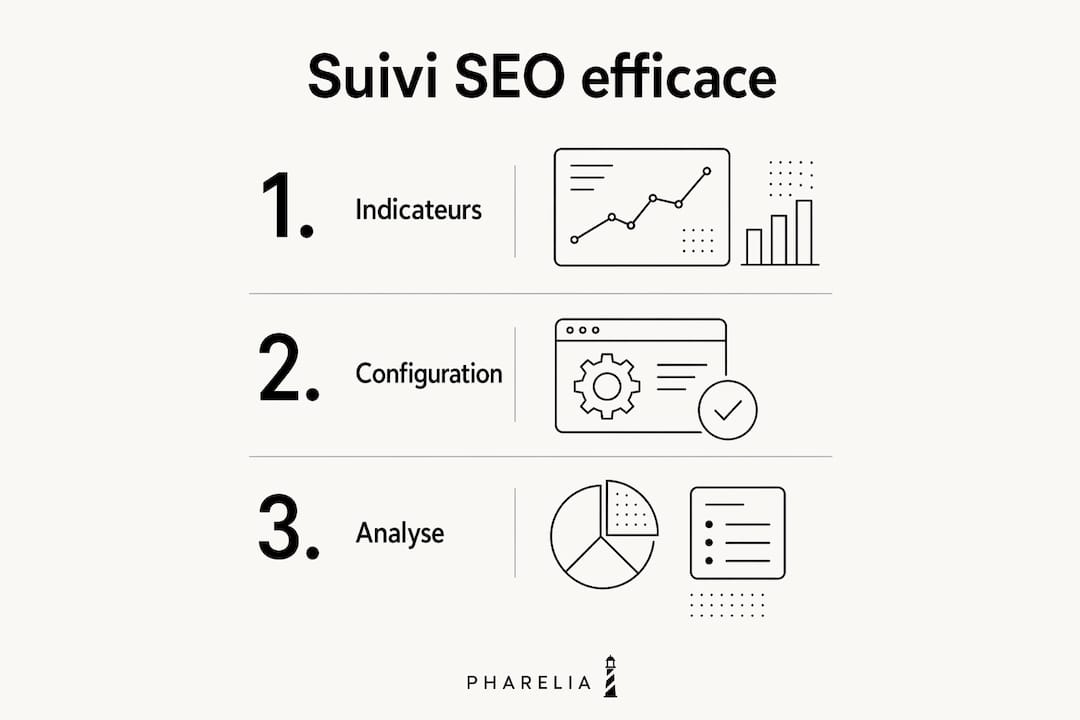
Effective SEO tracking rests on three pillars: the right metrics, rigorous tool configuration, and an analysis schedule suited to your business.
| Point | Details |
| --- | --- |
| Define a baseline | Record initial rankings before optimization to measure the actual impact of your actions. |
| Segment by intent | Classify keywords as transactional, informational, or branded for comparable analyses. |
| Configure alerts | Set critical thresholds (a drop of 5 positions, leaving the top 10) to respond without delay. |
| Compare with competitors | Analyze your changes alongside 3 to 5 direct competitors to distinguish a site-specific problem from a Google update. |
| Include AI visibility | Complement Google tracking with mention tracking in ChatGPT, Perplexity, and AI Overviews. |
## What SEO tracking really reveals about your business
Rank tracking is often presented as a measurement tool. I experience it mainly as a diagnostic tool. When a page falls from position 3 to position 12 in a week, the question is not “how do I regain my ranking?”. The real question is: “what did Google detect that I had not seen?”
What I regularly observe among small business and SME owners is a tendency to watch rankings without reading the signals they send. A page in position 6 with a CTR of 1 % says something specific: your title does not match what the user is looking for. A page losing rankings only on mobile says something else: a technical problem related to Google's mobile-first indexing.
Another frequent blind spot is generative AI visibility. Many marketing managers still think SEO means only Google. In 2026, a prospect can find your competitor in a ChatGPT or Perplexity answer without ever opening Google. If your tracking does not cover these channels, you have a partial view of actual visibility. This is not a future problem. It is a current one.
My practical advice: start simple. Ten well-chosen keywords, a recorded baseline, configured alerts, and a serious monthly review. That is enough to make better decisions than 80 % of your direct competitors. Add the AI layer once you have mastered the Google foundations.
> *— Louis*
## The visibility tracking Pharelia manages for you
Pharelia handles rank tracking and AI visibility measurement for small businesses, SMEs, and startups in France. The agency covers three channels under one contract: Google search visibility (SEO), presence in generative search engines (GEO), and answer optimization (AEO).
[](https://pharelia.com/en/contact)
Every engagement starts with a free visibility audit based on crawl, SERP, and AI mention data. Pharelia then measures Google rankings and citations earned in ChatGPT, Perplexity, Gemini, and AI Overviews through Search Console, GA4, and mention tracking. The published results speak for themselves: [Applewood achieved 300 %](https://pharelia.com/en/client-work/applewood) growth in SEO and 500 % in AI visibility. For more on AI search visibility, Pharelia regularly publishes practical guides tailored to small organizations.
## Frequently asked questions
### What exactly is SEO tracking?
SEO tracking, or rank tracking, means regularly measuring your site's search engine positions for every target keyword. It also includes monitoring CTR, impressions, and increasingly visibility in generative AI answers.
### What is the ideal frequency for tracking SEO rankings?
The optimal schedule combines daily monitoring of strategic keywords through alerts, a weekly review of overall trends, and in-depth monthly analysis cross-referenced with traffic and conversion data.
### Is Google Search Console enough for SEO tracking?
Google Search Console provides free official data on average positions, impressions, and CTR. It remains insufficient for real-time tracking of specific keywords, competitor comparisons, or automatic alerts on critical changes.
### How can I distinguish a Google-driven ranking drop from a problem with my site?
Compare your changes with 3 to 5 direct competitors on the same queries. If the whole sector loses rankings simultaneously, it is an algorithm update. If only you fall, the problem comes from your site.
### Should I also track visibility in AI such as ChatGPT?
Yes. A good Google ranking does not guarantee presence in ChatGPT, Perplexity, or AI Overview answers. These channels capture a growing share of users' attention, and complete tracking must now include them.
## Recommended reading
- [SEO boost for small businesses and SMEs: the 2026 guide | Pharelia](https://pharelia.com/en/resources/boost-seo-pour-tpe-et-pme-le-guide-2026)
- [SEO agency: a practical guide for small businesses and SMEs | Pharelia](https://pharelia.com/en/resources/agence-seo-guide-pratique-pour-tpe-et-pme)
- [PrestaShop SEO agency: a guide for small businesses and SMEs | Pharelia](https://pharelia.com/en/resources/agence-seo-prestashop-le-guide-pour-tpe-et-pme)
- [Generating qualified leads: a guide for small businesses and SMEs | Pharelia](https://pharelia.com/en/resources/generer-des-leads-qualifies-guide-pour-tpe-et-pme)