# Shopify SEO: a 30/90/180-day roadmap
Discover our 30-, 90-, and 180-day Shopify SEO roadmap. Improve your search visibility and boost your sales now!
Author: Louis Choquet · Founder, Pharelia
Published on 2026-08-06 · Updated on 2026-10-04
Source: https://pharelia.com/en/resources/seo-shopify
## Introduction

> **In brief:** - Organic search visibility for a Shopify store depends on priority technical and editorial actions. A thorough audit and regular optimization help strengthen visibility on Google and in AI engines.
Organic search visibility for a Shopify store depends on six priority actions: fixing technical indexing blockers, optimizing your ten commercially valuable pages, structuring a blog around a hub-and-spoke model, improving Core Web Vitals, enabling JSON-LD structured data for your products, and launching a targeted link-building plan. Shopify automatically handles the technical foundations — sitemap, canonical tags, SSL — but real organic growth requires manual work on content, metadata, and backlinks.
**Priority actions to start immediately:**
1. Connect Google Search Console, submit the sitemap, and audit indexing coverage.
2. Fix duplicate URLs between `/collections/.../products/...` and `/products/...` in the theme.
3. Rewrite the `` tags and meta descriptions for your ten most strategic product and collection pages.
4. Measure LCP, INP, and CLS with PageSpeed Insights; identify the JavaScript apps responsible for poor scores.
5. Add a `Product` + `AggregateRating` JSON-LD block to every product page.
6. Publish an initial 1,200- to 2,500-word pillar article linked to your main collection, then plan one spoke per week.
**Prioritized 30 / 90 / 180-day plan:**
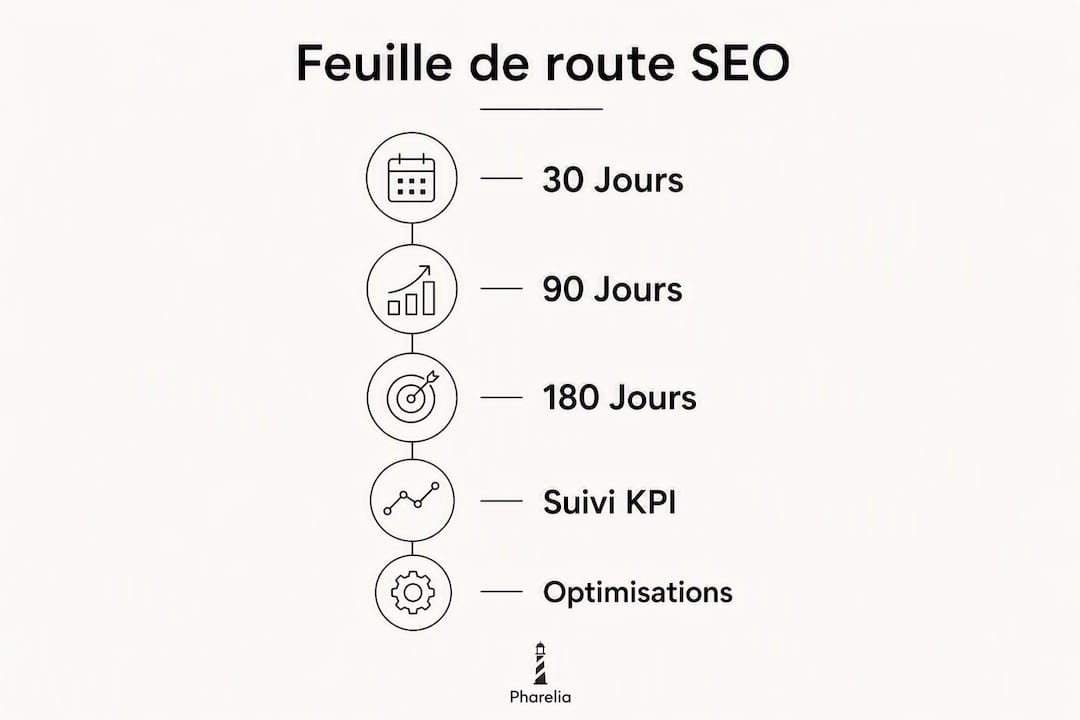
- **Day 0–30:** Complete technical audit, indexing fixes, metadata optimization on the ten priority pages, and initial Core Web Vitals fixes. Expected result: pages crawled correctly and an initial rise in impressions in Google Search Console.
- **Day 30–90:** Produce three pillar articles and six spokes, add internal links to collections and products, and begin outreach for 5 to 10 quality backlinks. Expected result: initial rankings for long-tail queries and measurable organic traffic.
- **Day 90–180:** Expand topic coverage, optimize high-traffic pages, A/B test product pages, and monitor citations in AI engines. Expected result: ranking gains on competitive queries and growing organic conversions.
**Initial KPIs to track:** impressions and clicks in Google Search Console, average position per page, number of indexed pages, and conversion rate by organic landing page.
<a id="table-des-matieres"></a>
## Table of contents
- [Why SEO matters for your Shopify store in France](#pourquoi-le-seo-est-decisif-pour-votre-boutique-shopify-en-france)
- [Before taking action: how to audit your Shopify store](#avant-dagir-comment-auditer-votre-boutique-shopify)
- [How to optimize product and collection pages for search](#comment-optimiser-vos-pages-produits-et-collections-pour-le-referencement)
- [Which technical fixes should you prioritize on Shopify?](#quelles-corrections-techniques-prioriser-sur-shopify)
- [How to build a content and link-building strategy for Shopify](#comment-construire-une-strategie-de-contenu-et-de-netlinking-pour-shopify)
- [Which tools and KPIs should you track to manage Shopify SEO?](#quels-outils-et-kpi-suivre-pour-piloter-votre-seo-shopify)
- [Why editorial consistency creates lasting gains on Shopify](#pourquoi-la-coherence-editoriale-genere-des-gains-durables-sur-shopify)
- [A practical roadmap: what should you do over the next 180 days?](#feuille-de-route-concrete-que-faire-dans-les-180-prochains-jours)
- [Key points](#points-cles)
- [What hands-on experience reveals about Shopify SEO](#ce-que-lexperience-terrain-revele-sur-le-seo-shopify)
- [Pharelia supports Shopify stores in France with SEO, GEO, and AEO](#pharelia-accompagne-les-boutiques-shopify-en-france-sur-le-seo-le-geo-et-laeo)
- [Useful sources for improving your Shopify search visibility](#sources-utiles-pour-approfondir-votre-referencement-shopify)
- [Frequently asked questions](#questions-frequentes)
<a id="pourquoi-le-seo-est-decisif-pour-votre-boutique-shopify-en-france"></a>
## Why SEO matters for your Shopify store in France
Organic traffic costs less to maintain than paid advertising, and its effect builds over time. A first-position result on Google captures a significant share of traffic for a given query on average, whereas a Google Ads campaign stops as soon as its budget runs out. For a Shopify store in France, this difference in cost structure is particularly important: e-commerce margins are often tight, and each euro invested in SEO keeps working for several months after content is published.
**What Shopify handles on its own, and what it does not:**
- [Shopify automatically generates an XML sitemap, applies canonical tags, and enables SSL](https://www.shopify.com/blog/seo-checklist-online-store)
**A realistic timeline for a French store:**
The first gains — rising impressions and appearances for long-tail queries — generally emerge between 4 and 12 weeks after technical fixes and initial on-page optimization. Significant effects on traffic and sales can take several months, depending on sector competitiveness and the domain's history. In a market such as France, where Google accounts for most searches, the priority is to rank well on Google.fr, enable Google Business Profile if you have a physical or local presence, and target French-language queries with relevant regional nuances.
> **Note:** AI engines such as ChatGPT, Perplexity, and Gemini rely on pages indexed by Google to formulate their answers. A poorly indexed site therefore loses two sources of visibility at once.
<a id="avant-d-agir-comment-auditer-votre-boutique-shopify"></a>
<a id="avant-dagir-comment-auditer-votre-boutique-shopify"></a>
## Before taking action: how to audit your Shopify store
Before producing content or optimizing metadata, you need to make sure Google can crawl and index your store correctly. Perfectly written content on a page blocked from indexing generates no traffic.
**Initial audit checklist, step by step:**
1. **Connect Google Search Console** and verify ownership of the domain.
2. **Submit the sitemap** (`votredomaine.com/sitemap.xml`) directly in Search Console.
3. **Inspect indexing coverage:** identify excluded pages, 404 errors, and broken redirects.
4. **Audit the `robots.txt.liquid` file:** check that no important commercial section is blocked by mistake.
5. **Run a crawl** with Screaming Frog or an equivalent tool to map URLs, duplicate tags, and redirect chains.
6. **Check canonical tags** on product pages: Shopify generates two URLs for the same product (`/products/slug` and `/collections/nom/products/slug`); the canonical version must point to `/products/slug`.
7. **Identify thin-content pages** (fewer than 250 words) and orphan pages with no internal links.
**Shopify-specific points:**
- Duplicate URLs between `/collections/.../products/...` and `/products/...` are one of the most common sources of lost link equity on Shopify. The fix is to change the theme's internal links so that they consistently point to the canonical `/products/` version.
- The `robots.txt.liquid` file is partially editable on Shopify; check that it does not exclude your collection or product pages.
- 301 redirects are managed in the Shopify interface under “Navigation”; a redirect chain with more than two levels dilutes the equity passed on.
**Recommended tools:**
- Google Search Console (free and essential)
- PageSpeed Insights and Lighthouse for Core Web Vitals
- Screaming Frog SEO Spider for technical crawling
- Google Rich Results Test to validate structured data
**Pro tip:** *Fix indexing and duplication issues before producing content. Publishing on a faulty technical foundation is like building on sand: pages do not accumulate the equity they deserve.*
Shopify's official SEO checklist covers 50 points across setup, keywords, on-page, technical, and off-page SEO. It provides a good starting point for structuring your audit, provided you add checks specific to your theme and apps.
<a id="comment-optimiser-vos-pages-produits-et-collections-pour-le-referencement"></a>
## How to optimize product and collection pages for search
On-page optimization on Shopify follows a prioritization approach: start with pages already generating impressions in Search Console or with the greatest commercial potential, before expanding to the entire catalog. Prioritizing ten key commercial pages — your best collections and flagship products — delivers the best short-term return on investment.

**Templates for `<title>` tags and meta descriptions:**
| Page type | Recommended structure | Example |
| --- | --- | --- |
| Product page | `[Nom produit] — [Bénéfice clé] \| [Marque]` | “Gore-Tex trail shoes — Lightweight and waterproof \| MaMarque” |
| Collection page | `[Catégorie] — [Différenciateur] \| [Marque]` | “Women's hiking jackets — Free shipping from €60 \| MaMarque” |
| Blog article | `[Question ou intention] : [Réponse directe] \| [Marque]` | “How to choose trail shoes? 2026 guide \| MaMarque” |
| Homepage | `[Proposition de valeur principale] \| [Marque]` | “Premium outdoor equipment delivered quickly \| MaMarque” |
Each `<title>` must stay under 60 characters to appear without truncation in Google results. The meta description should target 150 to 160 characters and include an implicit call to action.
**Product descriptions and collection content:**
Shopify recommends a minimum of 250 words for standard pages. In practice, a product page optimized for competitive queries often reaches 500 to 1,200 words, with sections structured using H2 and H3 headings that answer buyers' frequently asked questions. Successful authority articles often exceed 1,200 words, based on observations of Shopify blogs.
**Image optimization:**
- Name files descriptively before uploading (`chaussures-trail-gore-tex-homme.jpg`, not `IMG_4521.jpg`).
- Fill in the `alt` attribute with an accurate, natural description, without keyword stuffing. Harvard describes this practice as [describing the content of images](https://accessibility.huit.harvard.edu/describe-content-images) for users who cannot see them.
- Compress images into WebP or AVIF to reduce file size without a visible loss of quality.
- Enable deferred loading (`lazy-loading`) for off-screen images.
**Managing variants:**
Product variants (size, color) should not generate distinct pages indexed separately. Shopify handles this through URL parameters (`?variant=123`) that are canonicalized to the main product page. Check that your theme does not create accessible variant pages without a correct canonical tag.
**Common mistakes:**
- Duplicate titles across several similar products.
- URL slugs that are too long or contain unnecessary parameters.
- Empty descriptions or descriptions copied from the supplier, without added value.
- No internal link from the product page to its parent collection.
Each blog article should also link to at least one product and one collection to turn editorial traffic into sales. This simple rule, often overlooked, makes the difference between a blog that generates revenue and one that generates visits alone.
<a id="quelles-corrections-techniques-prioriser-sur-shopify"></a>
## Which technical fixes should you prioritize on Shopify?
Technical SEO on Shopify focuses on five critical points: canonical management, sitemap configuration, the `robots.txt.liquid` file, 301 redirects, and Core Web Vitals. Structured data is a sixth factor, separate but complementary.

**Priority technical checks:**
| Technical point | Risk if left unresolved | Recommended action |
| --- | --- | --- |
| Canonical URLs: `/products/` vs `/collections/.../products/` | Diluted equity, duplicate content | Change the theme's internal links to point to `/products/` |
| Sitemap not submitted | Pages not discovered by Google | Submit in Search Console |
| Misconfigured `robots.txt.liquid` | Commercial pages blocked | Audit and fix `Disallow` directives |
| Redirect chains | Loss of equity, slow loading | Flatten chains to a single hop |
| Poor Core Web Vitals | Page experience penalty | Defer JS, compress images, limit front-end apps |
**Core Web Vitals on Shopify:**
INP (Interaction to Next Paint) has replaced FID as the interactivity metric in Core Web Vitals. On Shopify, heavy JavaScript apps are the main cause of poor INP scores. Each installed app adds scripts that run at load time. The approach is to audit active apps in PageSpeed Insights, disable those that do not contribute directly to conversions, and defer non-critical scripts.
LCP (Largest Contentful Paint) is often harmed by an uncompressed hero image or one loaded at low priority. Converting that image to WebP and assigning it the `fetchpriority="high"` attribute generally fixes the problem.
**JSON-LD structured data:**
The `Product` format from [Schema.org](https://schema.org/Product) allows Google to display rich results (price, availability, reviews) directly in the SERPs. On Shopify, first check whether your theme already outputs microdata: duplicating several `Product` blocks on the same page creates conflicts that Google reports in Search Console.
A minimal JSON-LD block for a product page includes `@type: Product`, `name`, `image`, `description`, `offers` (with `price`, `priceCurrency`, `availability`), and `aggregateRating` if you have reviews. The `FAQPage` schema on blog articles improves the chances of appearing in rich results and increases the likelihood of being cited by AI engines.
**Pro tip:** *After deploying structured data, test each page with Google's Rich Results Test, then inspect it in Search Console under “Enhancements”. A technically valid schema containing data inconsistent with visible content will be rejected.*
<a id="comment-construire-une-strategie-de-contenu-et-de-netlinking-pour-shopify"></a>
## How to build a content and link-building strategy for Shopify
Editorial content is what turns a correctly configured Shopify store into a lasting source of organic traffic. The hub-and-spoke structure (or semantic silo) is best suited to e-commerce: a pillar article covers a broad topic linked to a collection, and spoke articles explore specific subtopics while linking back to the pillar and the relevant product pages.
**A practical hub-and-spoke example for an outdoor store:**
- **Hub (pillar):** “The complete guide to mountain hiking” (1,500 to 2,500 words) — linked to the “Hiking equipment” collection.
- **Spokes:** “How to choose trail shoes”, “The best waterproof jackets for the mountains”, “Hiking backpacks: which capacity should you choose?” — each linked to the pillar and to a specific product or collection.
Structuring a hub-and-spoke model with product links to the spokes, and spokes linking back to the hub and collections, increases the likelihood of being cited by AI engines and improves Google's internal discovery.
**Recommended editorial cadence:**
Consistency matters more than volume. Publishing quality content weekly for six months consistently outperforms a burst of twenty articles published in one month and then abandoned. For a Shopify store run by a small team, a regular article cadence is realistic and sufficient to build topic authority gradually. As discussed in [editorial cadence as an SEO growth engine](https://pharelia.com/en/resources/moteur-de-contenu-cadence), consistency creates a freshness signal that Google values over time.
Pillar articles should be long enough to compete with established informational pages: they generally exceed 1,200 words and sometimes reach 2,500 words. More focused spokes work well at 500 to 1,200 words, provided they answer a specific search intent precisely.
**Link building for e-commerce in France:**
Quality backlinks remain a major ranking signal. For a new store, a number of quality backlinks can have a noticeable impact on rankings. The most effective tactics in France are:
1. **Product PR:** send products to bloggers and journalists specializing in your sector, with a clear press kit.
2. **Partner comparison guides:** contribute your expertise to guides published on authoritative websites in your niche.
3. **Niche influencers:** favor micro-influencers with an engaged audience over high-volume profiles with little topical relevance.
4. **French industry directories:** register in recognized professional directories in your sector.
5. **Co-produced content:** studies, data, or guides developed with partners who have an interest in sharing them.
For more on organic acquisition without an advertising budget, Digital Dandy's resource on acquisition strategies without paid advertising outlines complementary approaches suited to small organizations.
**Managing customer reviews:**
Customer reviews have a dual impact: they feed `AggregateRating` structured data (rich results on Google) and strengthen buyer trust. For Shopify stores in France, an automated post-purchase email sent after delivery is recommended as a natural way to encourage reviews. Handle negative reviews by responding publicly rather than deleting them: a professional response to criticism signals reliability to prospective buyers and to Google.
<a id="quels-outils-et-kpi-suivre-pour-piloter-votre-seo-shopify"></a>
## Which tools and KPIs should you track to manage Shopify SEO?
An effective SEO dashboard for a Shopify store does not require a dozen tools. Three are enough to cover the essentials: Google Search Console, Google Analytics 4, and a rank-tracking tool.
**Essential tools:**
| Tool | Main use | Review frequency |
| --- | --- | --- |
| Google Search Console | Indexing, impressions, clicks, crawl errors | Weekly |
| Google Analytics 4 | Traffic by channel, conversions, on-site behavior | Weekly |
| PageSpeed Insights / Lighthouse | Core Web Vitals, technical performance | Monthly or after each deployment |
| Screaming Frog | Technical crawling, link audits, duplicate detection | Quarterly |
| Rank-tracking tool | Keyword position tracking | Weekly |
**Operational KPIs to monitor:**
- Total impressions and clicks in Search Console (weekly trend).
- Average position per page and target query.
- Number of indexed pages versus pages submitted in the sitemap.
- Conversion rate by organic landing page in GA4.
- LCP, INP, and CLS scores in PageSpeed Insights.
- Crawl error rate (404s, server errors) in Search Console.
**Impact / effort prioritization model:**
Not every SEO action deserves the same investment. A simple two-axis matrix — potential impact on traffic or conversions, and implementation effort — helps prioritize without debate. Technical fixes (canonicals, redirects, indexing) generally sit at the top right: high impact, moderate effort. Pillar content production has a high impact but takes longer. Metadata optimization on existing pages often provides the best ratio: immediate impact, low effort.
**Recommended reporting cadence:**
- Weekly operational review: Search Console, rankings, error alerts.
- Monthly strategic review: organic traffic trends, conversions, editorial calendar progress, and backlink profile status.
<a id="pourquoi-la-coherence-editoriale-genere-des-gains-durables-sur-shopify"></a>
## Why editorial consistency creates lasting gains on Shopify
Topic authority is not built through sporadic publications, even substantial ones. It is built through consistency: controlled vocabulary in blog tags, a stable category taxonomy, and internal links that systematically connect articles to the commercial pages they are intended to support.
A coherent hub-and-spoke architecture and [internal linking](https://pharelia.com/en/resources/maillage-interne) help connect content to the relevant categories and products. Monitoring distinguishes impressions, clicks, sessions and observed sales. These metrics do not, on their own, establish an effect attributable to an intervention. Our [e-commerce approach](https://pharelia.com/en/solutions/e-commerce) presents the work on categories, product pages and the purchase journey.
**A four-step method to build topic authority:**
1. **Topic audit:** map the topics covered, identify gaps and thin-content pages.
2. **Create hubs:** write one pillar article per major collection, optimized for high-volume queries.
3. **Write spokes:** produce articles targeting long-tail queries, each linked to a hub and a product.
4. **Product/collection linking:** make sure each spoke links back to at least one product and one collection, and the hub links to the main collection.
**Structuring content for AI engines:**
AI engines such as ChatGPT and Perplexity rely on well-structured pages to formulate their answers. An article optimized for AI citations follows a “lede-anchored” structure: the main answer appears in the opening paragraphs, sections use natural questions as headings, and structured data (FAQ schema, Product schema) is present. To explore this further, Digital Dandy's article on AI's impact on editorial SEO explains why articles optimized for Google are no longer enough.
**When to outsource to an agency:**
Three signals suggest a Shopify store needs outside support: internal production capacity is insufficient to maintain a weekly cadence, technical problems exceed the skills available in-house, or the store has stalled despite sound on-page optimization and needs a structured link-building plan.
**Pro tip:** *Shopify blog tag taxonomy is often overlooked. Uncontrolled tags generate hundreds of thin archive pages that Google crawls without ever indexing. Limit yourself to a maximum of 10 to 15 tags, each corresponding to a real editorial topic.*
<a id="feuille-de-route-concrete-que-faire-dans-les-180-prochains-jours"></a>
## A practical roadmap: what should you do over the next 180 days?
Here are the tasks to assign for each period, with expected deliverables and suggested responsibilities for your internal team and provider.
**Day 0–30: technical fixes and initial optimization**
1. Connect Google Search Console and submit the sitemap.
2. Audit indexing coverage and fix critical errors (404s, broken redirects, blocked pages).
3. Fix duplicate URLs in the theme (internal links to `/products/`).
4. Rewrite the `<title>` tags and meta descriptions for the ten priority pages.
5. Measure Core Web Vitals and disable non-essential JavaScript apps.
6. Check and fix `Product` structured data on the main product pages.
- **In-house:** rewrite metadata and disable apps.
- **Provider:** crawl audit, theme fixes, and JSON-LD deployment.
- **Checkpoint:** Search Console has no critical errors, ten pages optimized, mobile LCP below 2.5 seconds.
**Day 30–90: editorial production and initial link building**
1. Write three pillar articles (generally more than 1,200 words, up to 2,500 words each), one per major collection.
2. Publish six spoke articles (500 to 1,200 words), two per pillar.
3. Optimize metadata on the next twenty pages in the priority list.
4. Launch targeted outreach to obtain 5 to 10 quality backlinks (product PR, partner guides).
5. Set up an automated post-purchase email to collect customer reviews.
- **In-house:** collect product information for the articles and send products for PR.
- **Provider:** write pillars and spokes, run link-building outreach, and optimize metadata.
- **Checkpoint:** three pillars published and indexed, initial long-tail rankings, five backlinks secured.
**Day 90–180: expansion and iteration**
- Expand topic coverage with six new spokes targeting queries identified in Search Console.
- Analyze pages with high organic traffic and test title and description variants to improve CTR.
- Monitor the backlink profile and identify additional link opportunities.
- Track citations in AI engines and adjust content structure accordingly.
- Iterate on Core Web Vitals after every theme update or app installation.
For an [SEO checklist suited to small businesses and SMEs](https://pharelia.com/en/resources/boost-seo-pour-tpe-et-pme-le-guide-2026) with limited budgets, Pharelia has published an operational guide that complements this roadmap.
<a id="points-cles"></a>
## Key points
Effective Shopify SEO combines priority technical fixes, commercial page optimization, and regular editorial production, with measurable effects after a few weeks.
| Point | Details |
| --- | --- |
| Fix before producing | Resolve indexing and duplicate URL issues before creating any content. |
| Prioritize ten commercial pages | Optimizing high-potential collections and products first generates the best short-term return. |
| Editorial hub-and-spoke model | Each pillar links to a collection, and each spoke to a product, to convert editorial traffic. |
| Core Web Vitals and JSON-LD | Improving LCP/INP and enabling Product structured data increases visibility and click-through rate. |
| Measure with GSC and GA4 | Track impressions, rankings, and organic conversions weekly to manage priorities. |
| Pharelia for ongoing support | Pharelia delivers SEO, GEO, and AEO for Shopify stores in France, starting with a free audit. |
<a id="ce-que-l-experience-terrain-revele-sur-le-seo-shopify"></a>
<a id="ce-que-lexperience-terrain-revele-sur-le-seo-shopify"></a>
## What hands-on experience reveals about Shopify SEO
Most Shopify stores I see stagnating have the same profile: a sound technical foundation, presentable product pages, and a blog publishing occasionally without structure or internal linking. The problem is not a lack of effort. It is a lack of consistency across the three layers of search optimization: technical, editorial, and off-page.
What standard guides underestimate is the value of internal linking in e-commerce. In a store with hundreds of products, each blog article is an opportunity to direct equity toward specific commercial pages. When this linking is absent or random, Google crawls the site but does not understand which page should rank for which query. The result: average rankings across everything, without dominating anything.
Another frequently missed angle is visibility in AI engines. A buyer asking “which waterproof jacket should I choose” on Perplexity or ChatGPT receives an answer synthesized from well-structured pages. If your store has no pillar article on that topic, with a clear answer in the opening paragraphs and FAQ structured data, it does not exist in that answer. Conventional SEO and AI visibility are not two separate strategies: they share the same content infrastructure.
Finally, on timing: business leaders who wait six months for results and then give up have often started with content without fixing technical issues. Indexing and canonical fixes produce effects within a few weeks. That is where you should start, rather than with writing.
<a id="pharelia-accompagne-les-boutiques-shopify-en-france-sur-le-seo-le-geo-et-l-aeo"></a>
<a id="pharelia-accompagne-les-boutiques-shopify-en-france-sur-le-seo-le-geo-et-laeo"></a>
## Pharelia supports Shopify stores in France with SEO, GEO, and AEO
Shopify stores that want to accelerate organic visibility without multiplying providers have a practical alternative: entrust SEO, GEO, and AEO to a single operational partner. Pharelia works directly in your Shopify stack, from technical audits to editorial production, including link building and citation tracking in AI engines.
[](https://pharelia.com/en/contact)
Pharelia handles the SEO, GEO and editorial work agreed with your team. The scope may combine research, content production or revision, technical fixes and monitoring of the available data. The proposal specifies priority pages, production cadence, engines examined, deliverables and terms. Our [ongoing support](https://pharelia.com/accompagnement) explains this organization.
Each engagement begins with a free visibility audit built from your store's crawl, SERP, and AI mention data. For e-commerce stores, Pharelia publishes its results: Applewood saw a notable increase in SEO traffic and AI visibility after restructuring. Explore Pharelia's e-commerce offering or [contact us](/en/contact).
<a id="sources-utiles-pour-approfondir-votre-referencement-shopify"></a>
## Useful sources for improving your Shopify search visibility
- [Shopify's official SEO checklist (50 points)](https://www.shopify.com/blog/seo-checklist-online-store): setup, keywords, on-page, technical, and off-page SEO — a structured starting point for any audit.
- [Shopify SEO guide — Shopify Blog](https://www.shopify.com/blog/shopify-seo): Shopify's official guide to generating organic traffic, with commercial page prioritization.
- [Shopify blog SEO — Shopify Blog](https://www.shopify.com/blog/blog-seo): best practices for optimizing Shopify blog articles and improving their rankings.
- [Schema.org Product](https://schema.org/Product): official documentation for the structured data format used on product pages.
- [Rich Results Test — Google](https://search.google.com/test/rich-results): a tool to validate structured data before deployment.
- [Shopify SEO video checklist](https://www.youtube.com/watch?v=PCjbQvE7_Tg) — a short format for operational teams that prefer video.
- SEO, GEO, and AEO resources — Pharelia: practical guides to visibility in AI engines, complementing conventional SEO.
- [Local SEO guide for small businesses/SMEs — Pharelia](https://pharelia.com/en/resources/referencement-local-en-2026-guide-pour-tpe-et-pme): for Shopify stores targeting local customers in France.
- [Applewood client case — Pharelia](https://pharelia.com/en/client-work/applewood): measurable results from SEO and GEO restructuring for an e-commerce store.
A free visibility audit is available at [pharelia.com](https://pharelia.com/en) for any Shopify store seeking a personalized technical and editorial assessment.
*This article provides general information on organic search optimization. Results vary depending on the sector, competition, and domain history. For an analysis suited to your situation, consult a professional or request a personalized audit.*
<a id="questions-frequentes"></a>
## Frequently asked questions
### How do you do SEO on Shopify?
Start by connecting Google Search Console, submitting your sitemap, and fixing indexing issues. Then optimize the `<title>` tags, meta descriptions, and product descriptions on your priority commercial pages, and regularly publish blog articles structured around a hub-and-spoke model, linked to your collections and products.
### What are the four pillars of SEO?
The four pillars of organic search optimization are technical SEO (indexing, speed, structured data), on-page SEO (content, metadata, internal linking), off-page SEO (backlinks, brand awareness, reviews), and user experience (Core Web Vitals, navigation, mobile). On Shopify, Pharelia works on all four simultaneously.
### Is SEO free on Shopify?
Shopify's native SEO features (sitemap, canonicals, SSL) are included in the subscription. Content production, advanced technical optimization and link building, however, require an investment of time or budget. At Pharelia, the quote depends on the website's condition, selected pages and languages, research required, production volume and integrations. The proposal specifies the price, organization and terms before work begins.
### How long does it take to see Shopify SEO results?
The first improvements in indexing and long-tail rankings generally appear between 4 and 12 weeks after technical fixes. Significant effects on traffic and sales can take several months, depending on sector competitiveness.
### Does Shopify handle SEO automatically?
Shopify handles the technical foundations: XML sitemap, basic canonical tags, and SSL. But page titles, product descriptions, editorial content, backlinks, Core Web Vitals, and JSON-LD structured data remain entirely your responsibility and require manual work.
<a id="recommandation"></a>
## Recommendation
- [BigCommerce SEO for small businesses/SMEs: an operational checklist | Pharelia](https://pharelia.com/en/resources/bigcommerce-seo)
- [Business digital marketing: the guide for small businesses and SMEs | Pharelia](https://pharelia.com/en/resources/marketing-digital-entreprise)
- [SEO boost for small businesses and SMEs: the 2026 guide | Pharelia](https://pharelia.com/en/resources/boost-seo-pour-tpe-et-pme-le-guide-2026)
- [PrestaShop SEO agency: the guide for small businesses and SMEs | Pharelia](https://pharelia.com/en/resources/agence-seo-prestashop-le-guide-pour-tpe-et-pme)