# SEO website redesign: preserve your rankings in 2026
Discover how an effective SEO website redesign in 2026 preserves your rankings on Google and generative engines. Take action now!
Author: Louis Choquet · Founder, Pharelia
Published on 2026-07-24 · Updated on 2026-07-24
Source: https://pharelia.com/en/resources/refonte-seo
## Introduction

An SEO website redesign means simultaneously restructuring a website's technical, editorial and semantic dimensions in a way that maintains, or even improves, its position in search results. It is not simply a design change. It is a business decision that directly determines how your future clients find you, read your content and contact you.
In 2026, the stakes extend beyond Google. Generative engines such as ChatGPT, Perplexity and Gemini rely on indexed pages to build their answers. A poorly migrated site disappears from both surfaces at once. Here is what every website redesign must cover to avoid that double loss:
- A comprehensive SEO audit before touching a single line of code
- An exhaustive map of 301 redirects
- Technical optimization: Core Web Vitals, internal linking, metadata
- Adapting content to E-E-A-T criteria and the formats expected by AI
- Daily monitoring in the weeks following launch
## Table of contents
- [Why decide to redesign your website today?](#pourquoi-decider-de-refondre-son-site-aujourdhui)
- [What are the risks of a poorly prepared redesign?](#quels-risques-en-cas-de-refonte-mal-preparee)
- [The 5 steps to a successful SEO redesign without losing rankings](#les-5-etapes-pour-reussir-une-refonte-seo-sans-perdre-ses-positions)
- [How can you incorporate generative AI and E-E-A-T criteria into your redesign?](#comment-integrer-les-ia-generatives-et-les-criteres-e-e-a-t-dans-votre-refonte)
- [How can you measure the impact of an SEO redesign after launch?](#comment-mesurer-limpact-dune-refonte-seo-apres-la-mise-en-ligne)
- [Loading speed and indexing: technical points you should not neglect](#vitesse-de-chargement-et-indexation-les-points-techniques-a-ne-pas-negliger)
- [Mobile SEO after a redesign: what really changes](#referencement-mobile-apres-une-refonte-ce-qui-change-vraiment)
- [Pharelia supports your redesign without losing your rankings](#pharelia-accompagne-votre-refonte-sans-perdre-vos-positions)
- [Key points](#points-cles)
- [Frequently asked questions](#questions-frequentes)
## Why decide to redesign your website today?
The reasons for [redesigning a website](https://pharelia.com/en/resources/boost-seo-pour-tpe-et-pme-le-guide-2026) are rarely purely aesthetic. For a microbusiness or SME, the decision is justified when the site holds growth back rather than supporting it.
- **Deteriorating performance**: slow pages hurt mobile rankings and drive visitors away before they have even read your offering.
- **Unsuitable architecture**: a site structure designed five years ago no longer reflects your buyers' current search intent.
- **Outdated content**: pages that no longer answer a single, precise intent gradually lose their rankings.
- **Invisibility in generative AI**: a site with vague or poorly structured content is excluded from AI Overviews in favor of sources that are easier to cite.
- **High acquisition costs**: poorly qualified traffic from an unclear semantic architecture consumes budget without converting.
A well-prepared redesign does more than survive migration. It can improve rankings through better-designed architecture, provided search optimization is treated as a pillar of the project from the design stage.
## What are the risks of a poorly prepared redesign?
It is the legitimate fear of every business owner considering a website redesign. Many businesses experience a traffic loss after a poorly managed redesign, often between 30 and 60 % of organic traffic within a few weeks.
- **Incorrect canonicals**: a template error can deindex an entire directory within a few days.
- **Redirect chains**: URL A to URL B to URL C dilutes the SEO signal and slows crawling by bots.
- **Orphaned backlinks**: inbound links pointing to deleted pages without a redirect lose all their value.
- **Content rewritten without a method**: rephrasing high-performing pages without preserving their semantic relevance causes their rankings to drop.
A CMS change without a prior audit amplifies all these risks. A configuration error in the sitemap or templates can cause widespread deindexing, sometimes difficult to correct for several months.
## The 5 steps to a successful SEO redesign without losing rankings
### 1. Carry out a comprehensive SEO audit before making any changes
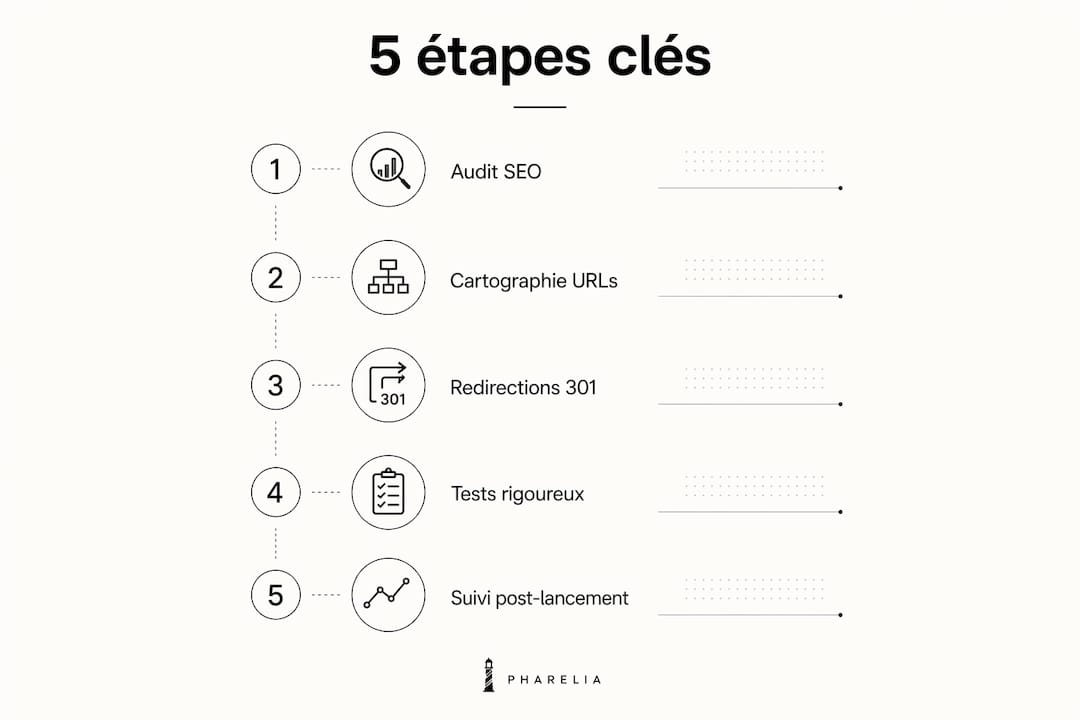
The [SEO audit](https://pharelia.com/en/resources/audit-seo-checklist) is the baseline snapshot without which you are navigating blind. It covers four dimensions: technical (crawl, indexing, Core Web Vitals), editorial (content quality, cannibalization, orphan pages), semantic (search intent coverage, topical linking) and backlinks (inbound link profile, anchors, toxicity). The aim is to identify the pages that must be preserved, those that need updating and those that can be safely deleted.
### 2. Map URLs and plan 301 redirects
The URL mapping must cover 100 % of old addresses. Each existing URL is matched to the closest new equivalent in intent and content. Google treats a redirect to the homepage as a soft 404, losing all its value. Redirects must be implemented at server level, not through a third-party module that could fail.
### 3. Optimize the technical and editorial structure
- Metadata: title tags, meta descriptions and H1 tags reviewed on every page.
- Internal linking: every new page must receive at least two inbound internal links as soon as it goes live; otherwise, it remains invisible to Google for weeks.
- Schema.org structured data: Organization, Service, FAQPage, BreadcrumbList in JSON-LD.
- Content: one distinct search intent per page, with definitions, lists and evidence of expertise.
### 4. Test rigorously before launch
A full crawl with Screaming Frog to check that every old URL is correctly redirected. No 4xx or 5xx errors. No redirect chains. Validate Core Web Vitals on the twenty most important pages, with thresholds of LCP below 2,5 s, INP below 200 ms and CLS below 0,1. Submit the XML sitemap to Google Search Console and Bing Webmaster Tools within 24 hours of launch.

### 5. Ensure daily post-launch monitoring
The first weeks after the switch are critical. Monitor 404 errors in Search Console, rankings for strategic keywords, organic traffic and Core Web Vitals daily. Every anomaly must be corrected within 48 hours to prevent it from becoming persistent.
## How can you incorporate generative AI and E-E-A-T criteria into your redesign?
In 2026, a website redesign that ignores generative engines leaves visibility on the table. Google's AI Overviews select sources capable of answering a question directly in a structured way. A site with vague or duplicated content is systematically excluded.
- **Structured, citable content**: clear definitions, lists, FAQs and tables make extraction by AI easier.
- **Stronger E-E-A-T**: experience, expertise, authority and trust are demonstrated through concrete evidence, identified authors and verifiable sources, not generic assertions.
- **One distinct intent per page**: catch-all pages are not cited. Every URL must answer a precise question.
- **robots.txt open to AI agents**: allow GPTBot, PerplexityBot, ClaudeBot and Google-Extended so generative engines can crawl your pages.
The ability to produce structured E-E-A-T content has become a major competitive differentiator, because generative AI relies on the same signals as Google to select its sources.
**Pro tip:** *Plan monthly monitoring of changes in AI Overviews. The formats Google extracts today (lists, definitions, FAQs) can evolve quickly. Continuously adapting your content is more effective than reworking everything after losing visibility.*
## How can you measure the impact of an SEO redesign after launch?
Post-redesign monitoring relies on three complementary tools: Google Search Console, Google Analytics 4 and a rank-tracking tool.
In Search Console, monitor crawl errors, impressions and clicks for your twenty main keywords daily. A decline in impressions without a decline in clicks often signals an indexing issue, not a content issue. In GA4, compare organic traffic week by week against the period before the redesign, segmenting by landing page to quickly identify URLs that are losing ground.
For rank tracking, export the rankings of strategic pages each week. A page that loses ten positions in seven days warrants an immediate check of its redirect, metadata and inbound internal links. Add monitoring of citations in generative AI to measure whether your redesign also improves your presence in ChatGPT and Perplexity answers, a surface that AI search optimization can monitor specifically.
## Loading speed and indexing: technical points you should not neglect
Core Web Vitals are essential because they directly affect mobile rankings and visitor abandonment rates. A slow site loses visitors before they have even read your offering, a factor Google takes into account. It is important to meet the recommended thresholds for these metrics to optimize site performance and rankings. These thresholds apply primarily to mobile, because Google uses mobile-first indexing. Test them on the twenty most important pages before launch, not after.
For indexing, check that robots.txt does not accidentally block entire directories, that the XML sitemap is submitted within 24 hours of the switch and that canonical tags point to the correct final URLs. A template error generating incorrect canonicals can deindex dozens of pages within a few days. Technical SEO deserves a dedicated checklist, checked point by point before and after launch.
## Mobile SEO after a redesign: what really changes
Google has prioritized indexing the mobile version of your site for several years. A redesign is an opportunity to correct accumulated mobile errors, but also to introduce new ones if testing is rushed.
Points to check systematically after launch:
- **Responsive design**: every page displays correctly on common screen sizes, without overflow or text that is too small.
- **Mobile speed**: mobile LCP is often worse than desktop LCP because of uncompressed images or blocking JavaScript.
- **Touch usability**: buttons and links sufficiently spaced to avoid accidental clicks, which Google measures through CLS and INP.
- **No hidden content**: all content hidden on mobile must remain indexable. Google does not assign less value to content displayed in an accordion, but it must be present in the HTML served to the bot.
For complementary retargeting and acquisition strategies after a redesign, the mobile experience also affects paid campaign performance, not just SEO.
## Pharelia supports your redesign without losing your rankings
An SEO-successful website redesign requires a level of rigor that few internal teams can maintain alongside their day-to-day work. Visibility audits, URL mapping, correction of technical obstacles, E-E-A-T content production, tracking Google rankings and AI citations: this is precisely what Pharelia operates for microbusinesses, SMEs and startups in France.
[](https://pharelia.com/en/contact)
Pharelia covers all three surfaces under one contract: Google search optimization, presence in generative engines (GEO) and optimization for answers (AEO). Every engagement starts with a [free visibility audit](https://pharelia.com/en) built on your site's crawl, SERP and AI mention data. If you are preparing a redesign, or have just completed one and your rankings have not returned, [contact us](/en/contact) to identify precisely what is blocking progress.
## Key points
A successful SEO redesign preserves existing ranking equity while creating the conditions for better visibility, provided migration is treated as a full SEO project from the design stage.
| Point | Details |
| --- | --- |
| Audit first | Map traffic, URLs, backlinks and keywords before changing anything. |
| Exhaustive 301 redirects | Cover 100 % of old URLs; a poorly prepared redesign causes a traffic loss of 30 to 60 % within a few weeks. |
| Core Web Vitals | Meet LCP < 2,5 s, INP < 200 ms, CLS < 0,1 for Google mobile rankings. |
| E-E-A-T and AI content | Structure every page around one distinct intent with citable definitions, lists and FAQs. |
| Pharelia | Free audit, technical fixes, content and tracking of Google rankings and AI citations. |
## Frequently asked questions
### Does a redesign always cause a loss of SEO rankings?
No, provided you prepare the migration as a full SEO project: a prior audit, exhaustive URL mapping, server-level 301 redirects and daily post-launch monitoring. A well-executed redesign often improves rankings rather than damaging them.
### How much does a website redesign cost for an SME in France?
The cost of a website redesign for an SME in France varies with the extent of the changes, from a modest budget for a partial redesign to a higher budget for a full redesign involving a technology change.
### What are the priority SEO strategies in 2026?
In 2026, the priorities are meeting Core Web Vitals thresholds, structuring content for AI Overviews (definitions, FAQs, lists), strengthening E-E-A-T signals and monitoring citations in generative engines such as ChatGPT and Perplexity.
### How can you preserve backlinks during a redesign?
Every old URL receiving inbound links must redirect to the closest new equivalent in content. Google treats a redirect to the homepage as a soft 404, causing the loss of all the SEO equity accumulated by those links.
### Should you use an SEO expert for a redesign?
Yes, unless your team has mastered technical auditing, URL mapping, server configuration and Search Console monitoring. A template error or misconfigured robots.txt can deindex dozens of pages within a few days, with recovery taking months.
## Recommendation
- [SEO boost for microbusinesses and SMEs: the 2026 guide | Pharelia](https://pharelia.com/en/resources/boost-seo-pour-tpe-et-pme-le-guide-2026)
- [GEO vs SEO in 2026: do you really have to choose? | Pharelia](https://pharelia.com/en/resources/geo-vs-seo)
- [ChatGPT search optimization in 2026: an operator's guide | Pharelia](https://pharelia.com/en/resources/referencement-chatgpt)
- [E-E-A-T beyond YMYL: what really matters in 2026 | Pharelia](https://pharelia.com/en/resources/eeat-hors-ymyl)