# Advanced Google search: practical 2026 guide
Discover how advanced Google search can optimize your results. Master operators and boost your visibility now.
Author: Louis Choquet · Founder, Pharelia
Published on 2026-07-10 · Updated on 2026-08-10
Source: https://pharelia.com/en/resources/recherche-avancee-google-guide-pratique-2026
## Introduction

> **In brief:** - Google's advanced search operators improve result precision by filtering the web according to specific criteria. In 2026, they remain essential for SEO audits, competitive intelligence and identifying opportunities. Combining traditional operators with AI agents offers a more reliable, efficient approach to optimizing online visibility.
Advanced Google search refers to all the search operators and filters that deliver targeted results by excluding the noise generated by a standard query. Google processes [8,5 billion queries](https://lejournaldumarketing.com/recherche-avancee-google/) a day in 2026. Yet 90 % of users are unaware of advanced features and miss out on a considerable gain in precision. For a business leader or marketing manager, mastering these techniques turns an ordinary search session into a real intelligence and SEO auditing tool. This guide covers essential operators, the graphical interface, AI-related developments, limitations to know and practical applications for your visibility.
## What are the main advanced Google search operators?
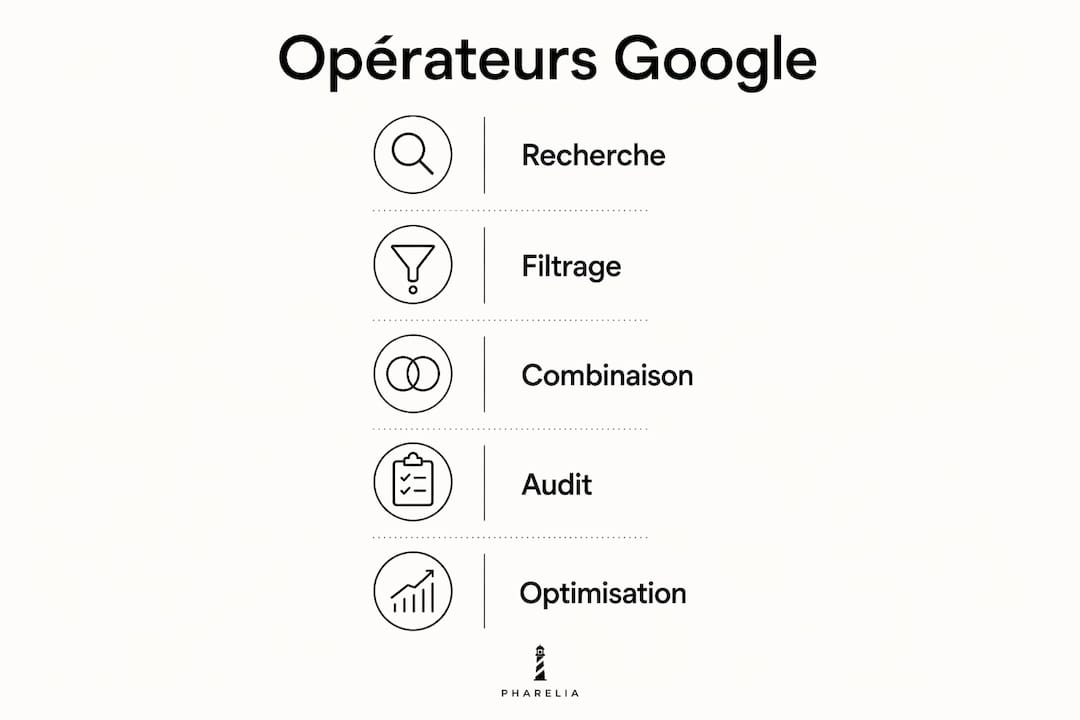
[Search operators](https://ahrefs.com/blog/fr/google-advanced-search-operators/) are text commands entered directly into the search bar to filter results precisely. In 2026, 27 operators work reliably out of the 44 theoretically documented. Marketing and intelligence professionals rely on this stable subset for audits and competitive analyses.
The most useful operators for everyday use:
- **`site:`** restricts results to a specific domain. Example: `site:monentreprise.fr` lists all your site's indexed pages.
- **`filetype:`** filters by file type. Example: `filetype:pdf rapport annuel secteur immobilier` retrieves PDF documents on the topic.
- **`intitle:`** searches for a word in a page's title tag. Example: `intitle:"stratégie SEO" PME` targets articles explicitly covering the topic.
- **`inurl:`** searches for a word in the URL. Example: `inurl:blog site:concurrent.fr` identifies a domain's blog section.
- **Quotation marks `" "` (exact search)** force Google to display only pages containing the phrase word for word. Example: `"audit de visibilité gratuit"` eliminates approximate results.
These operators can be freely combined. The query `site:mondomaine.fr intitle:"référencement local"` identifies pages on your site covering local search visibility in a few seconds, without manually browsing the hierarchy.
| Operator | Function | Professional use example |
| --- | --- | --- |
| `site:` | Limit to a domain | Audit indexed pages |
| `filetype:` | Filter by format | Find industry studies in PDF |
| `intitle:` | Word in the title | Identify competitors' articles |
| `inurl:` | Word in the URL | Analyze a site's structure |
| `" "` | Exact phrase | Check for specific content |

**Pro tip:** *Combine `site:` and `intitle:` to quickly audit duplicate content on your own domain. The query `site:votredomaine.fr intitle:"mot-clé cible"` reveals cannibalizing pages at a glance.*
## How do you use the advanced search graphical interface?
Google provides a [graphical interface](https://mundobytes.com/fr/Recherche-avanc%C3%A9e-sur-Google/) accessible through `google.com/advanced_search`. It visually translates the same operators without requiring you to memorize their syntax. This is the recommended starting point for teams new to advanced searches.
Filters available in this interface cover:
- **Language**: restrict results to French or any other language.
- **Region**: target results published in a specific country, useful for local intelligence in France.
- **Last update date**: limit results to the last 24 hours, the past week or the past year.
- **File type**: PDF, DOC, XLS, PPT and other formats.
- **Usage rights**: filter images or content under open licenses, essential for avoiding copyright infringement.
The difference between the graphical interface and entering operators directly is primarily one of speed. Experienced professionals prefer text-command operators because they allow complex queries to be built in seconds without navigating menus. The graphical interface remains useful for one-off queries or training less technical colleagues.
The graphical approach's main limitation is its rigidity: it does not allow several operators to be freely combined within one query. For structured competitive intelligence, mastering free-text operators remains essential.
## What AI-related developments are new in Google in 2026?
In 2026, Google integrated [AI agents and the Gemini 3.5 Flash model](https://blog.google/intl/fr-fr/nouveautes-produits/explorez-obtenez-des-reponses/google-io-2026-recherche/) to enrich the search experience. These agents enable conversational interaction: users ask a question in natural language, and Google synthesizes an answer from several indexed sources.
This development does not replace traditional operators. It complements them. How the two approaches coexist in practice:
- **Conversational search through AI**: ideal for exploring a new topic, obtaining a quick synthesis or rephrasing a complex question.
- **Traditional operators**: essential for precise tasks such as indexing audits, duplicate content detection or finding specific files.
- **AI agents for intelligence monitoring**: agents can continuously monitor topics and alert users to new publications, reducing time spent on repetitive searches.
> ‘Combining traditional operators with AI-powered natural-language search has become the expert standard in 2026. Professionals mastering both approaches obtain more reliable, faster results than those relying on a single method.’
For a marketing manager, combined use takes a concrete form: an AI agent monitors new publications in a given sector, while a `site:concurrent.fr intitle:"nouveau produit"` query periodically checks what a competitor has recently published. The two methods reinforce each other without replacing one another.
The productivity impact is direct. Intelligence monitoring that required several hours of manual search is reduced to an initial agent configuration and a few targeted queries. For small teams, this is a real gain in operational capacity. [ChatGPT search visibility](https://pharelia.com/en/resources/referencement-chatgpt) follows a similar logic: content well indexed by Google also feeds AI assistant answers.
## What are the limitations of advanced Google search?
Advanced search does not provide neutral, exhaustive access to the web. Google filters results according to its own algorithmic criteria and systematically displays sponsored ads at the top of the page. Even with the most precise operators, results remain subject to this filtering layer.
Other limitations to know:
- **Removed operators**: the `cache:` operator was permanently [removed in 2024](https://www.astuces-aide-informatique.info/9691/commandes-recherche-avancees-google). To consult an archived version of a page, the Wayback Machine (archive.org) is the reliable alternative.
- **Unstable operators**: some documented operators no longer produce consistent results. Regularly check their validity before incorporating them into an automated monitoring process.
- **Unindexed sources**: Google does not index the entire web. Content behind paywalls, private databases and some social networks remain out of reach.
- **Rights and licenses**: the graphical interface's ‘usage rights’ filter simplifies checking, but does not remove the need to verify rights directly at the source before any reuse.
**Pro tip:** *Keep a reference file listing your active operators with the date they were last checked. Google changes are not always announced, and an operator working in January can produce incorrect results in September.*
## How do you apply advanced search to your SEO and marketing strategy?
Advanced search is a direct auditing and benchmarking tool, with no intermediary. Professionals incorporating it into their routines gain precision on three fronts: analyzing their own visibility, monitoring competitors and identifying content opportunities.
Six practical applications, ranked by operational priority:
1. **Audit your site's indexing**: `site:votredomaine.fr` displays the number of pages indexed by Google. A substantial gap between this figure and the actual number of published pages signals an indexing problem to address first.
2. **Detect duplicate content**: `"phrase exacte tirée de votre contenu"` checks whether this text appears on other domains. It is the fastest way to spot plagiarism or unauthorized syndication.
3. **Analyze a competitor's indexed pages**: `site:concurrent.fr` gives an estimate of published content volume. Combined with `intitle:`, it reveals the priority themes of their editorial strategy.
4. **Find inbound link opportunities**: `intitle:"ressources" OR intitle:"liens utiles" secteur:votresecteur` identifies resource pages likely to host a link to your site.
5. **Find industry studies and data**: `filetype:pdf "étude de marché" secteur année` retrieves reference documents to support your content and strengthen its E-E-A-T credibility (Experience, Expertise, Authority, Trustworthiness).
6. **Monitor your brand mentions**: `"nom de votre entreprise" -site:votredomaine.fr` lists all pages citing your brand outside your own site, without including your own pages in the results.
These six queries cover the essentials of a first-level [SEO audit](https://pharelia.com/en/resources/audit-seo-checklist). They do not replace a complete technical crawl, but provide quick, actionable signals without any paid tool.
## Key takeaways
Mastering Google search operators, combined with the AI agents available in 2026, forms the foundation of reliable professional intelligence and a first-level SEO audit.
| Point | Details |
| --- | --- |
| Essential operators | `site:`, `filetype:`, `intitle:`, `inurl:` and quotation marks cover 90 % of professional needs. |
| Graphical interface | Accessible through `google.com/advanced_search`, useful for getting started but limited for complex queries. |
| AI complementarity | Gemini 3.5 Flash agents complement operators without replacing them, particularly for continuous monitoring. |
| Removed operators | `cache:` has been removed since 2024; regularly verify the validity of every operator used in production. |
| SEO applications | Indexing audits, duplicate detection, competitive analysis and inbound link research are the priority use cases. |
## What I observe after years of intelligence work with these tools
Most business leaders I meet use Google as a general-public search engine. They type a phrase, browse the first results and stop there. It is a methodological mistake that costs time and produces incomplete analyses.
What I have learned from working on dozens of visibility audits is that search operators are often more revealing than a paid analysis tool. A simple `site:votredomaine.fr` query compared with the actual number of published pages immediately shows whether Google indexes your content correctly. No dashboard replaces this direct check.
The arrival of Gemini 3.5 Flash and AI agents changes intelligence monitoring, not technical auditing. I see many professionals delegate all their research to these agents and neglect traditional operators. It is the mirror image of the first mistake. Agents synthesize well, but do not replace the precision of an `intitle:` query for detecting a duplicate or mapping a sector.
My practical recommendation: set aside 30 minutes each week for structured searches using operators. Build a file of sample queries for your sector, brand and competitors. Update it quarterly. This routine produces more reliable intelligence than any content aggregator subscription.
The future of advanced search lies in combining both approaches. Professionals mastering operators AND AI agents will have a structural advantage over those using only one method.
> *— Louis*
## Pharelia supports your visibility on Google and AI
[](https://pharelia.com/en/contact)
Mastering search operators is a skill. Turning it into lasting visibility on Google, ChatGPT and Perplexity is a profession. Pharelia supports French microbusinesses, SMEs and startups across these three surfaces under one contract: SEO, GEO and AEO. Every project starts with a free audit built on your site's real crawl and SERP data. The [results achieved for Applewood](https://pharelia.com/en/client-work/applewood) (+300 % SEO, +500 % AI citations) illustrate what a coherent visibility strategy produces. To see what such a system can bring to your business, [consult Pharelia](https://pharelia.com/en).
## Frequently asked questions
### What is a Google search operator?
A search operator is a text command entered into the Google bar to filter results precisely. Common examples: `site:`, `filetype:`, `intitle:` and quotation marks for an exact phrase.
### How do you access Google's advanced search interface?
The graphical interface is available at `google.com/advanced_search`. It lets you configure language, region, date and file-type filters without memorizing operators.
### Does the `cache:` operator still work in 2026?
No. Google permanently removed `cache:` in 2024. To consult an archived version of a page, the Wayback Machine (archive.org) is the available alternative.
### Do Google's AI agents replace traditional operators?
No. Gemini AI agents complement operators: they excel at conversational synthesis, but operators remain essential for auditing and precise detection tasks.
### How do you use advanced search for a quick SEO audit?
The `site:votredomaine.fr` query reveals the number of pages indexed by Google. Combined with `intitle:` and quotation marks, it allows you to detect duplicate content and analyze your site's topical coverage within a few minutes.
## Recommendation
- [ChatGPT search visibility in 2026: an operator's guide | Pharelia](https://pharelia.com/en/resources/referencement-chatgpt)
- Local SEO & AI agency for tradespeople and neighborhood services — Pharelia
- [Pharelia · Measurable SEO and AI visibility](https://pharelia.com/en)
- SEO & AI visibility for real estate — Pharelia