# Real estate digital marketing: the 2026 guide for agents
Discover how real estate digital marketing boosts your visibility. Learn to use essential digital levers to attract...
Author: Louis Choquet · Founder, Pharelia
Published on 2026-07-17 · Updated on 2026-07-17
Source: https://pharelia.com/en/resources/marketing-digital-immobilier-guide-2026-pour-agents
## Introduction

> **In brief:** - Real estate digital marketing enables agents to attract qualified prospects and improve local visibility. Mastering local search, Google Business listings and sector-specific content is essential for attracting contacts without a large advertising budget. Combining a strong online presence with field prospecting strengthens awareness and business success.
Real estate digital marketing refers to all digital techniques enabling agents and agencies to attract qualified prospects, strengthen local awareness and convert visitors into listing agreements. The number of real estate agents in France has [increased by 50 %](https://business-immodvisor.com) since 2021. This increasingly crowded market makes a structured digital strategy essential, no longer optional. The main levers are local organic search (local SEO), Google Business Profile, social media and online advertising. Mastering these channels means ensuring visibility at the precise moment a property owner is looking for a trusted professional in their area.
## How real estate digital marketing improves your local visibility
Local search is the first lever to activate. Around [40 % of potential real estate traffic](https://www.billie.immo/blog/referencement-immobilier-comment-construire-une-presence-locale-durable-et-devenir-incontournable-en-2026) comes from Google, heavily concentrated on the top three local pack results. Being absent from this pack means giving those contacts to a competitor.
### Optimize your Google Business Profile listing
Google Business Profile (formerly Google My Business) is the business listing appearing in local results and on Google Maps. A complete, regularly updated listing can [generate over 30 % more clicks](https://www.maformationimmo.fr/itw-marketing-digital-immobilier-2026/) than an incomplete one. Yet most agents leave this listing only half completed.
Elements to prioritize:
- **Recent photos**: agency interior, team, representative properties. Google favors listings with updated visuals.
- **Accurate opening hours**: an error in opening hours creates distrust and penalizes rankings.
- **Primary category**: choose ‘Real estate agency’ and add relevant secondary categories.
- **Customer reviews**: respond to every review, positive or negative. Social proof through reviews builds trust before the first contact.
- **Regular posts**: share local market news, recently sold properties and testimonials.
**Pro tip:** *Systematically ask every satisfied client for a Google review, ideally within 48 hours of signing. A personalized message with the direct link to your listing doubles the response rate.*
### Create area pages on your site
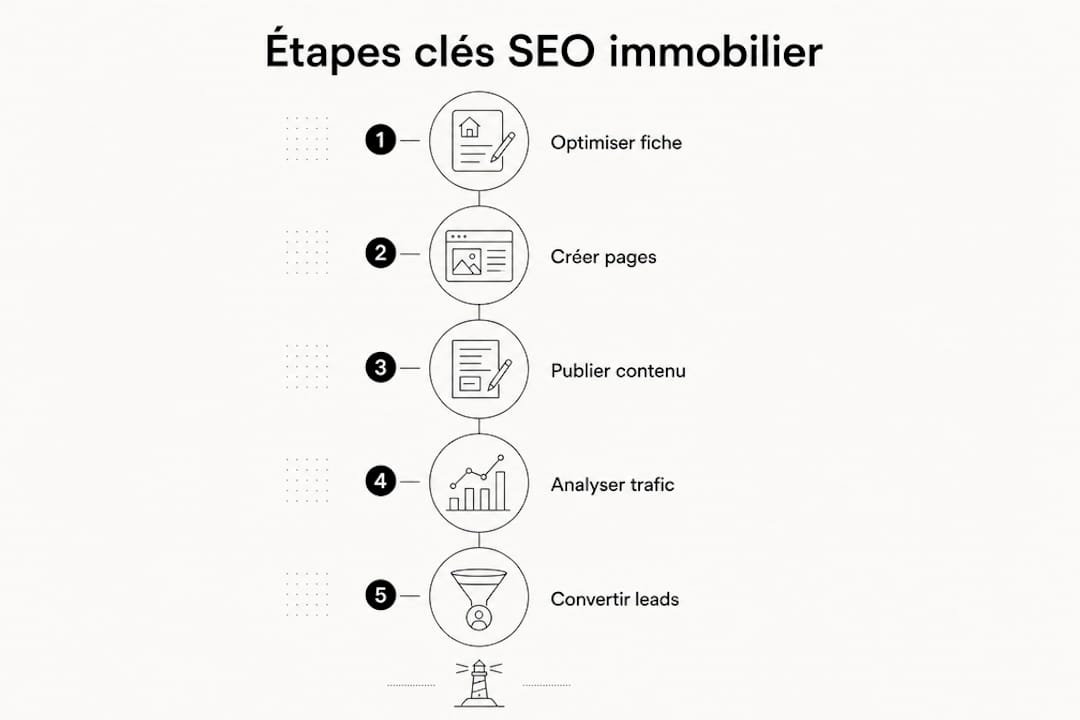
Local SEO rests on a human, personal presence, with a dedicated site highlighting local expertise rather than the national brand. An area page is a web page dedicated to a specific neighborhood or municipality: it describes the market, prices per square meter, recent trends and your activity in that area. Google values these pages because they answer very precise geolocated queries. A dedicated local SEO site also avoids diluting your credibility within a national network.
## Which digital channels should you prioritize for your audience?
The basic rule is simple: it is better to excel on one or two channels suited to your audience than to be mediocre on all of them. Spreading efforts too thin dilutes the message and exhausts resources without measurable results.
How to choose according to your specialization:
1. **Mainstream residential property**: Instagram and Facebook remain the most effective platforms. Individual buyers and sellers spend time there, visual formats showcase properties, and geographic targeting options are precise.
2. **Investment real estate and B2B**: LinkedIn targets investors, business owners and decision-makers. An article on rental yields in your area generates far more qualified contacts there than an Instagram post.
3. **Organic search vs paid advertising**: real estate SEO builds lasting visibility without a cost per click. Online advertising (Google Ads, Social Ads) generates immediate traffic but stops once the budget runs out. The two complement each other, but SEO should be established first.
4. **Short video formats**: videos from 30 seconds to 2 minutes humanize the brand and significantly increase engagement without requiring expensive production. A quick property tour or market commentary filmed from your office is enough.
**Pro tip:** *Before launching a paid advertising campaign, check that your landing page converts. An ad sending users to a poorly built page burns budget without generating contacts.*
## How do you create credible, engaging local content?
[DIGITAL MARKETING: THE ULTIMATE GUIDE TO ATTRACTING AND WINNING NEW CUSTOMERS](https://www.youtube.com/watch?v=7q7depQBIqA)
Local content drives organic search and trust. An agent regularly publishing market analyses of their neighborhood becomes the reference Google and prospects cite first.

### Content formats that work
Detailed area pages with prices per square meter, transaction volumes and recent trends answer the most qualified queries. A monthly blog article on local market changes generates organic traffic over the long term. Customer testimonials integrated into these pages strengthen SEO and credibility simultaneously.
Content types to produce first:
- **Local market analyses**: median prices, selling times, supply/demand ratio by neighborhood.
- **Practical guides**: ‘How to sell a property online in Lyon's 9th arrondissement’ targets a precise, qualified query.
- **Video testimonials**: a customer explaining in 60 seconds why they chose you is worth ten written reviews.
- **Regulatory news**: DPE energy performance assessments, the Alur law, rent controls. Commenting on these topics positions the agent as a trusted expert.
| Content type | Main objective | Recommended frequency |
| --- | --- | --- |
| Area page | Targeted local search visibility | Create once, update quarterly |
| Market blog article | Organic traffic and authority | At least once a month |
| Customer testimonial | Social proof and conversion | For every completed transaction |
| Short video | Engagement and human connection | Once or twice a week |
The relationship between content, SEO and organic traffic generation is direct: every well-written page is another entry point to your site. Successful professionals abandon one-off actions and adopt a structured method with a regular editorial calendar.
## How do you turn visitors into qualified prospects?
Attracting traffic is not enough. Conversion, meaning turning an anonymous visitor into an identified contact, requires a precise architecture on your site and in your tools.
1. **A clear landing page**: one value proposition per page, a short form (first name, phone number, project type), and a call to action visible without scrolling.
2. **A relevant lead magnet**: a PDF guide ‘Valuing your property in [ville] in 2026’ or a free agency fee simulation in exchange for an email address. This type of tool captures contacts while they are considering their options, before they contact a competitor.
3. **A CRM (customer relationship management software) for follow-ups**: a real estate prospect needs 5 to 8 touchpoints before making a decision. Without an automated follow-up sequence, most of these contacts disappear. A CRM sends personalized emails at D+2, D+7 and D+14 without manual intervention.
4. **Tracking key indicators**: form conversion rate, cost per contact, follow-up email open rate. These metrics help identify what works and stop what does not.
**Pro tip:** *Never ask for more than three pieces of information in an initial contact form. Each additional field reduces completion rate. Collect the rest during the first call.*
## Digital marketing and field prospecting: a combined strategy
Digital marketing does not replace field prospecting. The best-performing agents combine the two in an omnichannel approach, where each action reinforces the other.
How to connect the two approaches:
- **A flyer with a QR code**: a leaflet distributed in a residential building points to a dedicated area page. The prospect scanning the code lands on a page discussing their neighborhood, its prices and your local expertise.
- **The agency window as a digital touchpoint**: a screen displaying your Google reviews and latest sales reassures passersby and reinforces consistency between physical presence and online reputation.
- **The CRM as a connecting thread**: every field contact (a hallway greeting, handing over a business card, an inbound call) goes into the CRM. Digital marketing takes over with automated follow-ups.
- **Local awareness built through digital marketing**: an agent regularly visible on local social media is recognized in the street. This recognition makes securing a listing agreement easier during an in-person encounter.
Major national portals cannot reproduce the close relationship embodied only by a local agency. This is precisely the stronghold that local search and field presence help defend and expand.
## Key takeaways
Real estate digital marketing rests on three inseparable pillars: an optimized local Google presence, regular content demonstrating expertise, and a structured conversion system turning visitors into listing agreements.
| Point | Details |
| --- | --- |
| Google Business Profile | A complete listing generates over 30 % more clicks and remains the most underused local lever. |
| Channel selection | Focus on one or two channels suited to your audience rather than spreading efforts across every platform. |
| Regular local content | Area pages and monthly market articles build SEO authority and prospects' trust over the long term. |
| Conversion system | A lead magnet, a clear landing page and an automated CRM are needed to capture the 5 to 8 contacts a prospect requires before deciding. |
| Omnichannel strategy | Combining field prospecting and digital presence multiplies each action's impact and strengthens local awareness. |
## What I observe in practice in 2026
Many agents tell me they ‘do digital’ because they post on Instagram twice a week. That is not a strategy. It is a presence. The difference between the two is measured in listing agreements.
What I see among professionals making real progress is simple: they established a solid technical foundation before spending a euro on advertising. A well-indexed site, a complete Google listing, carefully written area pages. This foundation generates qualified traffic without recurring cost. Paid advertising comes next, as an accelerator, not a substitute.
The other common mistake is treating content as a secondary task. A well-written local market article can generate contacts for two years. A Facebook ad stops the day after its budget ends. The [return on investment of SEO content](https://pharelia.com/en/resources/moteur-de-contenu-cadence) extends over time, whereas paid advertising shortens it.
What I anticipate in the coming months: agents who have invested in Google visibility and generative engines (ChatGPT, Perplexity) will be cited first when a property owner asks an AI ‘who is the best real estate agent in [ville]?’ This channel still has little competition in real estate. It is an opportunity to gain a head start now.
> *— Louis*
## Pharelia supports your digital visibility in real estate
[](https://pharelia.com/en/contact)
Pharelia is an online visibility agency specializing in SEO, search visibility in generative engines (GEO) and optimization for AI answers (AEO). For real estate professionals, this means a correctly indexed site, area pages appearing higher on Google, and a presence in ChatGPT or Perplexity answers when a property owner seeks an agent in their area. Every project starts with a free visibility audit. Resources on SEO content and technical SEO are freely available to explore each lever in more depth.
## Frequently asked questions
### What is real estate digital marketing?
Real estate digital marketing refers to all digital techniques used by agents and agencies to attract prospects, strengthen local awareness and convert visitors into listing agreements. The main levers are local SEO, Google Business Profile, social media and online advertising.
### Where should you start to improve local visibility?
The priority is to complete and activate your Google Business Profile listing, then create area pages on your site. These two actions generate qualified traffic without an advertising budget and form the foundation of any effective local search strategy.
### Do you need to be on every social network?
No. It is better to excel on one or two channels suited to your audience. Instagram and Facebook suit mainstream residential property; LinkedIn targets investors and decision-makers. Quality and consistency matter more than the number of platforms.
### How many contacts are needed before a prospect takes action?
A real estate prospect needs an average of 5 to 8 touchpoints before making a decision. A CRM with automated follow-up sequences is essential to maintain this contact without constant manual effort.
### Is real estate SEO accessible when competing with major portals?
Yes, in the local segment. Major national portals cannot reproduce a local agency's close relationships. Local search, supported by area pages and a complete Google listing, remains a field where the local expert can dominate geolocated search results.
## Recommendation
- [SaaS digital marketing: strategy and levers in 2026 | Pharelia](https://pharelia.com/en/resources/marketing-digital-saas-strategie-et-leviers-en-2026)
- [Digital advertising agency: guide for business leaders | Pharelia](https://pharelia.com/en/resources/agence-de-publicite-digitale-guide-pour-dirigeants)
- [ChatGPT search visibility in 2026: an operator's guide | Pharelia](https://pharelia.com/en/resources/referencement-chatgpt)
- [Advanced Google search: practical 2026 guide | Pharelia](https://pharelia.com/en/resources/recherche-avancee-google-guide-pratique-2026)