# SEO internal linking: an expert guide for SMEs in 2026
Discover how to optimize internal linking to improve your SEO in 2026. Increase your website's visibility and authority effectively.
Author: Louis Choquet · Founder, Pharelia
Published on 2026-07-23 · Updated on 2026-07-23
Source: https://pharelia.com/en/resources/maillage-interne
## Introduction

Internal linking refers to all the hyperlinks connecting pages within the same website. It is the most underestimated SEO lever: it distributes PageRank between your pages, guides Googlebot to your priority content and structures your website's topic hierarchy. Unlike backlinks, you have complete control over it. In 2026, the three architectures dominating results are topic silos, semantic cocoons and topic clusters.
What internal linking achieves in practice:
- **Authority distribution**: each internal link transfers part of the PageRank accumulated by the source page to the destination page.
- **Discovery and indexing**: Googlebot follows internal links to find new pages; a page with no inbound link (an orphan page) has very little chance of being indexed.
- **Semantic understanding**: anchor text (the clickable phrase) tells Google the linked page's subject, reinforcing its topical relevance.
- **Difference from external link building**: backlinks come from third-party websites and are partly outside your control; internal links are entirely manageable.
## What are the fundamentals of good internal linking?
A strong internal link network rests on four non-negotiable rules.
- **Descriptive, varied anchors**: avoid "click here" or "learn more". A balanced distribution of exact-match anchors, close variations and natural anchors limits the risk of over-optimization while covering a broad semantic range.
- **Click depth limited to 3**: every strategic page should be reachable within three clicks of the homepage. Beyond 4 clicks, Google's crawl frequency drops by 40%, harming indexing and rankings.
- **No orphan pages**: every published page should receive at least 2 to 3 internal links from topically related pages as soon as it goes live.
- **A controlled number of links per page**: [beyond 100 links](https://www.webrankinfo.com/dossiers/conseils/nombre-maximum-liens-par-page) on the same page, the PageRank passed to each destination becomes negligible. For a standard article, aim for 5 to 15 contextual links outside the navigation.
## Internal linking and external link building: what actually differs?
The two approaches complement each other, but their underlying logic differs fundamentally.
Internal linking exclusively concerns links between pages on the same domain. You decide which pages to connect, with which anchor text and in which editorial context. It is continuous, free and entirely controllable work. Its primary role is to redistribute authority already present on the website toward the pages you consider priorities.
External link building concerns links from other domains. These backlinks bring in new authority from outside, but acquiring them depends on third parties and requires significant resources. A website that accumulates backlinks without structured internal linking lets much of that authority go to low-priority pages.
The winning combination: quality backlinks to build overall domain authority, and precise internal linking to redistribute it toward the pages that need to rank.
## Why does well-structured internal linking improve SEO?
The benefits are measurable and cover three dimensions: search visibility, navigation and conversion.
- **Rankings**: pages receiving 5 topically relevant internal links gain an average of 2.3 positions on Google.
- **Indexing**: regular internal linking audits can increase organic traffic by 30 to 60% in 3 months.
- **Navigation**: reducing page depth decreases the number of clicks needed to reach content, improving the experience and reducing the bounce rate.
- **Conversion**: directing links from high-traffic content toward your service or sales pages creates a natural path to purchasing or making contact.
- **AI understanding**: in 2026, Google AI Overviews, Perplexity and other generative search engines use link structure to build a semantic representation of the website. Consistent internal linking therefore also improves visibility in AI answers.
## How can you optimize your internal link network in practice?
Here are the techniques that produce measurable results without unnecessary complexity.
- **Internal Anchor Text Gap**: analyze the anchors already used to link to a target page, then diversify the anchor text to cover previously unused semantic variations. Each new anchor helps Google associate the page with new keywords.
- **Prioritize contextual links**: a link within a paragraph's body passes more value than a footer or menu link. Google gives more weight to editorial links naturally placed in the content.
- **The first anchor matters**: when several links point to the same page from the same article, Google takes [only the first anchor](https://audreytips.com/maillage-inter-contenus/) into account. Optimize it first.
- **Systematic updates**: every newly published piece of content should contain 3 to 5 links to existing articles, and 2 to 3 older articles should be updated to link to the new one.
- **A balanced link-to-word ratio**: for 2,000 words, aim for 5 to 10 contextual links, or roughly one link for every 200 to 400 words.
**Practical tip:** *combine vertical links (from parent pages to child pages and back) with horizontal links (between pages at the same level). The former concentrate authority on pillar pages; the latter strengthen topical coverage and make it easier to navigate between related content.*

## Silos, semantic cocoons or topic clusters: which architecture should you choose?
[](https://www.youtube.com/watch?v=f4G2xgYyJws)
Three structures have proved effective, each suited to a different context.
**The topic silo** organizes the website into separate categories. Links stay within each silo; connections between silos go only through the main pages. This approach suits e-commerce websites or portals with clearly distinct subject areas.
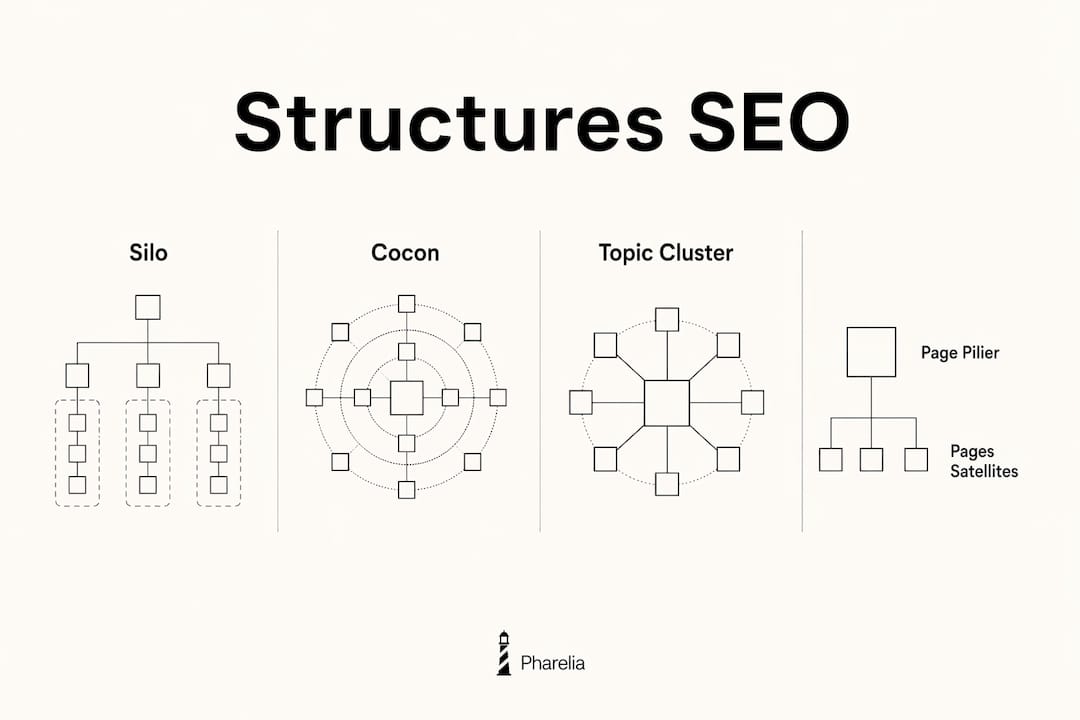
**The semantic cocoon**, popularized by Laurent Bourrelly, goes further by structuring content around search intent rather than categories. Each parent page links to its child pages, and each child page links to its parent and siblings. This vertical and horizontal linking optimizes the semantic hierarchy and maximizes PageRank transfer. It is the structure Pharelia most often recommends for blogs and B2B content websites. You will find a detailed construction guide in our resource on the [semantic cocoon](https://pharelia.com/en/resources/cocon-semantique).
**The topic cluster** consists of a comprehensive pillar page surrounded by supporting pages that explore each subtopic in depth. All supporting pages link to the pillar, and the pillar links to each supporting page. Suited to SaaS content strategies and B2B blogs, it helps demonstrate complete coverage of a subject to Google.
## Which tools can audit your existing internal linking?
A serious audit starts with a complete website crawl. Screaming Frog remains the technical standard: it identifies orphan pages, broken links (404 errors), each URL's depth and the number of inbound internal links per page. Google Search Console complements this overview by reporting unindexed pages and crawl errors. To visualize internal authority distribution, a link analysis tool such as Ahrefs helps identify which pages have the most links and which lack them.
The recommended frequency: a complete audit every three months, with a monthly broken-link check if the website publishes regularly. Our [SEO audit checklist](https://pharelia.com/en/resources/audit-seo-checklist) explains each step of this process.
## How do you fix common errors in your link network?
Three problems consistently recur on audited websites.
**Broken links (404 errors)** are a direct loss of PageRank: Googlebot reaches a dead end and authority does not transfer. The fix is simple: update the destination URL or add a 301 redirect to the most relevant replacement page.
**Orphan pages** account for 15 to 25% of pages on most audited websites. For each identified orphan page, add at least 2 to 3 internal links from topically related, well-indexed pages.
**Excessive depth** harms pages buried 5 or more clicks from the homepage. There are two solutions: restructure navigation to shorten the path, or add contextual links from higher-level pages to these deep pages. Breadcrumbs also help reduce the depth perceived by Google while improving navigation.
## Concrete examples for French SMEs
A 60-page B2B website (5 service pages, 40 blog articles, 15 case studies) with almost no internal links can structure its content into three silos corresponding to its three main services. Each service page links to 3 to 5 topically related blog articles and 2 to 3 relevant case studies. Articles link to one another within the same silo and back to the pillar service page. After three months in one documented case, the result was a 45% increase in indexed pages, a 30% increase in page views per session and an average gain of 15 positions on the service pages' target keywords.

Pharelia applied a similar approach for [Applewood](https://pharelia.com/en/client-work/applewood), achieving +300% growth in SEO visibility and +500% in citations by generative search engines. The strategy combined an internal linking overhaul, the creation of a semantic cocoon and the correction of technical indexing obstacles.
## How should you adapt internal linking for mobile and changes at Google?
Since Google adopted mobile-first indexing, the mobile version of the website is the version Googlebot primarily crawls. An internal link present only on desktop is therefore not guaranteed to be followed. Check that contextual links display correctly on mobile and that navigation menus do not hide strategic links behind JavaScript interactions inaccessible to crawlers.
Google's algorithms are moving toward a more precise semantic understanding. Internal link structures aligned with search intent, rather than arbitrary categories, are becoming more important. In 2026, generative search engines such as Perplexity and Google AI Overviews use link structure to build their representation of a website: topically coherent internal linking therefore also increases the likelihood of being cited in AI search answers. For SMEs that publish regularly, a scheduled content strategy combined with systematic internal linking updates produces cumulative effects over time, as our resource on content campaigns and their relationship with SEO explains.
## Key points
Well-structured internal linking is the SEO lever offering the best return on investment: no external cost, measurable results within a few weeks and a direct impact on Google rankings and AI citations.
| Point | Details |
| --- | --- |
| Choosing an architecture | Silo, semantic cocoon or topic cluster, depending on the website's size and nature. |
| Maximum depth | No strategic page should be more than 3 clicks from the homepage. |
| Varied anchors | Distribute anchors as follows: 30% exact match, 40% variations and 30% natural to avoid over-optimization. |
| Quarterly audit | Fix broken links and orphan pages every 3 months to maintain effective internal linking. |
| AI impact | Topically coherent internal linking improves visibility in generative search engine answers. |
## Frequently asked questions
### What is internal linking in SEO?
Internal linking refers to all the hyperlinks connecting pages within the same website. It distributes PageRank, guides Googlebot and structures the website's topic hierarchy.
### What is an internal link?
An internal link is a hyperlink pointing from one page to another on the same domain. It differs from a backlink, which comes from an external website.
### How many internal links should a page have?
For a standard article, aim for 5 to 15 contextual links outside the navigation. Beyond 100 links on the same page, the PageRank passed to each destination becomes negligible.
### What is the best internal linking structure for an SME?
The semantic cocoon remains the most effective structure for B2B content websites: it organizes pages by search intent with vertical and horizontal links, maximizing PageRank transfer to priority pages.
### How often should you audit internal linking?
A complete audit every three months is recommended, with a monthly broken-link check for websites publishing more than ten articles per month.
## Recommendation
- [Boosting SEO for microbusinesses and SMEs: the 2026 guide | Pharelia](https://pharelia.com/en/resources/boost-seo-pour-tpe-et-pme-le-guide-2026)
- [SEO agencies: a practical guide for microbusinesses and SMEs | Pharelia](https://pharelia.com/en/resources/agence-seo-guide-pratique-pour-tpe-et-pme)
- [Generating qualified leads: a guide for microbusinesses and SMEs | Pharelia](https://pharelia.com/en/resources/generer-des-leads-qualifies-guide-pour-tpe-et-pme)
- [PrestaShop SEO agencies: a guide for microbusinesses and SMEs | Pharelia](https://pharelia.com/en/resources/agence-seo-prestashop-le-guide-pour-tpe-et-pme)