# GEO vs SEO in 2026: do you really have to choose?
GEO SEO, AEO, AI Overviews: Google settles the question in 2026. What changes for your visibility, the actual figures, and decisions to make now.
Author: Louis Choquet · Founder, Pharelia
Published on 2026-07-04 · Updated on 2026-10-04
Source: https://pharelia.com/en/resources/geo-vs-seo
## The essentials in 60 seconds
GEO and SEO are not opposed: Google's official AI guide (May 2026) is explicit that optimizing for generative AI amounts to SEO. GEO SEO means structuring clear, sourced content with figures to rank on Google and be cited by ChatGPT or Perplexity. No separate channel, no magic llms.txt: one foundation, a few extra adjustments.
“GEO or SEO, which should we choose?” A B2B client asked us almost exactly this question in June, a few days after Google confirmed the arrival of AI Overviews in France. The answer is in this article: attributed figures, what we observe in production and the concrete decisions needed to track both surfaces.
## GEO vs SEO: two disciplines or one?
One, with different emphases. [Google's AI guide published on 15 May 2026](https://developers.google.com/search/docs/fundamentals/ai-optimization-guide) states it directly: “optimizing for generative AI means optimizing for search”. SEO covers indexing and rankings; GEO and AEO add citability by AI search engines. The same technical foundation, the same quality signals.
Search Engine Journal summarizes the official position in a headline: [AEO and GEO are still SEO](https://www.searchenginejournal.com/googles-new-ai-search-guide-calls-aeo-and-geo-still-seo/575026/). In practice, content answering a precise question with sources and quantitative data meets both sets of requirements. The marketing division between “SEO” and “GEO” sells services, not results.
GEO SEO: two emphases, one technical foundation. Details in our note [GEO and AEO: the essentials](/en/resources/geo-aeo-essentiel).
| Dimension | Traditional SEO | GEO / AEO |
| --- | --- | --- |
| Goal | Rank the page in the SERP | Be cited in the AI answer |
| Dominant signal | Relevance + authority + links | Factual clarity + sources + structure |
| Winning format | Complete, well-linked page | Self-contained paragraph with figures |
| Measurement | Position, clicks, impressions (GSC) | Citation position, AI share of voice |
| Common foundation | Clean indexing, E-E-A-T, useful structured data | Clean indexing, E-E-A-T, useful structured data |
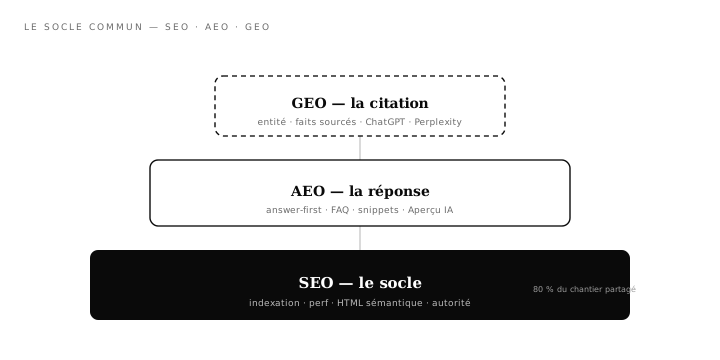
SEO, AEO, and GEO share the same technical foundation — 80 % of the work is common.
## llms.txt and content chunking: what Google really ignores
Google Search does not use llms.txt — neither as a ranking aid nor as a penalty. The AI guide's mythbusting section is categorical: no content chunking requirement, no need to write specifically for AI, and structured data is not required for generative AI (it remains useful for traditional rich results). Our observations confirm this: no measured effect on Google.
An honest qualification: an llms.txt file may serve other crawlers that use it, but there is no evidence of an effect on Google. Time spent generating it is better invested in paragraph clarity and data freshness. This is the logic of our [SEO audit checklist](/en/resources/audit-seo-checklist): fix what blocks progress, ignore rituals without impact.
- Google Search does not use llms.txt: neither a benefit nor a penalty.
- No requirement for content chunking or writing “for AI”.
- Structured data is not required for generative AI, but is useful for rich results.
- Factual clarity and sources remain the priority, not ritual files.
## AI Overviews in France: what should you track since the launch?
Google announced the [launch of AI Overviews and AI Mode in France on July 22, 2026](https://blog.google/intl/fr-fr/nouveautes-produits/explorez-obtenez-des-reponses/recherche-ia-apercus-mode/). AI Overviews appears when Google considers a generated answer useful for the query; it does not replace all conventional results.
What we are preparing now on our accounts: self-contained paragraphs at the top of pages, inline source citations, and tracking of informational queries where AI Overviews will appear. We document this shift in detail in our note on [Google AI Overviews in France](/en/resources/apercu-ia-google-france).
- **23 sept. 2026** : Deadline for AI Overviews + AI Mode rollout in France (Abondance / Ouest-France (2026))
- **450** : Publishers covered by the remuneration agreement (neighboring rights) (Abondance / Ouest-France (2026))
- **−15 à −30 %** : CTR decline on informational queries where AIO is deployed (Ahrefs (2026))
- **≈ 69 %** : Share of zero-click queries (Ahrefs (2026))
## Is AI traffic worthwhile if clicks are falling?
Yes, despite falling clicks. Ahrefs measures a CTR decline of 15 to 30 % on informational queries where AI Overviews appear, and around 69 % zero-click queries. But AI search traffic converts at ~14,2 %, compared with ~2,8 % for organic traffic (Seer Interactive). Less volume, much stronger intent.
Concentration also matters: ChatGPT represents ~87 % of AI referral traffic (Conductor 2026), while Perplexity ranks 3rd (~7,7 %, Statcounter May 2026). Being cited by ChatGPT therefore carries more weight than covering ten engines. Figures detailed in [Ahrefs — AI Overviews reduce clicks](https://ahrefs.com/blog/ai-overviews-reduce-clicks/).
### Share of AI Overview citations from Google's top 10
AI Overviews rely less and less on organic rankings: ~76 % of citations came from the top 10 in mid-2025, ~38 % in early 2026.
| Period | AIO citations from Google's top 10 (%) |
| --- | --- |
| Mid-2025 | 76 |
| Early 2026 | 38 |
Source: Higoodie — AI Search Traffic Report (2026)
## Why ranking 1st on Google is no longer enough to be cited
Because AI citations overlap only weakly with SERPs. According to Ahrefs (15 000 queries), ~80 % of LLM citations do not appear in Google's top 100. Higoodie measures ~12 % overlap between ChatGPT citations and Google SERPs, and only ~11 % of domains cited by both ChatGPT and Perplexity. Organic ranking and citability are two distinct races.
Practical consequence: Reddit, disproportionately cited by LLMs because its text is fully retrievable, becomes a GEO distribution channel. We test expert answers in relevant threads, not spam. To decide between the three disciplines, we often refer to the [AEO vs SEO vs GEO comparison](/en/resources/aeo-vs-seo-vs-geo).
- **≈ 80 %** : LLM citations do not rank in Google's top 100 (Ahrefs — 15 000 queries (2026))
- **≈ 12 %** : Overlap between ChatGPT citations and Google SERPs (Higoodie (2026))
- **≈ 11 %** : Domains cited by both ChatGPT and Perplexity (Higoodie (2026))
### Let's talk about your visibility
Let's discuss your site and priorities.
[Let's talk about your project](https://pharelia.com/en/contact)
## AI content and quality: does Google really penalize it?
No, Google does not penalize AI as a method. Danny Sullivan repeated it: “we judge quality, not the production method”. The Quality Rater Guidelines (September 2025 version, ~182 pages, ~16 000 raters) target three spam categories — Expired Domain Abuse, Site Reputation Abuse, Scaled Content Abuse — and low-value mass content receives the lowest rating.
The recent schedule confirms the pressure: the [May 2026 core update ended on 2 June](https://searchengineland.com/google-may-2026-core-update-rollout-is-now-complete-479119), followed by the [June 2026 spam update launched on 24 June](https://searchengineland.com/google-releases-june-2026-spam-update-481002), globally and across all languages. Our production rule: human writing, factual verification, sources. AI assists; it does not sign off. This is the E-E-A-T foundation detailed by [Google on helpful content](https://developers.google.com/search/docs/fundamentals/creating-helpful-content).
- Expired Domain Abuse: reusing an expired domain for its residual authority.
- Site Reputation Abuse: hosting parasitic third-party content under a reputable domain.
- Scaled Content Abuse: mass-producing low-value pages, regardless of method.
- Low effort / low originality: the lowest quality rating, AI or not.
## How can you measure without being misled by GSC and GA4?
Search Console provides a [generative AI performance report](https://support.google.com/webmasters/answer/16984139?hl=en) for AI Overviews and AI Mode impressions. Google reports a global rollout as of August 31, 2026, with access limitations depending on the property and impression volume. This data is also included in the Web report: do not add it to that report's total. In GA4, check the [AI Assistant channel and source/medium data](https://support.google.com/analytics/answer/9756891?hl=en) for identifiable sessions. Traffic with no identifiable source may appear as [Direct](https://support.google.com/analytics/answer/15258820?hl=en) — a custom channel group does not reconstruct a lost source. Do not therefore reattribute all Direct traffic to AI. Compare observed citations, sessions and conversions separately; a change in impressions is not enough to conclude success or decline.
What we set up: manual segmentation of AI sources in GA4, citation position tracking in ChatGPT and Perplexity across a query panel, and cautious interpretation of GSC impressions. AI Mode is also expanding into new languages and regions, as documented on the [Google blog](https://blog.google/products-and-platforms/products/search/ai-mode-expands-languages-locations/) — another reason to instrument early.
- [Official AI optimization guide — Google Search Central](https://developers.google.com/search/docs/fundamentals/ai-optimization-guide)
- [AEO and GEO still SEO — Search Engine Journal](https://www.searchenginejournal.com/googles-new-ai-search-guide-calls-aeo-and-geo-still-seo/575026/)
- [AI Overviews in France, summer 2026 — Abondance](https://www.abondance.com/20260630-2528492-google-ai-overviews-arrivee-france-ete.html)
- [AI Overviews reduce clicks — Ahrefs](https://ahrefs.com/blog/ai-overviews-reduce-clicks/)
- [AI Search Traffic Report 2026 — Higoodie](https://higoodie.com/blog/ai-search-traffic-report-2026/)
- [Creating helpful content (E-E-A-T) — Google Search Central](https://developers.google.com/search/docs/fundamentals/creating-helpful-content)
## Frequently asked questions
### GEO SEO, AEO, SEO: what is the practical difference?
SEO targets rankings in Google SERPs. AEO optimizes for becoming the direct answer (AI Overviews, featured snippets). GEO targets citations by generative search engines such as ChatGPT. Google considers all three SEO: the same technical foundation and quality signals, with different emphases on structure and sources.
### Do you need an llms.txt file to be cited by AI?
Not for Google. Google's official AI guide (May 2026) confirms that Google Search does not use llms.txt, neither as a benefit nor as a penalty. Some other crawlers may use it, but there is no evidence of an effect on Google. Instead, invest in clear, sourced paragraphs with figures.
### When are AI Overviews arriving in France?
Google announced the launch of AI Overviews and AI Mode in France on July 22, 2026. AI Overviews does not appear for every search: Google shows it when it provides a useful answer to the query.
### Does AI traffic compensate for falling clicks?
Often yes. Ahrefs measures a CTR decline of 15 to 30 % on informational queries with AI Overviews, and ~69 % zero-click queries. But AI search traffic converts at ~14,2 % versus ~2,8 % for organic traffic (Seer Interactive): lower volume, markedly stronger intent.
### Does Google penalize content written with AI?
Not as such. Google's position (Danny Sullivan) is to judge quality, not the production method. The Quality Rater Guidelines target Scaled Content Abuse and low-value mass content, which receives the lowest rating. AI content that is reviewed, fact-checked, and sourced remains entirely acceptable.
### Why does ranking 1st on Google not guarantee a citation?
Because AI citations overlap little with SERPs. Ahrefs measures that ~80 % of LLM citations do not appear in Google's top 100, and Higoodie finds ~12 % overlap between ChatGPT and Google SERPs. Organic ranking and AI citability are two distinct races, each requiring its own structural work.