# Content Refresh: When to Update, Merge or Replace a Page
A content refresh updates existing pages instead of publishing new ones. Learn when it beats new content, how to prioritize pages, and how to measure the result.
Author: Louis Choquet · Founder, Pharelia
Author profile: https://pharelia.com/en/authors/louis-choquet
Published on 2026-11-04
Source: https://pharelia.com/en/resources/content-refresh
## Introduction

A content refresh means updating, editing and optimizing a page that already exists so it keeps performing, or performs better. [CMSWire defines it](https://www.cmswire.com/digital-marketing/what-is-a-content-refresh-and-how-do-you-do-them/) in those terms and applies it to blog posts, landing pages, guides, knowledge bases and FAQs. Our position: refresh a page when the topic is still right and the page has gone wrong. Merge it when several pages compete for one intent. Write something new only when the reader’s need is genuinely different. Changing the date and swapping a few sentences is not a refresh.
This guide gives you a decision rule, a prioritization matrix, a worked example (illustrative), a measurement plan and a checklist of what to settle if you hire help. Where something is our analysis rather than a measured fact, we say so.
## TL;DR
- A refresh keeps the URL and the topic and fixes accuracy, depth, structure and intent match. A new page is for a distinct user need.
- Choose pages by business value, evidence of a problem and effort, not by age alone.
- Never change the date to fake freshness. Google’s guidance [flags that practice](https://developers.google.com/search/docs/fundamentals/creating-helpful-content) when the content has not substantially changed.
- Lock a baseline before you edit, record the go-live date, and track clicks, AI citations, enquiries and revenue separately.
- If you hire a service, agree the page selection method, who supplies expertise, who publishes, and how results are reported before work starts.
### Make Every Content Update Count
Pharelia helps teams optimise existing content, with the scope and deliverables tailored to the pages and goals that matter.
[Explore SEO and GEO support](https://pharelia.com/en/seo-geo-support)
## What a content refresh is, and what it is not
A refresh works on an existing page. You keep the page and its URL, and you improve what is on it. [ContentForce describes this](https://blog.contentforce.ai/content-refresh/) as preserving accumulated backlinks and ranking history while improving accuracy, depth, completeness and relevance. That is the practical difference from publishing a new page: the new page starts with no history, while the refreshed one keeps whatever authority it has earned.
It helps to separate four jobs that get lumped together:
- **Update:** correct facts, figures, screenshots, product names and links that have aged.
- **Refresh:** update plus rework the page so it answers today’s question better. That can mean a new structure, missing sections, a clearer answer at the top and stronger evidence.
- **Consolidate:** merge several overlapping pages into one and redirect the rest.
- **Rewrite or replace:** start over because the page’s purpose no longer matches any real demand.
What a refresh is not: a new timestamp. Google’s people-first content guidance asks whether content offers original information, shows expertise and gives readers enough to reach their goal, and it warns against changing a page’s date to look fresh without substantial change. If the edit would not matter to a reader, it will not matter to a search engine either. That last sentence is our reading, not a quote from Google.
## Refresh, consolidate or write new: a decision rule
The question is not “is this page old?” It is “does this page still serve a need I want to serve?”
[Search Engine Journal’s guidance](https://www.searchenginejournal.com/ask-an-seo-is-it-better-to-refresh-content-or-create-new-pages/553877/) says a refresh fits when information, products, customer questions, brands or formats have changed but the page can stay on topic. It says a new page is better when the user need is sufficiently distinct from the original page’s topic, with internal links connecting the two.
There is also a trap on the other side. [RankTracker’s workflow guide](https://www.ranktracker.com/blog/human-in-the-loop-content-refresh-workflow/) cautions about cannibalization and suggests that when several pages answer the same intent, consolidating them into one authoritative piece is often better than adding yet another page that fragments authority. A site that has published five “ultimate guides” to the same subject over six years does not need a sixth. It needs one good guide and four redirects.
Here is the rule we apply, labeled as our analysis:
| Situation | Usual best move | Why |
| --- | --- | --- |
| Right topic, outdated facts or weak depth | Refresh in place | Keeps URL history, fixes the actual problem |
| Two to five pages target the same intent | Consolidate into the strongest URL, redirect the rest | Concentrates signals and removes internal competition |
| Reader need has shifted to a different question | Write a new page, link both ways | The old page cannot serve both intents |
| Page has no traffic, no links, no business role | Leave alone or remove | Effort better spent elsewhere |
| Page ranks well and converts | Protect it: change little, test carefully | Editing a winner is a risk, not a chore |
The last row is the one most refresh programs ignore. A page that works should be touched only with a baseline and a hypothesis.
### Why age is a poor trigger
[Quattr and Demand Spring argue](https://www.quattr.com/blog/content-refresh-vs-new-content-how-to-make-the-right-call) that teams default to age or traffic as the trigger, when the real driver should be whether the content’s purpose still matches current user intent. We agree, with one nuance: age is a useful way to build a review queue, but a poor reason to edit. A three-year-old page on a stable topic may need nothing. A four-month-old page about a product you have since renamed needs work today.
## How to choose which pages to refresh
[Search Engine Land recommends](https://searchengineland.com/how-to-prioritize-seo-content-updates-and-new-opportunities-497220) prioritizing by business relevance, evidence of a problem or unmet need, and the effort required. It also points to data such as click loss, conversion potential and strategic importance rather than age alone. CMSWire lists the signals that should make you look: declining or plateauing traffic, falling rankings, declining conversions or leads, major industry shifts and changed searcher intent.
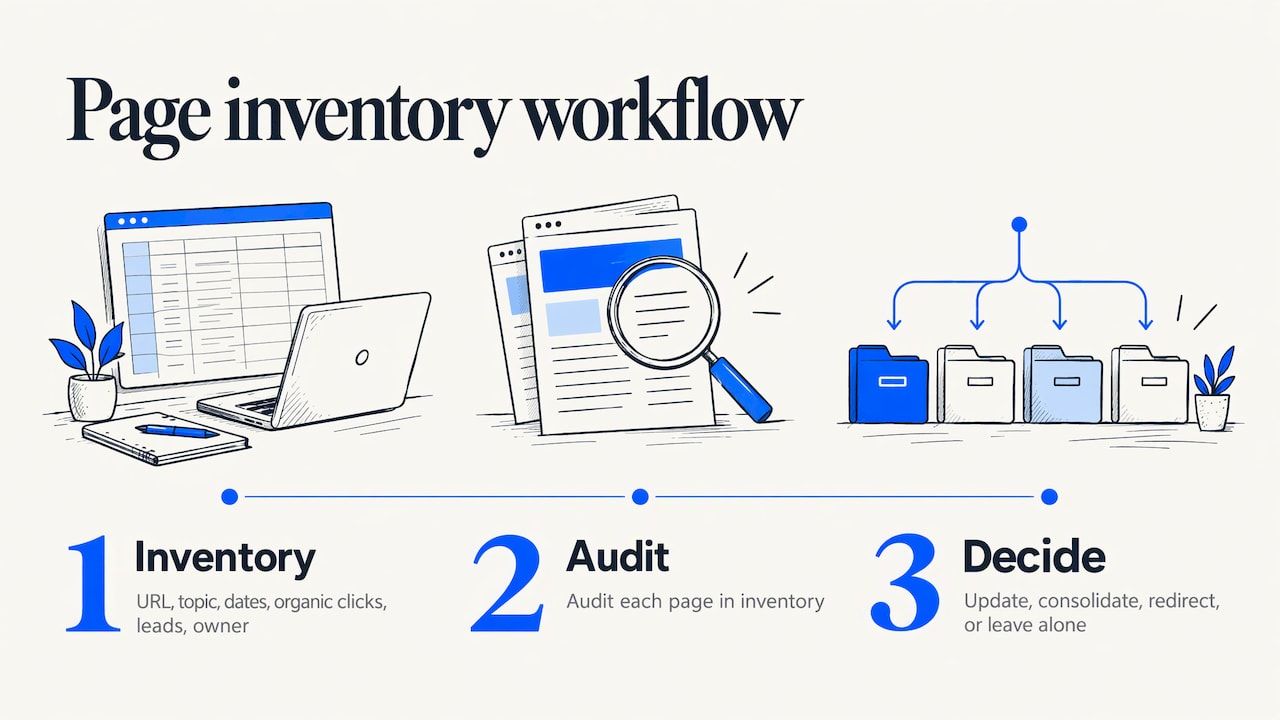
### Step 1: Build an inventory
List every indexable page with its URL, topic, publication and last substantive update, organic clicks over a fixed window, conversions or leads attributed to it, and its owner. RankTracker’s workflow starts the same way: inventory, then audit, then a decision to update, consolidate, redirect or leave each page alone.
### Step 2: Score each page
Use a simple three-factor score. This is a template, not a standard; adjust the weights to your business.
| Factor | Question | Score 1 | Score 3 | Score 5 |
| --- | --- | --- | --- | --- |
| Business value | Does this page influence pipeline or sales? | None | Indirectly | Directly, near a buying decision |
| Evidence of a problem | Is there measurable decline or a known gap? | None | Mild decline or dated content | Clear click loss, wrong facts or intent mismatch |
| Effort | How much work to fix? | Rebuild | Moderate rework | Light edit with high impact |
Add the three. Pages scoring 12 or more go first. Pages scoring below 7 wait or are left alone. If effort is a 1 and value is a 5, consider whether a rebuild is really a new page in disguise.
### Step 3: Separate B2B from ecommerce logic
For B2B software and services, the pages worth refreshing first are usually those close to a decision: solution pages, comparison pages, integration pages, and the guides that feed them. For ecommerce, category pages, product pages and buying guides tend to matter most, because stock, specifications, pricing and seasonal intent change often. Treat that as a working assumption to test against your own data, not a universal rule.
## What a good refresh changes on the page
A refresh that only changes wording is a copy edit. A useful one works through these layers, in this order.
1. **Intent check.** Search the target query as your reader would. Look at what kinds of pages appear and which questions are answered. If the page answers a different question than the one people ask, no polish will fix it.
2. **Answer first.** Put the direct answer in the opening paragraph, then develop it. Readers and AI answer engines both lift from clear, early statements. That second point is our hypothesis, not a proven mechanism.
3. **Facts and sources.** Replace outdated numbers with current ones and link the primary source next to the claim. Delete claims you cannot support.
4. **Gaps.** Add the sections competitors cover that you do not, but only when they help the reader. Length for its own sake is padding.
5. **Proof and expertise.** Add original information: your own data, process detail, examples, named sources. Google’s guidance asks about original information and demonstrated expertise, so this is where thin pages gain the most.
6. **Structure and internal links.** Clear headings, scannable tables where a comparison exists, and links to the pages that should rank for related queries.
7. **Titles and descriptions.** Rewrite for the current query and a clear promise, not for keyword repetition.
8. **Technical hygiene.** Keep the URL stable, fix broken links, and confirm redirects if you merged pages.
If the update is substantial, updating the visible date is honest. If it is a typo fix, leave it. The point is that the date should tell the truth.
### Make future refreshes cheaper
Much of the pain comes from content that was never built to be maintained. Tag pages with an owner and a review interval. Avoid hardcoding figures that change quarterly into headings. Keep a short change log per page so you know what was altered and when, which also gives you the go-live date you need for measurement.
## A worked example (illustrative)
The following is a fictional case with invented figures, to show the arithmetic of prioritizing. It is not a client result and not a benchmark.
A B2B software company has 120 blog and guide pages. A review shows:
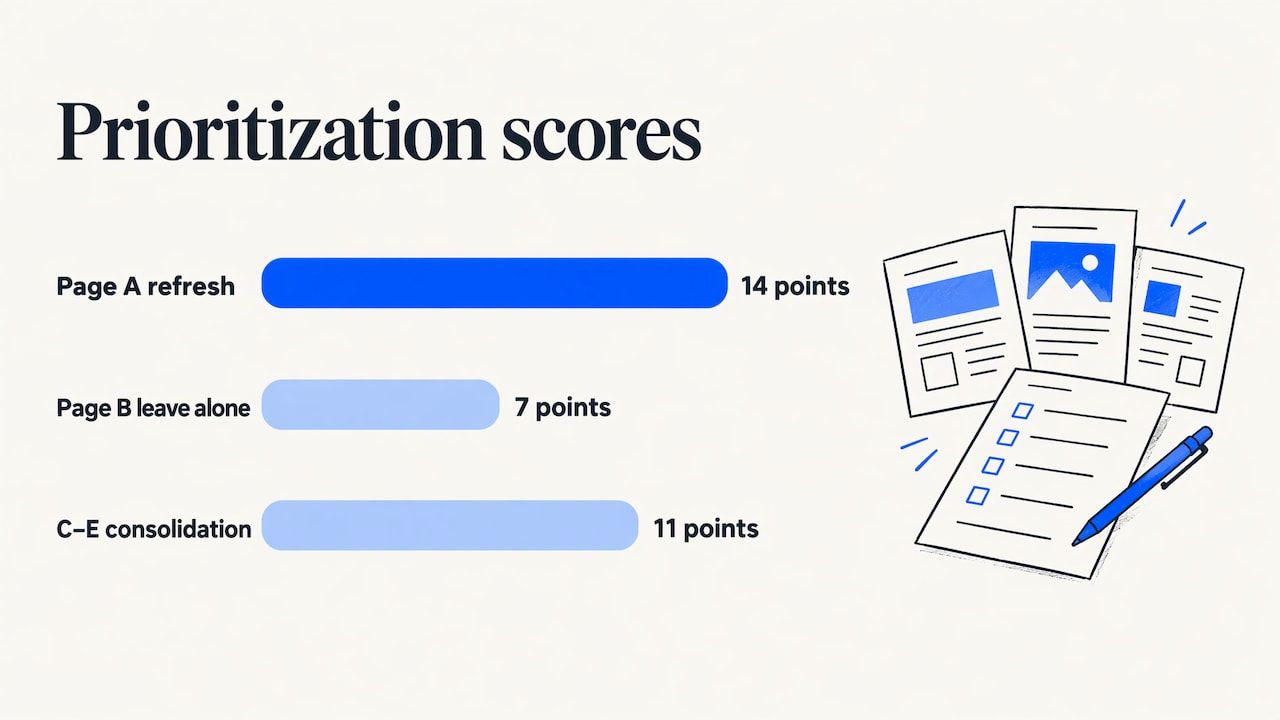
- Page A, an integration guide near the demo request flow: 40 clicks a month, down from 140 over a year, outdated screenshots, two renamed features. Business value 5, problem 5, effort 4. Score 14.
- Page B, a glossary entry with 900 clicks a month and no conversions: stable. Value 1, problem 1, effort 5. Score 7.
- Pages C, D and E, three overlapping articles on the same buying question, each with a few dozen clicks. Value 4, problem 4, effort 3 for a consolidation. Score 11.
The decision: refresh Page A first. Consolidate C, D and E into the strongest URL and redirect the others in the same release. Leave Page B alone despite its traffic, because a glossary page with no commercial role is a poor use of an edit.
Notice what drove the decision: business role and evidence of a problem, not raw traffic. Page B has the most clicks and gets the least attention. That is the point of the scoring.
## How often should content be updated?
There is no universal interval. [Semrush suggests](https://www.semrush.com/blog/when-to-update-blog-content/) updating much blog content every three to six months, adds that frequency depends on type and purpose, and says news may need daily or weekly updates while evergreen how-to guides can stay fresh for a year or more. That is a vendor’s blog guidance, not a rule from a search engine, so treat it as a starting range for your review queue.
Our analysis gives a more useful pattern: set review cadence by how fast the underlying facts move.
| Content type | Review prompt |
| --- | --- |
| Pricing, features, specifications, regulations | Whenever the underlying fact changes, plus a scheduled check |
| Comparisons and “best of” pages | Regularly, and after any competitor or product change |
| Evergreen how-to guides | Annual check, or when a tool or process changes |
| Thought leadership | Only if the argument is still ours and the evidence has moved |
| Low-value or duplicate pages | Consolidate or retire rather than review |
Search Engine Journal’s Brittany Berger [argues](https://www.searchenginejournal.com/content-refreshing-step-by-step/411051/) that content needs maintenance after publication because even evergreen material gradually loses usefulness, and that refreshing reduces dependence on an endless cycle of new pages. We find that persuasive for sites with a large back catalog, and less so for sites with few pages and wide topic gaps, where new content may do more.
## Refresh versus new content: what the evidence does and does not show
Vendor blogs often say refreshing yields faster results than new content because it builds on existing authority. [CoSchedule’s comparison](https://coschedule.com/content-marketing/content-refresh-vs-new-content) summarizes that view, citing other vendor sources. Treat this as a plausible vendor claim rather than a tested law: the speed depends on how strong the page already is, how competitive the query is and how well the edit matches intent.
There is one number worth noting, with care. Search Engine Land [reports organic revenue rose 20.1%](https://searchengineland.com/scale-seo-content-updates-claude-code-483862) across 59 content-update tests. That is one publication’s account of one set of tests. It shows that updates can be run as tests with measurable outcomes. It does not tell you what your site will see, and we would not use it as a forecast in a business case.
## Measuring whether a refresh worked
Search Engine Land’s advice is to record performance before making changes, note when the update goes live, and over the following weeks and months review metrics such as visibility, inquiries and lead quality. The same publication argues that updates should be treated as tests, and that a locked baseline helps separate real impact from lucky timing.
### Keep the layers separate
One of the most common measurement mistakes is blending signals. Track these on separate lines:
1. **AI mentions:** your brand named in an AI answer.
2. **AI citations:** your page linked or sourced in an answer.
3. **Clicks and visits:** traffic from classic search and from AI surfaces where measurable.
4. **Enquiries:** forms, demo requests, calls.
5. **Revenue:** closed business attributed to the page, with the attribution method stated.
[Search Engine Land’s 2026 content strategy guide](https://searchengineland.com/guide/content-strategy-in-2026) notes that measurement now includes traditional organic signals such as clicks, rankings and conversions, plus AI-search signals such as citation frequency and brand mention consistency. It also reports the view that visibility has decoupled: a page may lose Google clicks while gaining AI citation share. So a refresh that lowers clicks is not automatically a failure, and one that raises mentions is not automatically a win. What matters is whether enquiries and revenue move.
### A simple test design
1. Choose a group of pages to refresh and, if the site is large enough, a comparable group to leave unchanged for the same period.
2. Record 8 to 12 weeks of baseline data for clicks, impressions, average position, conversions and, where you can, AI citations on a fixed set of prompts.
3. Log the go-live date and a one-line description of every change.
4. Compare the same window after the change. Account for seasonality and any site-wide events in the period.
5. Decide in advance what result would make you repeat, adjust or stop.
This is a method we recommend, not a published standard. It will not prove causation, but it prevents the worst error: crediting a refresh for a trend that was already under way.
## What a content refresh service includes
No public source defines a standard scope for a refresh service, so scope varies by provider. That is why a B2B team should settle specific points before signing. Whoever you choose, ask these questions.
- **Selection:** how are pages chosen? Look for a method based on business value and evidence of a problem, not a flat list of old posts.
- **Decisions per page:** will the provider recommend update, consolidate, redirect or leave alone, and show the reasoning?
- **Expertise:** where does the subject knowledge come from? Pages in technical B2B fields need your internal experts, documents and product knowledge. Agree who provides what and how often.
- **Editorial standards:** how are sources cited, claims checked and AI-assisted drafts reviewed by a human?
- **Publishing:** who has CMS access, who approves changes and how are redirects handled?
- **Languages and sites:** which languages, brands or sites are in scope?
- **Measurement:** which baseline, which metrics, which reporting cadence, and how are AI citations tracked separately from clicks and revenue?
- **Boundaries:** which technical SEO, design or conversion work sits outside the refresh and who owns it?
- **Commercial terms:** deliverables, responsibilities, cadence and budget written into the proposal.
Be wary of any promise of guaranteed rankings or citations. Nobody outside the search engines controls those outcomes.
> Our perspective We think most content programs publish too much and maintain too little. The back catalog is often the most underused asset a B2B team owns: pages that already have links, history and a place in the buyer’s journey, sitting with outdated claims and no owner. A refresh is where strategy, production and measurement meet. You need a view on which pages deserve effort, writing that adds original substance from your own experts and documents, and a way to read the result without fooling yourselves. That is why we treat it as part of a coordinated SEO and GEO service rather than a one-off cleanup. This is our analysis, not a measured result. Our position is also a refusal: we would rather leave a working page untouched than edit it to show activity. And we would rather merge four weak pages than add a fifth. We make no guarantee of rankings or AI citations, and we do not think anyone credible can. *Louis Choquet*
## Where Pharelia fits
If you have a back catalog that needs triage, our [existing content optimization](https://pharelia.com/en/seo-geo-support#optimisation) work covers selecting, reworking and measuring pages, scoped to your site and priorities. Pricing is available on request, and the proposal defines deliverables, languages, cadence and access. You can also read how we approach [content optimization](https://pharelia.com/en/seo-geo-support) before getting in touch.
## Common mistakes to avoid
- Refreshing by calendar instead of by evidence.
- Changing the date without substantial change.
- Adding words to hit a length target. Depth means answering the question, not stretching it.
- Editing a high-performing page without a baseline.
- Creating a new page for a query an existing page could serve, which splits authority.
- Judging success on clicks alone when AI citations and enquiries also matter.
- Leaving no owner, so the same page decays again.
## Sources
- [The Ultimate Guide for a Content Refresh, CMSWire](https://www.cmswire.com/digital-marketing/what-is-a-content-refresh-and-how-do-you-do-them/)
- [Creating Helpful, Reliable, People-First Content, Google Search Central](https://developers.google.com/search/docs/fundamentals/creating-helpful-content)
- [Content Refresh: The Complete Guide (2026), ContentForce](https://blog.contentforce.ai/content-refresh/)
- [Ask An SEO: Is It Better To Refresh Content Or Create New Pages, Search Engine Journal](https://www.searchenginejournal.com/ask-an-seo-is-it-better-to-refresh-content-or-create-new-pages/553877/)
- [How to Build a Human-in-the-Loop Content Refresh Workflow, RankTracker](https://www.ranktracker.com/blog/human-in-the-loop-content-refresh-workflow/)
- [Content Refresh or New Content: What Should You Prioritize, Quattr](https://www.quattr.com/blog/content-refresh-vs-new-content-how-to-make-the-right-call)
- [How to prioritize SEO content updates and new opportunities, Search Engine Land](https://searchengineland.com/how-to-prioritize-seo-content-updates-and-new-opportunities-497220)
- [When to Update Blog Content & Why You Should, Semrush](https://www.semrush.com/blog/when-to-update-blog-content/)
- [Content Refreshing: 4 Steps to Keep Top-Performing Content, Search Engine Journal](https://www.searchenginejournal.com/content-refreshing-step-by-step/411051/)
- [Content Refresh vs. New Content, CoSchedule](https://coschedule.com/content-marketing/content-refresh-vs-new-content)
- [How to scale SEO content updates with Claude Code, Search Engine Land](https://searchengineland.com/scale-seo-content-updates-claude-code-483862)
- [Content strategy in 2026: What actually changed, Search Engine Land](https://searchengineland.com/guide/content-strategy-in-2026)
### Discuss Your Content Refresh
Email Pharelia to discuss whether your pages need updating, consolidation or a different approach, and what support could fit your remit.
[Email Pharelia](mailto:contact@pharelia.com)
## Recommended
- [Campus Consulting: Connect Content with Business Needs](https://pharelia.com/en/client-work/campus-consulting)
## Frequently asked questions
### How do I refresh a page?
Start by checking whether the page still matches what searchers want. Then correct outdated facts, add the missing depth, put the answer near the top, cite sources and improve internal links. Keep the URL, record a baseline and log the go-live date so you can measure the result.
### How often should website content be updated?
It depends on how fast the facts change. Semrush suggests three to six months for much blog content, with evergreen guides lasting a year or more. We would set review intervals per content type and update immediately when a price, feature or regulation changes.
### Should I refresh an old page or write a new one?
Refresh when the topic is right and the page is outdated or thin. Write a new page when the reader’s need is clearly different from the existing page, then link the two. If several pages target the same intent, consolidate them instead of adding another.
### Does changing the publish date help rankings?
Not on its own. Google’s guidance flags changing a page’s date to seem fresh when the content has not substantially changed. Update the date when the page has meaningfully changed, so the date stays accurate.
### How do I know a refresh worked?
Compare against a baseline taken before the edit, over a window that accounts for seasonality. Track AI mentions, AI citations, clicks, enquiries and revenue separately, because they can move in different directions.