# Semantic content clusters in 2026: building them for SEO and AI
Semantic content clusters remain a valid SEO approach in 2026, provided they are designed for Google and AI search engines. An operator's method.
Author: Louis Choquet · Founder, Pharelia
Published on 2026-07-14 · Updated on 2026-10-04
Source: https://pharelia.com/en/resources/cocon-semantique
## The essentials in 60 seconds
A semantic content cluster organizes pages around a central intent and related sub-intents connected by dense internal linking. In 2026, it remains effective: it clarifies the topic for Google and gives AI search engines self-contained, sourced paragraphs to cite. It is not a technical trick, but a content architecture summarizing what you want to rank and why.
For our clients, a semantic content cluster is never a decorative deliverable: it is the map deciding which pages we write, in what order, and how we connect them. This article explains the method we actually apply, what Google's AI guide changes, and what we measure when GSC is no longer enough.
## What exactly is a semantic content cluster?
A parent page (pillar) covers the broad intent, child pages each address a precise sub-intent, and downward/upward internal links connect everything. The goal: concentrate topical relevance on the pillar and cover the long tail through child pages. What we observe is that linking consistency matters as much as the content itself.
- Pillar: answers the broad query and links to every child page.
- Child pages: one intent per page, a clear angle, links back to the pillar.
- Internal links: descriptive anchors, no “click here” links, priority given to intent rather than raw volume.
- Boundary: stop the cluster where the nature of the intent changes — otherwise, you create cannibalization.
The most common mistake we correct: targeting the main query with the very first page. First win the long tail with child pages, then build toward the pillar. This is the same logic set out in our note on [content publishing frequency](/en/resources/moteur-de-contenu-cadence).
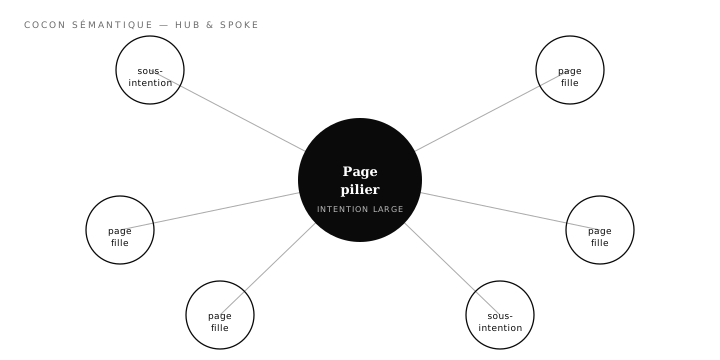
The semantic content cluster: a central pillar page, child pages for each sub-intent, descriptive internal linking.
## Are semantic content clusters still valid in 2026?
Yes. Google's official AI guide (15/05/2026) indirectly confirms this: “optimizing for generative AI means optimizing for search — therefore SEO”. A well-built semantic content cluster serves both: it structures the topic for Google and divides content into clear answers AI search engines can cite. Nothing in recent updates invalidates it.
The May 2026 core update ended on 02/06/2026 after around twelve days of rollout, followed by the June 2026 spam update launched globally on 24/06/2026 ([Search Engine Land](https://searchengineland.com/google-may-2026-core-update-rollout-is-now-complete-479119)). These updates do not penalize content cluster architecture; they penalize low-value mass content. A cluster filled with hollow pages remains a hollow cluster.
- **~12 j** : rollout duration of the May 2026 core update (completed on 02/06/2026) (Search Engine Land (2026))
- **76 % → 38 %** : share of AI Overview citations from Google's top 10 (mid-2025 → early 2026) (Higoodie (2026))
- **~69 %** : zero-click queries where AIO is deployed (Ahrefs (2026))
## Why AI's arrival in France changes the picture
Google announced the [launch of AI Overviews and AI Mode in France on July 22, 2026](https://blog.google/intl/fr-fr/nouveautes-produits/explorez-obtenez-des-reponses/recherche-ia-apercus-mode/). AI Overviews appears when Google considers a generated answer useful for the query; it does not replace all conventional results. Your semantic cocoon should primarily provide useful, accessible, interconnected pages; whether they are cited still needs to be verified.
Three commitments accompany this launch: control (opt-in/opt-out of AI features), transparency (separate reporting of AI impressions), and remuneration under neighboring rights (450 publishers involved). For a site that is not a news publisher, the practical consequence is simple: factual clarity on every child page becomes a citation asset, not just a ranking factor.
### CTR decline on informational queries where AIO is deployed
Range of organic click-through rate decline observed by Ahrefs on informational queries covered by an AI Overview.
| Period | CTR decline (%) |
| --- | --- |
| Lower end of range | 15 |
| Upper end of range | 30 |
Source: Ahrefs (2026)
## Does your cluster need an llms.txt file?
No, not for Google. Google's AI guide is explicit in its mythbusting section: Google Search does not use llms.txt — neither a benefit nor a penalty. No content chunking requirement, no need to write specifically for AI, and structured data is not required for generative AI (it remains useful for traditional rich results).
An honest qualification: llms.txt may serve other crawlers or engines, but there is no evidence of an effect on Google. In production, we do not spend time optimizing it while Google remains the priority. Instead, we invest in self-contained, sourced paragraphs — what Google confirms is SEO, not a separate AI layer ([Search Engine Journal](https://www.searchenginejournal.com/googles-new-ai-search-guide-calls-aeo-and-geo-still-seo/575026/)).
Mythbusting in Google's official AI guide (15/05/2026).
| Common belief | What Google's guide says (2026) |
| --- | --- |
| llms.txt helps Google search visibility | Google Search does not use it (neither a benefit nor a penalty) |
| Content must be divided into chunks for AI | No content chunking requirement |
| You must write specifically for AI | Optimizing for AI = optimizing for search (SEO) |
| Structured data is required for AI | Not required for generative AI; useful for rich results |
## How we build semantic content clusters at Pharelia
We start with intent, not volume. We map the pillar query and its sub-intents, write the child pages closest to a purchase decision first, then weave the internal links. Each page must answer upfront before elaborating — the same answer-first requirement that makes it citable by an AI search engine.
1. Map the pillar and 5 to 12 distinct sub-intents, without overlap.
2. Write every child page answer-first: an answer in 40-70 words, followed by development with figures and sources.
3. Connect: links down from the pillar, links up from child pages, descriptive anchors.
4. Check cannibalization: one intent = one page; otherwise, merge.
5. Optimize after publication: where the long tail improves, strengthen the pillar.
This method overlaps with our [SEO audit checklist](/en/resources/audit-seo-checklist) and the distinction between [AEO vs SEO vs GEO](/en/resources/aeo-vs-seo-vs-geo). For comprehensive support, our services cover cluster construction, human writing, and factual verification.
- Semantic content clusters remain valid in 2026: Google confirms that optimizing for AI is SEO.
- Structure answer-first: the upfront answer serves Google and makes the page citable by AI search engines.
- Ignore llms.txt for Google: it has no proven effect on Google Search.
- Prioritize the long tail on child pages before building toward the pillar.
- Quality, not the production method, decides: a cluster of hollow pages will not rank.
### Let's talk about your visibility
Let's discuss your site and priorities.
[Let's talk about your project](https://pharelia.com/en/contact)
## Measuring a cluster when GSC is no longer enough
Search Console provides a [generative AI performance report](https://support.google.com/webmasters/answer/16984139?hl=en) for AI Overviews and AI Mode impressions. Google reports a global rollout as of August 31, 2026, with access limitations depending on the property and impression volume. This data is also included in the Web report: do not add it to that report's total. In GA4, check the [AI Assistant channel and source/medium data](https://support.google.com/analytics/answer/9756891?hl=en) for identifiable sessions. Traffic with no identifiable source may appear as [Direct](https://support.google.com/analytics/answer/15258820?hl=en) — a custom channel group does not reconstruct a lost source. Do not therefore reattribute all Direct traffic to AI. To assess the semantic cocoon, distinguish impressions, observed citations, sessions and conversions.
You therefore need to track something else. AI Search traffic converts at around 14,2 % versus around 2,8 % for organic traffic (Seer Interactive): few sessions, but highly qualified. ChatGPT accounts for around 87 % of AI referral traffic (Conductor 2026), while Perplexity ranks third (~7,7 %, Statcounter May 2026). We track citations by target query, engine by engine.
A structural point for cluster strategy: AI citations are fragmented. ChatGPT citations overlap with only around 12 % of Google SERPs, and around 80 % of LLM citations do not rank in Google's top 100 ([Ahrefs, 15 000 queries](https://ahrefs.com/blog/ai-overviews-reduce-clicks/)). A good Google ranking therefore does not guarantee an AI citation: the cluster must explicitly target both channels.
- [Google's official AI guide (May 2026)](https://developers.google.com/search/docs/fundamentals/ai-optimization-guide)
- [AEO and GEO still SEO — Search Engine Journal](https://www.searchenginejournal.com/googles-new-ai-search-guide-calls-aeo-and-geo-still-seo/575026/)
- [AI Overviews — arrival in France in summer 2026 — Abondance](https://www.abondance.com/20260630-2528492-google-ai-overviews-arrivee-france-ete.html)
- [May 2026 core update completed — Search Engine Land](https://searchengineland.com/google-may-2026-core-update-rollout-is-now-complete-479119)
- [AI Overviews reduce clicks — Ahrefs](https://ahrefs.com/blog/ai-overviews-reduce-clicks/)
- [AI Search Traffic Report 2026 — Higoodie](https://higoodie.com/blog/ai-search-traffic-report-2026/)
## Frequently asked questions
### Do semantic content clusters still work in 2026?
Yes. Google's official AI guide (May 2026) confirms that optimizing for generative AI amounts to SEO. A well-linked semantic content cluster structures the topic for Google and provides citable paragraphs for AI search engines. Recent updates penalize hollow pages, not the architecture.
### Do you need an llms.txt file to improve your cluster?
No, not for Google. Google's AI guide states plainly that Google Search does not use llms.txt: neither a benefit nor a penalty. It may serve other crawlers, but there is no evidence of an effect on Google. Instead, invest in self-contained paragraphs with sources and figures.
### How many child pages should a semantic content cluster contain?
As many as there are genuinely distinct sub-intents, generally 5 to 12. The rule is not a number but the absence of overlap: one intent per page. If two pages target the same intent, they cannibalize each other and should be merged. Write the child pages closest to a decision first.
### When are AI Overviews arriving in France?
Google announced the launch of AI Overviews and AI Mode in France on July 22, 2026. AI Overviews does not appear for every search: Google shows it when it provides a useful answer to the query.
### Does a good Google ranking guarantee an AI citation?
No. According to Ahrefs (15 000 queries), around 80 % of LLM citations do not rank in Google's top 100, and ChatGPT citations overlap with only around 12 % of Google SERPs. Rankings and AI citations are two distinct visibility channels: the cluster must explicitly target both.
### How should you measure a cluster's AI performance?
Cross-check AI impressions in Search Console's dedicated report, attributable sessions in GA4 and citations observed across a stable query panel. The AI report overlaps with the Web report: do not combine their totals. Assess conversions using your own data and a sufficient volume; a study average does not predict your semantic cocoon's performance.