# Product Description SEO: What Actually Moves Product Pages
How to write product descriptions that serve search and buyers: length, structure, B2B vs ecommerce, a scoring template and the metrics that show it works.
Author: Louis Choquet · Founder, Pharelia
Author profile: https://pharelia.com/en/authors/louis-choquet
Published on 2026-11-12
Source: https://pharelia.com/en/blog/product-description-seo
## Introduction
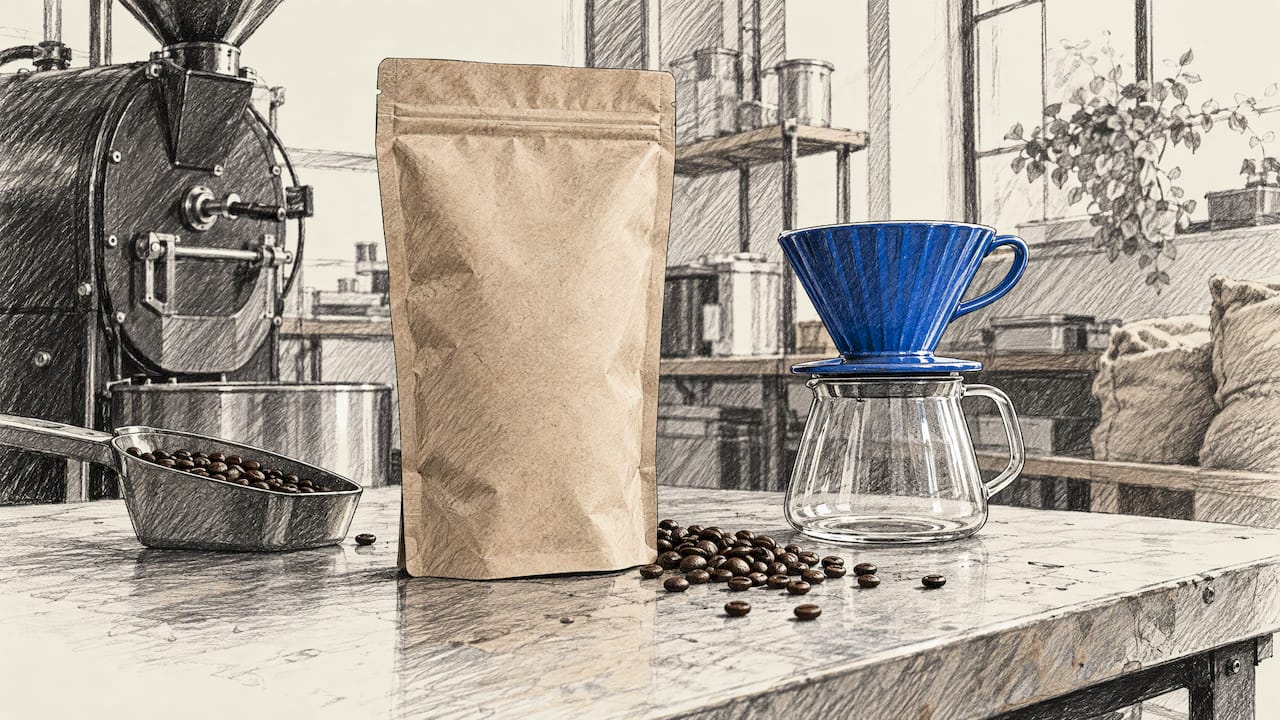
A product description helps SEO when it gives a buyer, and a search engine, facts they cannot get from the manufacturer’s copy: specifications, use cases, compatibility, answers to the questions that stall a purchase. Keyword placement is the smallest part. The description is also only one element of the product detail page, so the real job is to make the whole page easier to find, understand and trust.
This guide takes a position, labelled as our analysis where it is opinion, and separates sourced facts from vendor claims. It covers what to write, how long to write it, how B2B and ecommerce differ, and how to tell whether any of it worked.
## TL;DR
- Write the description to remove buying doubts first and place keywords second. Search visibility follows from pages that are specific, original and complete.
- Length depends on product complexity, not on a magic number. Commodity items need little; technical and B2B products need structured depth.
- B2B product pages need specification tables, compatibility, compliance and logistics facts. Ecommerce pages can lean more on story and media.
- A description is one part of product page optimization. Titles, images, reviews, structured data and internal links often matter as much.
- Measure in layers: impressions and clicks, then add-to-cart and conversion, then revenue. Do not credit copy for what the layout or price changed.
### Make Product Pages More Useful
Pharelia supports content and SEO strategy, product page optimisation and tailored content production for brands improving search visibility.
[Explore SEO and GEO support](https://pharelia.com/en/seo-geo-support)
## What an SEO product description is, and what it is not
Sources describe an SEO product description as copy written so a product page can rank and persuade at once. [Cension’s definition](https://www.cension.ai/blog/seo-product-description-best-practices/) lists intent-driven keywords in titles, URLs, headings and meta tags, unique benefit-focused copy, structured data and social proof. That is a vendor-blog definition, useful as a checklist, but it blurs two things worth keeping apart.
**The description** is the copy that explains the product: what it is, who it suits, how it performs, what is included.
**Product page optimization** is wider. [Shopify defines it](https://www.shopify.com/blog/expert-advice-improve-product-pages) as improving the product detail page so shoppers understand the product, trust the offer and buy without friction, covering the title, images, copy, price display, reviews, trust signals and calls to action.
Our analysis: most weak product pages do not fail because the description lacks a keyword. They fail because the description repeats the supplier feed, the images do not answer the obvious question, and nothing tells the buyer whether the product fits their situation. Fixing the keyword density of that page changes very little.
## Why original descriptions matter
Three reasons hold up across the sources, though their strength differs.
**Duplication.** Many shops publish the manufacturer’s text unchanged. Search Engine Journal [argues that supplier-duplicated copy hurts rankings](https://www.searchenginejournal.com/ecommerce-site-unique-product-descriptions/364458/), and [Ahrefs advises writing a unique description](https://ahrefs.com/blog/product-page-seo/) rather than copying from manufacturers. Both are editorial advice from publishers, not a measured penalty. The safer reading: identical text across dozens of sites gives a search engine no reason to prefer yours, and gives a buyer no reason to stay.
**Specific intent.** Original copy can answer searches the feed never touches. The Search Engine Journal piece gives the example of a coffee product described with food pairings and brewing tips. A description that addresses the use case can match longer, more specific queries.
**Buyer confidence.** [Yoast lists](https://yoast.com/improve-product-descriptions/) clearer benefits, a consistent voice, better customer experience and trust among the reasons to improve descriptions. Treat these as plausible mechanisms rather than guaranteed outcomes.
There is also a context point. Shopify’s 2026 guide cites Baymard’s benchmark that [52% of desktop and 62% of mobile ecommerce sites have mediocre or worse product page UX](https://www.shopify.com/enterprise/blog/seo-product-descriptions). If that is roughly right, a clearly structured page is a differentiator before any keyword work.
## Write for the buyer’s questions, then check the keywords
[Yoast’s advice](https://yoast.com/improve-product-descriptions/) is to write for humans first and use keyword research to find the terms a product can rank for. We agree with the order, with one addition: the same research tells you which questions to answer.
### Step 1: Pick the intent per page
Search Engine Journal suggests [starting with transactional keywords](https://www.searchenginejournal.com/writing-product-descriptions-tips/404473/) for product descriptions. That works for a single-product page. A category page, a comparison page and a buying guide target different intent and should not be forced into the same template. Give each product page one primary query and two or three supporting phrases, and leave informational queries to guides that link to the product.
### Step 2: Collect the questions
Gather the questions buyers actually ask: sales calls, support tickets, reviews, returns reasons, on-site search. Our analysis: these beat any keyword tool for deciding what the description must contain, because every unanswered question is a reason to leave.
### Step 3: Write in a fixed order
1. A title with the product type, brand and the one specification that distinguishes it.
2. One or two sentences saying who it is for and what problem it solves.
3. The decisive facts near the top: size, capacity, compatibility, material, power, lead time.
4. Benefits tied to those facts, not adjectives.
5. Use cases, and who should not buy it, stated plainly.
6. Care, warranty, delivery and returns, or a link to them.
### Step 4: Place keywords naturally
Use the primary phrase in the title, the first paragraph, a heading and the meta description. [Search Engine Land warns against keyword stuffing](https://searchengineland.com/product-page-seo-guide-437261) because descriptions are meant to convince users, not only Google. If a sentence reads awkwardly aloud, rewrite it.
## How long should a product description be?
There is no official word count. Google does not publish a minimum length for product descriptions, and the numbers below come from commercial blogs, so treat them as ranges to start from.
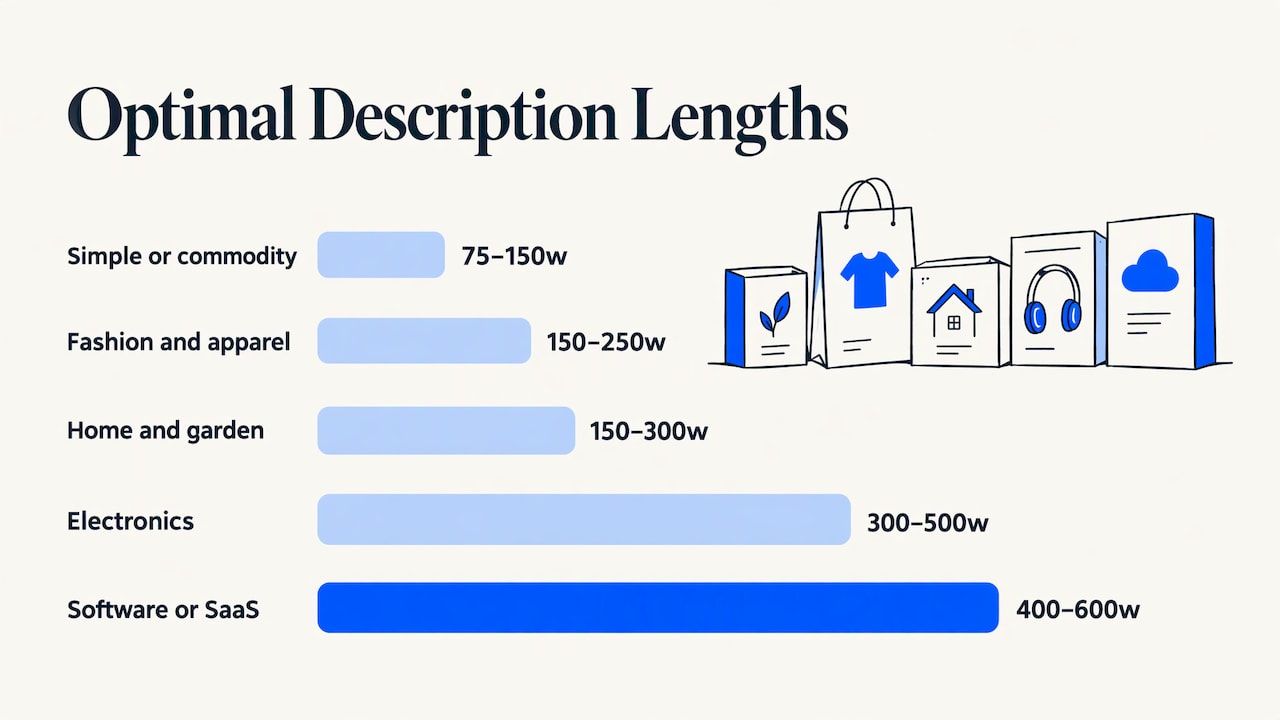
[TypeCount’s 2026 guide](https://typecount.com/blog/product-description-word-count) suggests these optimal ranges:
| Product type | Range cited | Optimal cited |
| --- | --- | --- |
| Simple or commodity | 50–200 words | 75–150 |
| Fashion and apparel | 100–350 words | 150–250 |
| Home and garden | 100–400 words | 150–300 |
| Electronics | 200–750 words | 300–500 |
| Software or SaaS | 250–1,000+ words | 400–600 |
The same source says longer copy tends to suit technical, high-consideration, innovative and B2B products. That matches common sense: someone buying a pallet of fasteners or a software licence needs more than someone buying a phone case.
For Google Shopping feeds, the constraint is different. [FeedOptimizer states](https://www.feedoptimizer.ai/blog/optimize-google-shopping-product-descriptions) that Google allows up to 5,000 characters but recommends 500 to 850, with the main selling point and keyword first. That is a vendor recommendation for feeds, not a rule for the page.
Our position: stop asking for a word count and ask whether every question on your list has an answer on the page. A 120-word description that answers everything beats a 500-word one that repeats itself. If you do need a number, use the ranges above as a starting point and edit down, never up.
## B2B and ecommerce need different descriptions
This is where generic tips fail the readers we write for. A consumer shop and an industrial distributor share a template, and it hurts the second one.
[Icecat’s channel guidance](https://icecat.com/blog/channel-specific-product-content/) says distributor catalogs and B2B portals need certifications, compliance data, logistics specifications, minimum order quantities and technical attributes, while a webshop has more room for storytelling, rich media and comparison tools. It recommends one complete product record, shaped per destination.
[Growmax](https://www.growmax.io/blog/writing-product-description-guide) describes the B2B reader as an engineer, procurement manager or maintenance technician who needs precise data, and suggests this structure:
- a title with brand, product type and the key differentiating specification
- a two to three sentence short description
- a technical specification table
- application and compatibility notes
- cross-reference numbers such as OEM part numbers
The point about several readers is practical. In a B2B purchase, a technical evaluator, a buyer, a manager and an end user each look for different things. Clear sections and tables let each find theirs quickly, as [Start With Data argues](https://startwithdata.co.uk/insight/how-to-write-compelling-product-descriptions-for-b2b-products/). These are vendor and agency views, so we use them as a structure, not as evidence of results.
### Illustrative example: an industrial valve
The following is a fictional example with invented figures, shown only to illustrate structure.
- **Title:** Stainless steel ball valve, 2-inch, 316L, PN40
- **Summary:** For chemical dosing lines where corrosion resistance matters. Compatible with standard flanged connections.
- **Decision specs:** Pressure rating, temperature range, connection type, certification list.
- **Spec table:** Full dimensions, materials, seals, weight.
- **Compatibility:** Fluids it suits, fluids it does not, replacement for named part numbers.
- **Trade block:** Minimum order quantity, lead time, stock status, datasheet download.
A consumer version of the same page would lead with an image and a short benefit line. The B2B version leads with the facts that decide whether the product is even eligible.
## Beyond the description: the rest of the product page
If the aim is product page optimization, the description is one lever among several. Our analysis of what usually matters, in the order we would check:
1. **Title and URL.** Descriptive, specific, not stuffed. Product titles in search results are often truncated, so put the distinguishing words early.
2. **Duplicate and variant handling.** [Search Engine Land recommends](https://searchengineland.com/product-page-seo-guide-437261) avoiding duplicated content across similar products and using canonicals where needed.
3. **International versions.** The same source recommends hreflang tags for versions in other languages or regions. Write each version for its market, not as a translation of the first.
4. **Structured data.** Google says Product markup can make a page [eligible for merchant listing experiences](https://developers.google.com/search/docs/appearance/structured-data/merchant-listing) , and that product rich results support pages focused on a single product or its variants. Eligible is not guaranteed: markup must match what the visitor sees on the page.
5. **Images and media.** Photos, diagrams, dimension drawings and videos answer questions text handles badly.
6. **Reviews and trust signals.** Real reviews add language that matches how buyers talk, which no copywriter can supply.
7. **Internal links.** Link from category pages, guides and related products so the page is reachable and its context is clear.
When the technical layer is the bottleneck, descriptions will not rescue the page. Crawlability, canonicalization and templates come first. That is where [technical SEO work](https://pharelia.com/en/seo-geo-support) belongs in the plan.
## Using AI to draft descriptions
Ahrefs [recommends avoiding tools like ChatGPT](https://ahrefs.com/blog/product-page-seo/) for product descriptions because hallucinated information can create confusion and mistrust. We would not go that far, but the risk is real: a description that invents a specification or a certification is a liability, not a time saver, especially in B2B where buyers act on the numbers.
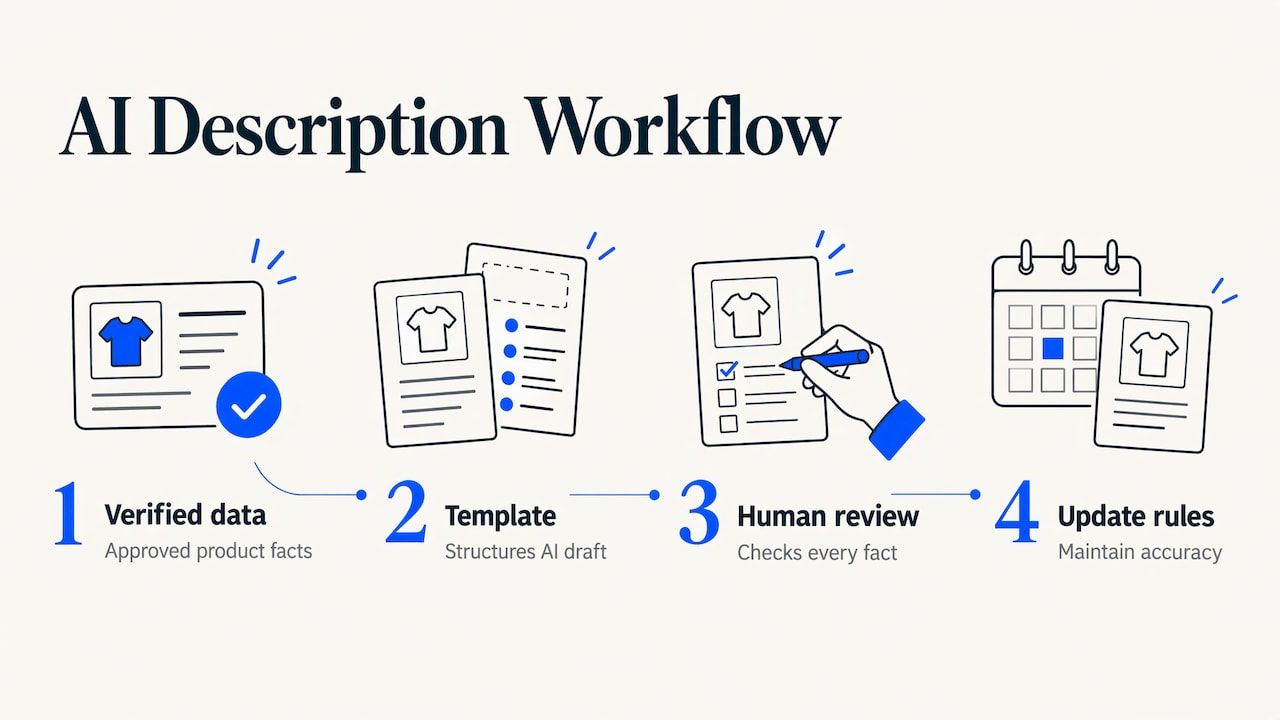
Our position: AI can structure, rephrase and scale drafts, provided it starts from a verified product record and a human checks every fact before publication. Never let a model supply specifications it was not given. For catalogs of thousands of items, the process, meaning source data, templates, review and update rules, matters more than the model.
## A scoring template for existing descriptions
Before rewriting anything, score what you have. This is a practical tool you can copy into a spreadsheet. Score each criterion 0 (absent), 1 (partial) or 2 (complete).
| Criterion | What a 2 looks like |
| --- | --- |
| Originality | Text not copied from the supplier or reused across products |
| Decisive facts | Key specifications visible without scrolling |
| Audience fit | States who it is for, and who it is not for |
| Questions answered | Top five buyer questions answered on the page |
| Structure | Short paragraphs, headings, a table where data is tabular |
| Search basics | Specific title, one clear primary phrase, no stuffing |
| Trust | Warranty, certifications, reviews or documentation present |
| Consistency | Page text matches structured data and the product feed |
A page scoring under 8 out of 16 is a rewrite candidate. Between 8 and 12, edit. Above that, leave the copy and look at images, price and technical issues.
Prioritize by revenue and search demand, not by catalog order. Start with products that already get impressions in Search Console but weak clicks or conversion, because the demand exists and the page is the obstacle. This is a hypothesis about where effort pays back fastest, not a measured result.
### Worked example (illustrative)
The figures below are invented to show the arithmetic.
A shop has 400 products. Sorting by impressions, 40 products account for most of the search visibility. Scoring those 40 shows 25 below 8 points. Rewrite those 25 first. Leave the other 360 until the first batch has been measured for a full quarter or so, so seasonality does not fool you.
## How to measure whether it worked
The [Shopify Help Center](https://help.shopify.com/en/manual/products/details/product-descriptions/write) suggests deciding on a set of product page metrics up front: conversion rate, cart abandonment, return rate, support inquiries and organic rankings. [Shopify’s product page guide](https://www.shopify.com/blog/expert-advice-improve-product-pages) adds add-to-cart rate, reached-checkout rate, average order value, engagement metrics and organic traffic, clicks and rankings.
Keep the layers separate, because they answer different questions:
| Layer | Metric | What it tells you |
| --- | --- | --- |
| Visibility | Impressions, average position | Whether the page appears for the target queries |
| Attention | Clicks, click-through rate | Whether title and snippet earn the visit |
| Behavior | Add-to-cart, engagement | Whether the page convinces |
| Outcome | Conversion rate, orders, returns | Whether the visit turned into revenue |
| Quality | Return rate, support tickets | Whether the description set the right expectation |
Two cautions. First, rankings are not revenue: a page can climb and sell nothing. Second, a return rate that falls after a rewrite is among the better signs that a description is now accurate. If you also track AI answer engines, count mentions, citations, clicks and visits as distinct things, and none of them as sales.
To isolate the effect, change a batch of similar products, keep a comparable batch untouched, and compare over the same period. Do not change price, images and copy at once if you want to attribute the result.
## Common mistakes
- **Pasting the supplier feed.** The cheapest option and the easiest to ignore for a search engine.
- **Keyword-first sentences.** Copy that reads like a query list loses the buyer.
- **One template for every product.** A commodity and a configurable industrial product need different depth.
- **Hiding the facts.** Specifications buried below paragraphs of brand story.
- **No updates.** Discontinued parts, changed standards and outdated compatibility notes quietly destroy trust.
- **Optimizing copy while the page is slow or unindexable.** Fix the foundation first.
A short note of sarcasm, aimed at the practice: “premium quality, unbeatable value” has appeared on so many pages that it now tells a buyer nothing about any of them.
## Our perspective
> We think product description SEO is usually mis-scoped. Teams treat it as a copywriting task with a keyword list, when the underlying problem is a content system: where product data comes from, who verifies it, how it is shaped for each channel, and how it is kept current. That is why we work on it as part of a wider remit: strategy to decide which pages and queries matter, production to write the pages, optimization to improve what already exists, and measurement to show what changed. For B2B and industrial catalogs the work starts from internal expertise and documents, because that is where the accurate specifications live. This is our analysis, not a measured result, and we do not promise rankings or citations. We do think that a complete, accurate and well-structured page is the most defensible thing a team can build, because it serves the buyer, the search engine and the AI answer engines that increasingly summarize product information. *Louis Choquet*
## When to bring in help
Doing this in-house is reasonable for a small catalog with strong product knowledge. It gets harder when you have thousands of products, several brands or websites, multiple languages, or product data scattered across spreadsheets and PDFs.
Pharelia provides a managed, tailored service covering strategy, [article, guide and page production](https://pharelia.com/en/seo-geo-support#production) and [existing content optimization](https://pharelia.com/en/seo-geo-support), scoped to your catalog and priorities. For online stores, see our [ecommerce SEO approach](https://pharelia.com/en/solutions/e-commerce). Pricing is on request, and the proposal defines scope, deliverables and responsibilities.
## FAQ
### How long should a product description be for SEO?
There is no official minimum. Commercial guides suggest roughly 75 to 150 words for simple items and 400 to 600 for software, with technical and B2B products toward the longer end. Use the ranges as a starting point and let your buyers’ questions set the final length.
### Do product descriptions affect rankings?
They help a search engine understand what the page is about and which queries it fits, and they affect whether visitors stay and buy. Copied supplier text gives your page no distinguishing content. No source we found proves a fixed ranking effect from rewriting descriptions alone, so measure on your own pages.
### How is product page optimization different from writing a description?
The description is the copy. Product page optimization covers everything on the page that influences the purchase: title, images, price display, reviews, trust signals, structured data and calls to action. Descriptions are often the easiest part to fix, but not always the main problem.
### Should B2B product descriptions look different from ecommerce ones?
Yes. B2B pages need specification tables, compatibility, certifications, minimum order quantities and lead times so engineers and buyers can qualify the product quickly. Consumer ecommerce pages can lean more on imagery, story and comparison.
### Can I use AI to write product descriptions?
You can, with limits. Give the model a verified product record, forbid invented specifications, and have a person check every claim before publishing. Unchecked output risks inaccurate details that damage trust.
### Discuss Your Product Pages
Email Pharelia to discuss content and SEO priorities for product pages, including what to improve and how the work could be scoped.
[Email Pharelia](mailto:contact@pharelia.com)
## Sources
- [Ecommerce Product Page Optimization (Shopify)](https://www.shopify.com/blog/expert-advice-improve-product-pages)
- [SEO Product Description Best Practices (Cension)](https://www.cension.ai/blog/seo-product-description-best-practices/)
- [SEO Product Descriptions: 7 Tips (Shopify Enterprise)](https://www.shopify.com/enterprise/blog/seo-product-descriptions)
- [Unique Product Descriptions (Search Engine Journal)](https://www.searchenginejournal.com/ecommerce-site-unique-product-descriptions/364458/)
- [Product Page SEO (Ahrefs)](https://ahrefs.com/blog/product-page-seo/)
- [Improve product descriptions (Yoast)](https://yoast.com/improve-product-descriptions/)
- [Writing product descriptions tips (Search Engine Journal)](https://www.searchenginejournal.com/writing-product-descriptions-tips/404473/)
- [Product page SEO guide (Search Engine Land)](https://searchengineland.com/product-page-seo-guide-437261)
- [Product description word count (TypeCount)](https://typecount.com/blog/product-description-word-count)
- [Google Shopping descriptions (FeedOptimizer)](https://www.feedoptimizer.ai/blog/optimize-google-shopping-product-descriptions)
- [Channel-specific product content (Icecat)](https://icecat.com/blog/channel-specific-product-content/)
- [B2B product descriptions (Growmax)](https://www.growmax.io/blog/writing-product-description-guide)
- [B2B product descriptions (Start With Data)](https://startwithdata.co.uk/insight/how-to-write-compelling-product-descriptions-for-b2b-products/)
- [Merchant listing structured data (Google Search Central)](https://developers.google.com/search/docs/appearance/structured-data/merchant-listing)
- [Writing product descriptions (Shopify Help Center)](https://help.shopify.com/en/manual/products/details/product-descriptions/write)
## Recommended
- [E-commerce SEO agency: audit and content](https://pharelia.com/en/solutions/e-commerce)