# Outsourced Content Marketing: How It Works and How to Do It Well
What outsourced content marketing includes, what to hand over, how to brief and measure a partner, and how to judge the cost, with a decision matrix and worked example.
Author: Louis Choquet · Founder, Pharelia
Author profile: https://pharelia.com/en/authors/louis-choquet
Published on 2026-11-12
Source: https://pharelia.com/en/blog/outsourced-content-marketing
## Introduction

Outsourced content marketing means a B2B company hands part or all of its content planning, production, optimization and measurement to an external team, while keeping the knowledge and the final say. It works best when the partner runs the whole system (strategy, writing, publishing, updates, reporting) and the company supplies its own expertise and documents. It works worst when it is a pile of freelance articles with no strategy behind them. This is our analysis, built on the sources linked below.
If you lead marketing, content or SEO at a B2B company and are weighing the decision, the sections below cover what to outsource, what to keep, how to brief, how to measure and how to read a proposal.
## TL;DR
- Outsource the system, not just the words: strategy, production, optimization and measurement connected under one plan.
- Keep the inputs only you have: product knowledge, customer insight, approvals and the commercial goal.
- Set quality thresholds before the first draft: voice, accuracy, SEO and compliance checkpoints.
- Track mentions, citations, clicks, visits, enquiries and revenue as separate numbers. Never treat one as proof of another.
- Budget as a scoped engagement. Price follows scope, languages, cadence and the amount of your internal input.
Pharelia
Build a Connected Content System
Explore managed support spanning content strategy, production and optimisation, with the proposal defining scope, responsibilities, languages and cadence.
- ✓ AI content operations
- ✓ Content and SEO/GEO strategy
- ✓ Articles, guides and pages
- ✓ Optimisation of existing content
[Explore our SEO and GEO support](https://pharelia.com/en/seo-geo-support)
## What outsourced content marketing includes
In practice the label covers four layers, and a proposal can include any of them:
1. **Strategy.** Choosing topics, audiences and formats from business goals and search demand, including how your content should appear on Google and in AI answer engines.
2. **Production.** Articles, guides, landing pages, category and product pages, written from your briefs, interviews and internal documents.
3. **Optimization.** Updating existing pages so they keep ranking and stay accurate, which is usually cheaper than starting from zero.
4. **Measurement.** Reporting that connects content to visits, enquiries and pipeline, not only to traffic.
How common is it? The Content Marketing Institute’s B2B research reported that [half of marketers outsource some content marketing](https://contentmarketinginstitute.com/b2b-research/b2b-content-marketing-insights-for-2022-more-budget-more-work-more-empathy-research), a figure that was on par with the year before and higher at larger companies (survey of 2022, so treat it as a directional benchmark). Outsourcing is a normal operating model, not a fringe one.
## Why B2B companies outsource, and when it makes sense
The usual benefits are well documented. [Capterra’s guide](https://www.capterra.com/resources/outsource-content-marketing/) lists time and cost savings, access to specialized talent, scalability and flexibility, and fresh perspectives. It also notes that outsourcing avoids the cost of full-time salaries, benefits and training, and lets a company pay only for the services it needs.
Those are generic reasons. Our reading of when they apply to B2B teams specifically:
- **The calendar is the bottleneck.** You have a strategy and subject-matter experts, but nothing ships on a schedule. A steady rhythm matters more than polish, as we explain in [why a steady publishing schedule beats perfection in SEO](https://pharelia.com/en/blog/moteur-de-contenu-cadence) .
- **The skills are spread across too many people.** Strategy, writing, technical SEO, CMS publishing and reporting rarely sit in one hire. A coordinated team covers them without four separate recruitments.
- **You run several brands, languages or sites.** Keeping structure and voice consistent across them is an operations problem. Our work for [Groupe Squadra](https://pharelia.com/en/client-work/groupe-squadra) on giving a group website a shared structure is an example of that kind of task.
- **Existing content is decaying.** Old pages with outdated claims cost you rankings and credibility. Optimization of what you already have can come before any new production.
- **AI answer engines are changing discovery.** Content now needs to be findable and quotable in generated answers as well as ranked in classic results. Google’s own [guidance on optimizing for generative AI features](https://developers.google.com/search/docs/fundamentals/ai-optimization-guide) says to apply foundational SEO first, which is a content and site-quality job.
It makes less sense when you have no defined offer, no access to anyone who knows the product, or no intention to measure. In those cases the first task is scoping, not production.
## What to outsource and what to keep
The useful split is not “writing out, thinking in”. It is about who owns which input and which decision.
| Activity | Outsource | Keep in-house |
| --- | --- | --- |
| Topic research and keyword mapping | Yes, with your goals as input | Business priorities, target accounts |
| Editorial strategy and calendar | Build and run it | Sign-off on direction |
| Drafting articles, guides, pages | Yes | Subject-matter facts, interviews, internal documents |
| Technical SEO and CMS publishing | Yes | Access and approvals |
| Updating existing content | Yes | Product changes, legal review |
| Reporting and analysis | Yes | Deciding what the numbers mean for the business |
| Brand positioning and claims | Contribute | Final ownership |
Two columns matter more than the rest. What you keep is the raw material: product detail, customer language, case facts, compliance rules. What gets outsourced is the labor and the method. A partner that works from your own expertise and documents produces content that reads like your company. A partner working from the open web produces content that reads like everyone’s.
## Models compared: managed service, freelancers, in-house
There are three common ways to get content produced. Here is our analysis on the same criteria. It is judgment, not measured fact.
| Criterion | Managed, coordinated service | Freelancers you coordinate | In-house team |
| --- | --- | --- | --- |
| Strategy, writing, SEO and reporting under one plan | Yes, by design | You assemble and manage it | Depends on hires |
| Management load on your team | Lower: one scope, one relationship | Higher: briefs, edits and handoffs for each person | Highest: you manage everything |
| Fit for multi-site or multilingual work | Scoped into the engagement | Depends on each freelancer | Depends on headcount |
| Ramp-up | Initial scoping, then production | Per-freelancer onboarding | Recruiting and training |
| Best for | Teams that want an owned system without building a department | Isolated, well-briefed one-off pieces | Companies with stable volume and budget |
For a B2B team that wants content to drive acquisition, we recommend the managed route first. Pharelia is built that way: a coordinated, managed service with an initial scoping and a tailored remit, not self-service software. The in-house model fits a team with stable volume that can fund several specialist roles. Freelancers fit single, well-defined pieces where you already own the strategy and the editing.
## How to run it step by step
### 1. Define the business goal before the content goal
Write one sentence: what should content do for revenue in the next twelve months? Pipeline for a specific product line, authority in a new market, support for sales conversations. Without it, a partner optimizes for what is easy to count, usually traffic.
Where it goes wrong: goals like “more visibility” with no audience attached. Every deliverable then looks fine and nothing connects.
### 2. Scope the work with the partner
A serious proposal states work, deliverables, responsibilities, languages, cadence, access and budget. At Pharelia, that is exactly what the proposal defines after initial scoping, and none of the possible workstreams is assumed in advance. Ask any provider the same: what is in, what is out, who does what, what access is needed.
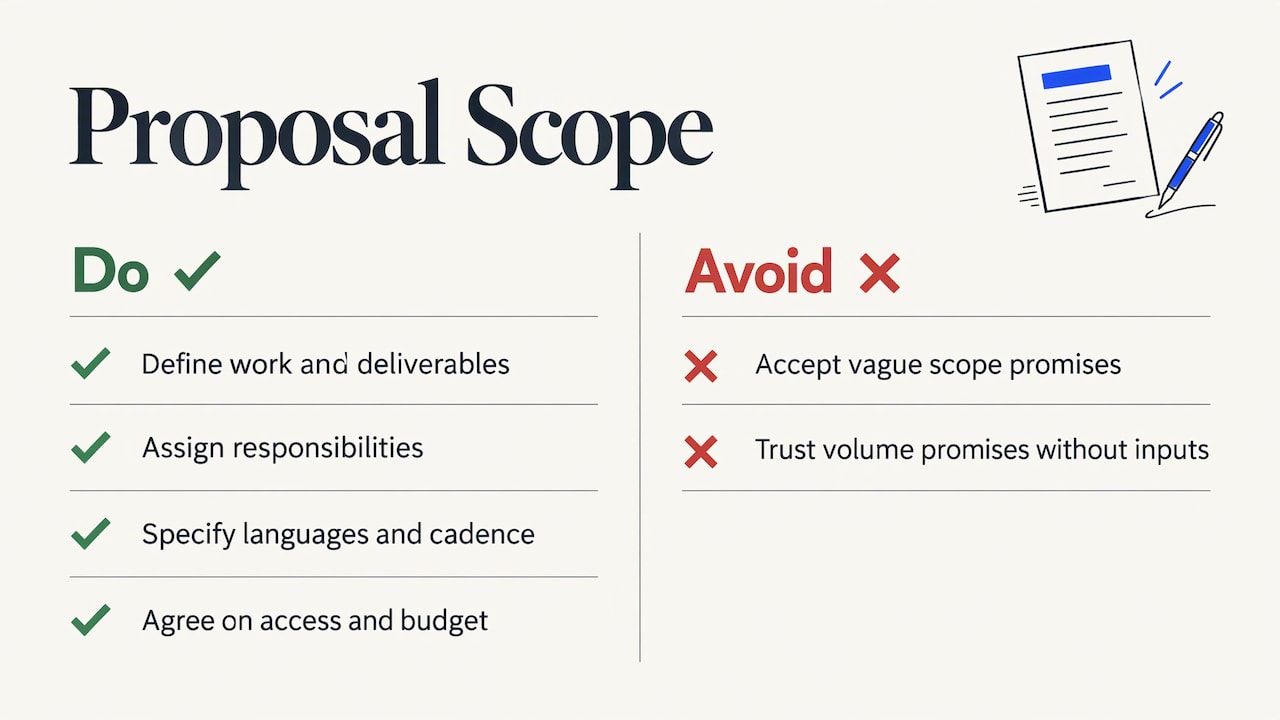
Where it goes wrong: vague scope with output promises. Be wary of volume promises that ignore your inputs, because content built from your expertise depends on how fast you can supply it.
### 3. Hand over your raw material
Provide product documentation, sales decks, support tickets, past articles, customer language and a named person for fact questions. This step decides the quality ceiling. Thin input produces generic text whoever writes it.
### 4. Agree the editorial standard in writing
A tone-of-voice paragraph is not enough. Write down audience, reading level, banned phrases, how claims are sourced, how numbers are cited, and what needs legal or expert review. Elizabeth Irvine, in a [Siteimprove article on scaling content operations with external partners](https://www.siteimprove.com/blog/scaling-content-operations-with-external-partners/), recommends defining QA thresholds in advance, with checkpoints for voice and tone, SEO, accuracy and compliance. That is a sound template, and we use it below.
### 5. Start with a small, representative batch
Begin with a few pieces across your main formats, such as one guide, one commercial page and one update of an existing page. Review them against the standard and adjust the brief before the cadence ramps up.
### 6. Set the cadence and the review loop
Decide how often work ships, who approves, and how long review takes. Slow approvals are the most common cause of stalled programs, and they sit on your side of the table.
### 7. Measure on a monthly rhythm, adjust quarterly
Content compounds slowly. Review leading indicators monthly and strategic direction quarterly. More on what to measure below.
## A quality checklist you can reuse
Use this as a one-page review sheet for every deliverable. It is our adaptation of the checkpoint idea above, not a published standard.
| Checkpoint | Question | Owner |
| --- | --- | --- |
| Voice and tone | Would a customer recognize this as our company? | Marketing lead |
| Accuracy | Is every product claim true today, and every external figure linked to its source? | Subject expert |
| SEO | Does it answer one clear query, with sensible headings, internal links and metadata? | Content or SEO lead |
| Compliance | Does it meet industry, legal and brand rules for the markets it targets? | Legal or compliance |
| Usefulness | Does it contain something a competitor’s article does not: a method, a worked example, a decision aid? | Editor |
If a piece fails two checkpoints, send it back with the brief amended, not just the draft corrected. Repeated failures are brief problems.
## AI in outsourced content: what the rules actually say
Many teams worry that using AI in production invites penalties. Google’s published position is that [it rewards helpful, people-first content however it is produced](https://developers.google.com/search/blog/2023/02/google-search-and-ai-content), and that using automation primarily to manipulate rankings violates its spam policies. The test is quality and purpose, not tooling. We cover this in more depth in [AI content and Google: penalties or not](https://pharelia.com/en/blog/contenu-ia-penalite-google).
For you as a buyer, this means the question for any partner is not “do you use AI?” but “how is the work checked, and what is it built from?” AI content operations at Pharelia are one of the workstreams a proposal can include, applied to client content using the client’s internal expertise and documents.
## How to measure outsourced content
The most common measurement mistake is collapsing different signals into one “visibility” number. Keep these apart:
- **AI mentions:** your brand appears in a generated answer.
- **Citations:** your page is named or linked as a source in that answer.
- **Clicks:** a person clicks from a result or answer to your page.
- **Visits:** sessions on your site, from any source.
- **Enquiries:** forms, demo requests, calls attributable to content paths.
- **Revenue:** closed business your sales team connects to content-assisted journeys.
Each step down the list is harder to attribute and more valuable. A rise in mentions with flat clicks is a different situation from rising clicks with flat enquiries. The first is a visibility story, the second a conversion story, and the fix differs. No provider can honestly guarantee a ranking, a citation or a revenue figure, and we do not.
A reporting setup worth asking for shows these six numbers for the same period, by content group, with notes on what changed. Pharelia’s offer includes SEO/GEO measurement and performance tracking, and custom reporting or a dashboard can be part of an engagement depending on scope.
## How outsourced content is priced
I will be direct: published prices for managed content programs are rare, and the figures you find in blog roundups come from vendors with their own interests and different definitions of scope. We have not found an independent source that gives a reliable market-wide price, so we will not quote one. Pharelia’s pricing is on request, after scoping.
What moves a quote, in our analysis:
- **Scope breadth.** Strategy plus production plus technical work plus measurement costs more than production alone.
- **Cadence.** More pieces per month means more production and more review.
- **Languages and sites.** Each market adds editing and structural work.
- **Depth of expertise needed.** Technical or regulated subjects need more interviews and verification.
- **Your input.** Fast access to experts and documents shortens work. Slow access lengthens it.
- **Existing content.** A large library to optimize is a different job from a blank site.
### A worked example (illustrative figures)
This calculation is fictional and uses invented numbers to show the method. Replace them with yours. Currency: US dollars, for a US-based company.
A B2B software company compares two options for producing 4 expert articles a month for a year.
- **In-house hire:** one content marketer at an assumed $85,000 salary, plus an assumed 25% for benefits and overhead, is $106,250 a year. That person covers writing but not technical SEO or reporting, so assume a further $20,000 a year for tools and ad hoc specialist help. Total: $126,250, or $2,630 per article across 48 articles.
- **Managed engagement:** an assumed quote of $9,000 per month covering strategy, production, optimization and reporting is $108,000 a year, or $2,250 per article.
The point is not which number is lower, since the figures are invented. The point is to compare the same scope: count what each option leaves uncovered, and add your own team’s hours for briefing and review to both sides. Then divide by the business outcome you defined in step one, such as qualified enquiries, rather than by articles.
## Choosing and onboarding a partner
Use this decision matrix. Score each candidate from 1 to 5 on each row, then weight the rows by what matters to you.
| Criterion | What good looks like |
| --- | --- |
| Scope clarity | A written proposal naming deliverables, responsibilities, cadence, languages, access and budget |
| Strategy link | Content tied to your commercial goal and search demand, not only a list of articles |
| Use of your expertise | A process for interviews and internal documents |
| Quality control | Defined checkpoints for voice, accuracy, SEO and compliance |
| Measurement | Separate reporting for mentions, citations, clicks, visits, enquiries |
| Fit with your footprint | Experience with your type of site: B2B, multilingual, ecommerce, multi-brand |
| Honesty on outcomes | No guaranteed rankings, citations or revenue |
On fit, look at the customer stories. Ours include [Campus Consulting](https://pharelia.com/en/client-work/campus-consulting), where the aim was to connect content with business needs, and others collected on the [customer stories page](https://pharelia.com/en/client-work). If your site is a store, the [ecommerce SEO and content page](https://pharelia.com/en/solutions/e-commerce) shows how category and product pages are handled.
For onboarding, prepare a short pack: goals, audience, competitors, access to your CMS and analytics, a named approver, and a folder of source documents. Before production starts, agree on the first batch and the review dates. If your site needs structural work first, a technical review such as the one in our [SEO audit checklist](https://pharelia.com/en/blog/audit-seo-checklist) clarifies what should be fixed before content scales.
## Where outsourced content goes wrong
Capterra names the main risks: potential misalignment with brand voice, communication gaps and delays, and less control over the process. Each has a practical answer built into the steps above:
- **Voice drift** is handled by the written standard and the first-batch review.
- **Communication gaps** are handled by a named approver on each side and a fixed review rhythm.
- **Loss of control** is handled by scope clarity, shared access and the checkpoint sheet.
A fourth failure is not on that list: content that nobody uses. Articles that sales never sees and pages that never get updated are wasted. Build a simple habit of sharing new pieces with sales and scheduling updates.
> Our view: buy a system, not a word count Most advice on outsourcing content marketing treats it as a purchasing decision about words. We think that framing is the reason so many programs disappoint. Words are the visible part. What decides results is the system around them: why this topic, for whom, built from which of your facts, published where, updated when, measured how. That is why we run content as one coordinated service. Strategy, AI content operations, production, optimization and measurement are connected, and every engagement starts with scoping so the remit matches your goals, sites and languages. We work from your internal expertise and documents, because that is what separates your content from the generic text any competitor can publish. We also think the honest position on outcomes is the useful one. We do not guarantee rankings, citations or revenue, and you should be skeptical of anyone who does. What we can do is make the work clear, the reporting separated by signal, and the next decision obvious. *Louis Choquet*
## Work with Pharelia
If you want a managed team to run this system for you, our [article, guide and page production](https://pharelia.com/en/seo-geo-support#production) and [content and SEO/GEO strategy](https://pharelia.com/en/seo-geo-support#strategie) services are scoped to your goals, with pricing on request and no guaranteed results.
## FAQ
### What is outsourced content marketing?
It is the delegation of some or all content planning, creation, optimization and reporting to an external team. The company keeps ownership of goals, facts and approvals. Scope can range from a single format to a full coordinated program.
### Which content tasks should a B2B company keep in-house?
Keep the inputs and decisions only you can supply: business priorities, product knowledge, customer insight, compliance rules and final approval. Research, drafting, optimization, publishing and reporting can all be outsourced when they run from those inputs.
### How long before outsourced content shows results?
It depends on your site’s current authority, the competition and your cadence, so no honest provider can give a fixed figure. Review operational signals such as publishing cadence and quality scores monthly, and judge visits and enquiries over quarters.
### Is AI-assisted content a risk for rankings?
Google’s guidance says the focus is on helpful, people-first content, and that automation used mainly to manipulate rankings breaches its spam policies. Build quality checkpoints into the process and the production method matters less than the result.
### How is outsourced content marketing priced?
Price follows scope, cadence, languages, sites and how much expert input is needed. Pharelia scopes each engagement first and gives pricing on request.
### Discuss Your Content Marketing Priorities
Share your content marketing priorities by email to discuss a tailored remit, including its scope, deliverables, responsibilities and budget.
[Email us](mailto:contact@pharelia.com)
## Sources
- [How To Outsource Content Marketing, Capterra](https://www.capterra.com/resources/outsource-content-marketing/)
- [Scaling Content Operations with External Partners, Siteimprove](https://www.siteimprove.com/blog/scaling-content-operations-with-external-partners/)
- [B2B Content Marketing Insights for 2022, Content Marketing Institute](https://contentmarketinginstitute.com/b2b-research/b2b-content-marketing-insights-for-2022-more-budget-more-work-more-empathy-research)
- [Optimizing your website for generative AI features on Google Search, Google Search Central](https://developers.google.com/search/docs/fundamentals/ai-optimization-guide)
- [Google Search’s guidance about AI-generated content, Google Search Central](https://developers.google.com/search/blog/2023/02/google-search-and-ai-content)
## Recommended
- [Content Marketing ROI: How to Calculate It and Make It Credible](https://pharelia.com/en/blog/content-marketing-roi)
- [User-generated content: a guide for microbusinesses/SMEs](https://pharelia.com/en/blog/user-generated-content)
- [Why a steady publishing schedule beats perfection in SEO](https://pharelia.com/en/blog/moteur-de-contenu-cadence)
- [Digital marketing for businesses: a guide for small businesses and SMEs](https://pharelia.com/en/blog/marketing-digital-entreprise)