# Multilingual SEO Services: What to Buy and How to Scope It
What multilingual SEO services include, how to pick languages and markets, which technical setup to expect, and how to scope and measure the work.
Author: Louis Choquet · Founder, Pharelia
Author profile: https://pharelia.com/en/authors/louis-choquet
Published on 2026-11-12
Source: https://pharelia.com/en/blog/multilingual-seo-services
## Introduction

Multilingual SEO services should do one thing: make each language version of your site findable and useful for the people who search in that language. In practice that means market selection, local keyword research, a clean URL and hreflang setup, localized content, a maintenance workflow and reporting split by language. If a provider’s proposal is mostly translation plus a technical audit, you are buying a fraction of the job.
This guide is for marketing and SEO leaders, SaaS and B2B teams, and ecommerce teams deciding whether to hire help. Where we give a judgment, it is our analysis, not measured fact. Where a figure comes from someone else, it is linked.
## TL;DR
- Multilingual SEO is language-led: you serve languages, not only countries. International SEO targets countries and may use a single language.
- Start from market evidence (demand, revenue potential, support and legal readiness), not from a list of languages that sounds ambitious.
- Expect separate URLs per language, self-referencing hreflang, localized keyword research and a named owner for keeping versions in sync.
- Scope has two columns: what is included and what is explicitly excluded. Most disputes start in the second column.
- Measure by language, market and device, and keep AI mentions, clicks, visits, enquiries and revenue as separate lines.
### Scope multilingual SEO with clarity
Pharelia can tailor SEO and GEO support around your content strategy, production and optimisation needs, with the proposed remit defining what is included.
[Explore SEO and GEO support](https://pharelia.com/en/seo-geo-support)
## What multilingual SEO is, and how it differs from international SEO
Multilingual SEO is [a language-led approach](https://www.contentful.com/blog/multilingual-seo-best-practices/): you prioritize language over locale in how you target users and structure the site. International SEO targets several countries and does not have to involve more than one language.
The overlap is where teams get confused. [Search Engine Land’s example](https://searchengineland.com/multilingual-and-international-seo-5-mistakes-to-watch-out-for-453030) is useful: adapting a U.S. site into Spanish for U.S. residents is multilingual SEO, while a U.S. company expanding to Canada, the U.K. or Australia is international SEO. Many real projects are both, for instance a German-language site for Germany, Austria and Switzerland, each with its own pricing and legal text.
Why it matters when you buy: the two problems need different skills. A language problem needs linguists and local keyword research. A country problem needs pricing, currency, shipping, regulation and sometimes different domains. A provider who treats them as one will under-scope one of them.
## What a multilingual SEO service should include
We see the work as seven blocks. Not every engagement needs all of them, and a good proposal says which ones apply.
| Block | What it covers | Question to ask |
| --- | --- | --- |
| Market and language selection | Demand, revenue potential, support coverage, legal readiness | Which data decides the order of markets? |
| Keyword and intent research per language | Local queries, not translated English ones | Is research done natively in each language? |
| Architecture and technical setup | URL structure, hreflang, canonicals, indexation | Who implements it on the site? |
| Content production and localization | New pages and adapted pages | Who writes, who reviews, who approves? |
| Optimization of existing content | Fixing mismatched or outdated versions | How are priorities set? |
| Workflow and governance | Sync between source and translations, owners | Who owns updates after launch? |
| Measurement | Reporting by language, market and device | Which KPIs, in which tool? |
The last two are where purchases most often disappoint. Launching 12 language versions is a project. Keeping them accurate for three years is the service.
## How to choose languages and markets
The usual mistake is to start with a list of languages. [Stepes argues](https://www.stepes.com/resources/global-content-strategy/multilingual-seo-guide/) that the work should begin with market opportunity: a language can be used across many countries, and one country can contain several important language communities. It suggests weighing current and forecast demand, revenue potential, product availability, existing traffic, support coverage, legal readiness and fulfillment, then rating each market High, Medium or Low.
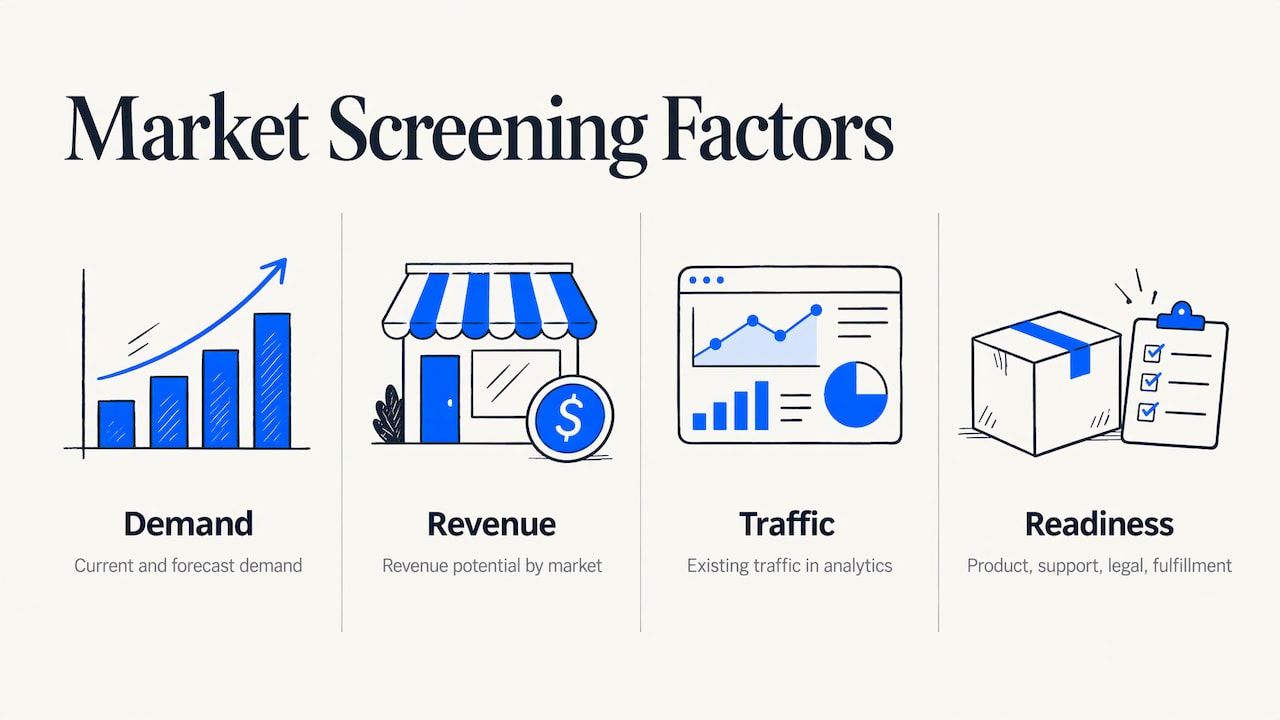
The cheapest evidence is already in your analytics. [Klaviyo’s guide](https://www.klaviyo.com/uk/blog/multilingual-marketing) recommends looking for organic visitors arriving with non-English browser settings and cross-referencing them with order data, to see where purchases already happen without any localization effort.
### A worked example (illustrative)
Imagine a B2B software company with an English-only site. All figures below are illustrative, not real data.
| Language | Organic sessions with that browser language (monthly) | Demo requests from them (monthly) | Sales team can support it? | Priority |
| --- | --- | --- | --- | --- |
| German | 1,200 | 9 | Yes | High |
| Spanish | 2,100 | 4 | Partly | Medium |
| Japanese | 300 | 0 | No | Low |
Spanish has the most traffic, but German converts and can be served. Our reading: German first, Spanish after support coverage is fixed, Japanese not yet. The point is the logic: traffic alone does not pick the market, the ability to answer an enquiry does.
## The technical setup you should expect
This is the part with the clearest official guidance, so a provider’s proposal should match it.
### One URL per language version
[Google recommends](https://developers.google.com/search/docs/specialty/international/managing-multi-regional-sites) different URLs for each language version rather than cookies or browser settings, because Googlebot usually sends requests without an Accept-Language header. It lists country-specific domains, subdomains and subdirectories as options and does not recommend URL parameters.
Between those options, [Ahrefs reports](https://ahrefs.com/blog/localization-seo/) that subfolders such as example.com/fr/ usually suit SEO better because they consolidate authority in one domain, while country-code domains can feel more local but split effort. Our analysis: for most B2B sites, subdirectories are the default, and a country domain needs a business reason such as legal presence or local trust.
### Hreflang
Per [Google’s documentation](https://developers.google.com/search/docs/specialty/international/localized-versions?hl=fr), hreflang tells Google about localized variations of the same content. Each version must reference itself and all other versions, and URLs must be complete, including the protocol. Google does not use hreflang or the HTML lang attribute to detect a page’s language, so the visible text still has to be in one language per page.
[Search Engine Land’s guide](https://searchengineland.com/guide/international-seo) adds practical rules: keep URL patterns consistent across regions (for example /fr/ and /es/), include an x-default tag as a fallback, and avoid mixing languages on one page.
### Canonicals
Canonical tags point to the preferred version of a page within one language, while hreflang links equivalents across languages. [One translation vendor’s guide](https://circletranslations.com/blog/multilingual-website-best-practices) warns that canonicalizing every page to English can get non-English pages dropped from the index. It is a common implementation error, and it is worth checking in any proposal that includes a technical audit.
If you need this implemented rather than only audited, see our [technical and international SEO](https://pharelia.com/en/seo-geo-support#seo-technique) scope.
## Translation is not localization
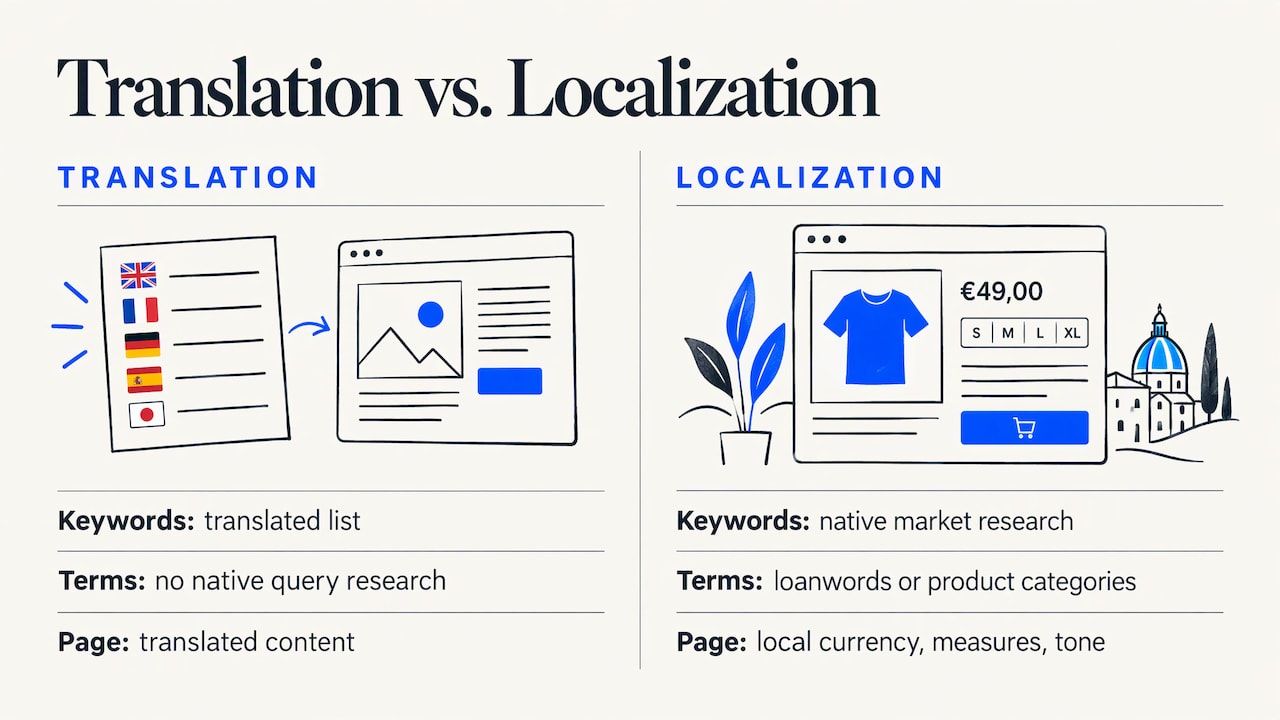
A provider that sells translated pages and calls it SEO is selling the first step. [Search Engine Land’s international SEO guide](https://searchengineland.com/guide/international-seo) puts it plainly: translation gets you started, and localization drives relevance. That means local keywords and phrasing, currency, measurements, legal disclaimers, tone, calls to action and cultural cues.
A concrete case: the English query you rank for may have no direct equivalent. People in another market may use a different term, a loanword or a competitor’s product category. Research done natively in that language finds this. A translated keyword list does not.
Our analysis: this is also where AI-assisted production helps or hurts. Machine drafts can speed up first versions across languages, but without a native reviewer and a brief built from your own product documents, you get fluent pages that miss how buyers search. We build content operations around internal expertise and documents, with review steps defined in the proposal.
## Workflow: how multilingual sites go wrong after launch
Most of the cost sits after the first publish. [Crowdin notes](https://crowdin.com/blog/content-governance-for-multilingual-websites) that many traditional CMS platforms keep each language version as a separate entry, often disconnected from the original, which creates duplicated structures and inconsistencies. It points to structured content models, clear editorial workflows and locale-based publishing control as remedies.
The [circletranslations.com guide](https://circletranslations.com/blog/multilingual-website-best-practices) makes the ownership point: without a defined update workflow, translated pages go stale, and without a named owner for synchronization, maintenance typically fails. We agree, and we would go further: ask any provider who owns each of these after launch.
- Updating translations when the English source changes
- Retiring or redirecting pages removed from the source
- Approving new terminology per language
- Checking hreflang and indexation after releases
A vendor-side caveat: guides from translation and localization platforms tend to recommend centralizing in a platform, which is also what they sell. Treat the principle (one source of truth, a clear owner) as sound and the tool choice as a separate decision.
## How to scope the service
A scope that lists only inclusions protects nobody. According to [SEO Beni’s contract guide](https://seobeni.com/blog/seo-contract-template-2026/), the enforceable version has two columns, included and explicitly excluded, because content production, developer implementation, migrations, translation, PR outreach and tool licences are often assumed by the client and excluded by the provider.
RuleDox’s template suggests sections for overview, deliverables, out of scope, timeline, roles, assumptions, acceptance criteria and commercials, and notes that markets and languages, content production and reporting cadence change what belongs in it.
Here is a checklist you can paste into your own brief:
1. **Markets and languages in scope** , and the criteria for adding one later.
2. **Who writes** each language’s content, who reviews it, who approves it.
3. **Who implements** technical changes on the site: your developers, the provider, or a third party.
4. **CMS access** and publishing rights per language.
5. **Translation** : included, excluded, or supplied by your team.
6. **Maintenance cadence** for existing pages.
7. **Reporting** : which dimensions, how often, in which tool.
8. **Assumptions** that must stay true, such as access to product experts for review.
9. **Acceptance criteria** for a delivered page or a delivered setup.
10. **What is excluded** , written out.
Prices vary widely with the number of languages, the size of the site and how much is production versus advice, so we do not quote ranges here. Ask each provider to price by block, so proposals can be compared on the same scope.
## Measuring multilingual SEO by language and market
A single sitewide organic line hides everything useful. [Search Engine Land’s measurement guide](https://searchengineland.com/guide/international-seo-best-practices) recommends GA4 custom dimensions and audience segmentation to track by market maturity, language and behavior, plus conversions including micro-conversions and customer lifetime value by geographic segment.
A layered setup is described by [Bright SEO Tools](https://brightseotools.com/post/track-international-seo-performance): core KPIs (visibility, traffic, conversions), diagnostic KPIs (indexing, coverage, hreflang, crawl) and market context such as seasonality and device mix. It suggests tracking by country, language and device to isolate why a market underperforms. That source is a lighter one, so we use it for the structure, not for any number.
Whatever tool you use, keep these as separate lines in every report:
| Metric | What it tells you | What it does not tell you |
| --- | --- | --- |
| Impressions and rankings per language | Visibility in that market | Whether anyone clicked |
| AI answer mentions and citations | Presence in generated answers | Visits or revenue |
| Clicks and organic visits | Traffic | Intent quality |
| Enquiries or demo requests | Commercial interest | Closed revenue |
| Revenue or pipeline by language | Business outcome | Which page caused it |
No service can guarantee rankings, citations or traffic gains. You can reasonably ask for a clear plan, clear reporting and honest diagnostics when a market lags.
On the size of the upside, [Ahrefs states](https://ahrefs.com/blog/multilingual-seo/) that leading brands see an average organic traffic lift above 58% from multilingual SEO. That is a vendor-published figure from a 2017 article about large brands, so treat it as an illustration of potential, not a forecast for your site.
## Perspective
> Our view is that multilingual SEO is a content-operations problem wearing a technical costume. Hreflang and URL structure can be specified once and checked. What decides results over years is whether each language has its own research, its own reviewed pages and an owner who updates them. That is why we do not sell multilingual SEO as a translation job or a one-off audit. The work we offer connects strategy, AI-assisted content operations, production, optimization of existing pages and measurement, and the proposal defines which of those apply, in which languages, with what access and cadence. The scope is tailored because a five-language industrial catalog and a two-language SaaS site do not need the same thing. Our advice when you compare providers: pay for the parts that are hard to fake, which are native keyword research, review by someone who knows your product, and reporting split by language. Be wary of any proposal that cannot say what it excludes. *Louis Choquet*
## Doing it in-house or hiring help
In-house works when you have native-level editors per language, developer time for the setup and a person who owns the workflow. Hiring help makes more sense when you need to coordinate strategy, production and technical changes at once, or when several brands or websites must share one structure. Our [Groupe Squadra case](https://pharelia.com/en/client-work/groupe-squadra) shows how we approach a shared structure across a group site.
If you are choosing between agency types, compare them on the same criteria: scope blocks, language coverage, who implements, reporting and exclusions. Do not rank on a price line alone, since a low price usually means more sits in the excluded column.
## How we can help
We run managed SEO and GEO engagements for B2B and ecommerce teams, covering [content and SEO/GEO strategy](https://pharelia.com/en/seo-geo-support#strategie), production, optimization and measurement, with multilingual and international needs scoped in the proposal. Pricing is on request, and the remit is built around your markets, languages and access. You can start from the [managed SEO and GEO services page](https://pharelia.com/en/seo-geo-support) and bring the checklist above.
## FAQ
### Is multilingual SEO the same as international SEO?
No. Multilingual SEO is about serving several languages, even within one country. International SEO is about targeting several countries and may use one language. Many sites need both, and a good scope names which markets and which languages it covers.
### Should I use subdirectories, subdomains or country domains?
Google supports all three and recommends separate URLs per language, but not URL parameters. Subdirectories such as /de/ are often the simplest choice because authority stays on one domain. Country domains fit cases with a real local presence or legal requirement.
### Do I need hreflang on every page?
On every page that has an equivalent in another language, yes. Each version should reference itself and all its alternates with complete URLs, and an x-default is recommended as a fallback. Pages with no translation should not point to a version that does not exist.
### Is machine translation enough for SEO?
It can produce a draft, but a draft is not localization. Pages still need local keyword research, correct currency, measurements and legal text, and review by someone fluent in the market. Quality and usefulness to the reader are what you are paying for.
### How do I know if the service is working?
Report by language, market and device, and keep visibility, AI mentions, clicks, enquiries and revenue as separate lines. Compare each language against its own baseline, since a new market usually starts from zero. A diagnostic layer (indexing, hreflang, crawl) explains underperformance.
### Discuss your multilingual SEO scope
Email Pharelia to outline your languages, markets and website needs, and discuss which SEO and content work belongs in the remit.
[Email Pharelia](mailto:contact@pharelia.com)
## Sources
- [Multilingual SEO best practices, Contentful](https://www.contentful.com/blog/multilingual-seo-best-practices/)
- [Multilingual and international SEO: 5 mistakes, Search Engine Land](https://searchengineland.com/multilingual-and-international-seo-5-mistakes-to-watch-out-for-453030)
- [Multilingual SEO Guide, Stepes](https://www.stepes.com/resources/global-content-strategy/multilingual-seo-guide/)
- [Multilingual marketing guide, Klaviyo](https://www.klaviyo.com/uk/blog/multilingual-marketing)
- [Managing multi-regional and multilingual sites, Google Search Central](https://developers.google.com/search/docs/specialty/international/managing-multi-regional-sites)
- [Localization SEO, Ahrefs](https://ahrefs.com/blog/localization-seo/)
- [Localized versions of your pages, Google Search Central](https://developers.google.com/search/docs/specialty/international/localized-versions?hl=fr)
- [International SEO guide, Search Engine Land](https://searchengineland.com/guide/international-seo)
- [Multilingual website best practices, circletranslations.com](https://circletranslations.com/blog/multilingual-website-best-practices)
- [Content governance for multilingual websites, Crowdin](https://crowdin.com/blog/content-governance-for-multilingual-websites)
- [SEO contract template, SEO Beni](https://seobeni.com/blog/seo-contract-template-2026/)
- [International SEO measurement, Search Engine Land](https://searchengineland.com/guide/international-seo-best-practices)
- [Track international SEO performance, Bright SEO Tools](https://brightseotools.com/post/track-international-seo-performance)
- [Multilingual SEO, Ahrefs](https://ahrefs.com/blog/multilingual-seo/)
## Recommended
- [B2B SEO agency for the French market](https://pharelia.com/en/solutions/b2b)