# Enterprise SEO Services: What You Actually Buy and How to Choose
What enterprise SEO services include, what they cost, how to measure them and how to choose a provider, with a decision matrix and a worked example.
Author: Louis Choquet · Founder, Pharelia
Author profile: https://pharelia.com/en/authors/louis-choquet
Published on 2026-11-12
Source: https://pharelia.com/en/blog/enterprise-seo-services
## Introduction

Enterprise SEO services are managed programs that improve organic visibility for large, complex websites: thousands or millions of URLs, several teams, often several brands, domains or languages. The work is mostly not “more SEO”. It is the same fundamentals, applied through governance, engineering pipelines and reporting that a smaller site never needs. Our analysis: choose a provider on how it gets changes shipped and verified inside your organization, not on the length of its service list.
## TL;DR
- Enterprise SEO uses the same principles as regular SEO, but scale, approvals and technical debt make implementation the hard part ( [Search Engine Land](https://searchengineland.com/guide/enterprise-seo) ).
- Retainers for enterprise work are commonly reported at $5,000 to $15,000+ per month in one 2026 agency pricing survey, a global benchmark rather than a quote ( [Goodfirms](https://www.goodfirms.co/resources/seo-pricing-plans) ).
- Judge a provider on five things: ownership mapping, a ship-and-verify process, template-level fixes, reporting for two audiences, and a clear split between your team and theirs.
- Measure in separate layers: AI mentions, citations, clicks, visits, enquiries and revenue are different numbers and should never be merged in a report.
- No honest provider can guarantee rankings or citations. Treat a guarantee as a reason to ask harder questions.
### Make Enterprise SEO Work at Scale
Pharelia scopes managed SEO and GEO support around your organisation’s needs, with the remit and deliverables defined in the proposal.
[Explore SEO and GEO support](https://pharelia.com/en/seo-geo-support)
## What enterprise SEO services are
Enterprise SEO is search optimization for large organizations, designed around scale, complexity and operational needs, often across global markets. [Semrush describes](https://www.semrush.com/blog/enterprise-seo/) the defining difference this way: the person who finds a problem is rarely the person who can fix it, and one change can touch thousands or millions of pages. That is why templated implementations and coordinated execution matter more than any single tactic.
Search Engine Land frames it as improving visibility for sites with thousands of pages or more, where [the basic principles stay the same](https://searchengineland.com/guide/enterprise-seo) while implementation and complexity grow. We agree with that framing, and it has a practical consequence. If a provider sells you “enterprise” as a premium tier of the same audit and keyword list a 50-page site gets, you are paying for a label.
A useful way to see the difference is to ask who has to say yes. On a small site, one person edits a title tag. At scale, a title template change needs a developer, a regional marketer, sometimes legal, and a release window. The service you are buying is the machinery that moves that change through.
## What the work can include
No two engagements look alike, and any list is a menu rather than a package. These are the work areas that most commonly appear in enterprise scopes:
| Work area | What it covers | Where it usually bites |
| --- | --- | --- |
| Strategy and governance | Priorities by market, brand and page type; ownership and approval paths | Siloed teams optimizing small things while nobody owns the whole |
| Technical SEO | Crawl and index control, templates, rendering, internal linking, redirects, migrations | Legacy CMS platforms and change freezes |
| International SEO | Hreflang, language and country structures, market-specific content | Interconnected sites across many language and country pairs |
| Content production | Articles, guides, category and product pages from internal expertise | Subject-matter experts with no time, brand and legal review |
| Content optimization | Updating, consolidating and pruning existing pages | Thousands of pages with no clear owner |
| AI answer visibility | Making content easy for AI answer engines to find, understand and cite | Measurement is immature and unstable |
| Measurement | Diagnostic reporting for technical teams, business reporting for executives | Connecting organic work to pipeline and revenue |
The challenges in the right-hand column are documented. [Search Engine Land lists](https://searchengineland.com/guide/enterprise-seo) siloed teams and conflicting priorities, technical debt from legacy CMS platforms, multi-viewpoint approvals, change freezes around sale periods, international complexity and structural changes such as mergers, domain changes and platform migrations. A good scope names which of these apply to you and says what will be done about each.
### International complexity is a good example
Hreflang is the classic place where scale breaks things. One vendor study, [Seology.ai](https://seology.ai/blog/enterprise-seo-strategy-guide), reports that 68% of enterprise sites have hreflang errors. That figure comes from a company blog, so read it as a signal rather than a precise rate. The point stands either way: when a site has dozens of country and language versions that must reference each other correctly, small errors multiply, and an annual audit will not catch them.
## How an engagement should run
The most useful idea in the research is that enterprise SEO is a delivery problem. [Phloz suggests](https://phloz.com/blog/enterprise-seo-project-management) a pipeline for engineering recommendations: specced, ticketed, prioritized, deployed, verified. The last stage deserves its own tracking, because a fix that is deployed but broken costs more than one that was never shipped. That is a company-blog recommendation, not a standard. We still find it a sound test of a provider.
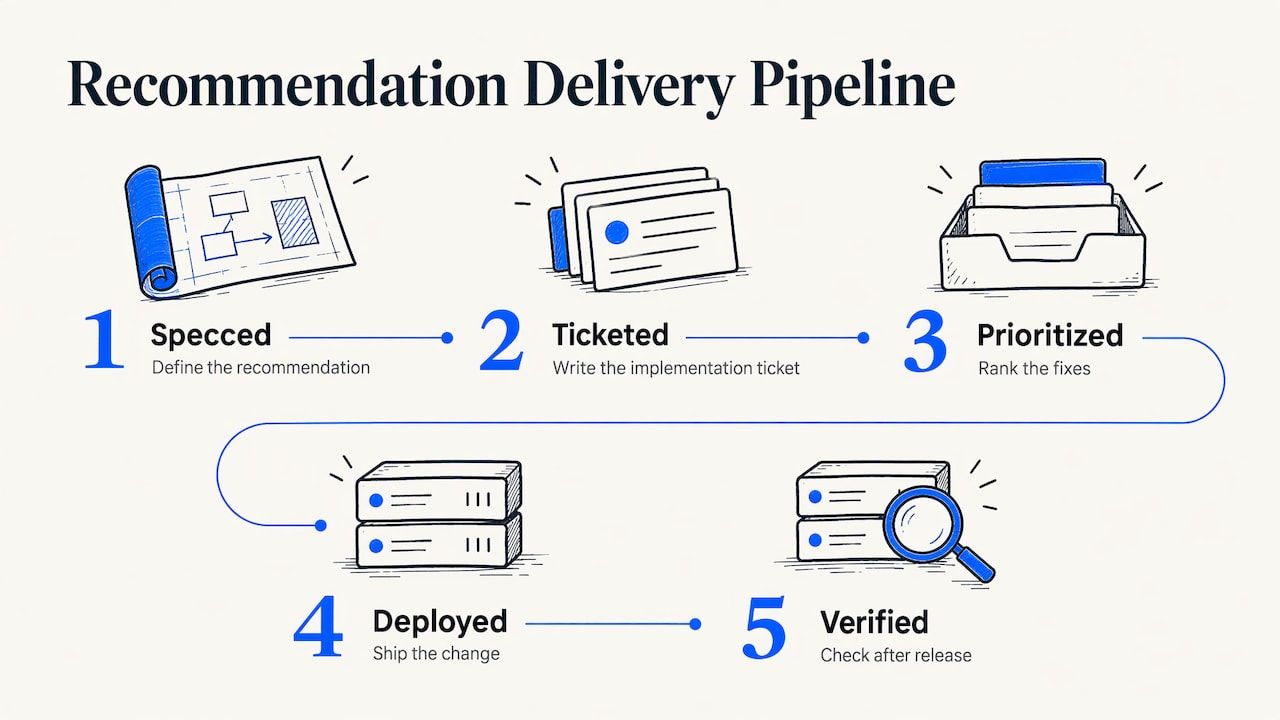
Ask any candidate to walk you through this on a real kind of problem. For example: a canonical tag template is wrong on a product category template. Who writes the ticket? What does the ticket contain? Who checks it after release, and against what?
### Ownership and approvals
Semrush notes that fixes often need sign-off from [several teams](https://www.semrush.com/blog/enterprise-seo/): engineering for templates and code, content or regional marketing for copy, brand or legal for regulated categories. An engagement should start by mapping these paths. The map is unglamorous and it is the single document that most predicts whether recommendations ever reach production.
### Governance
Without governance, in Search Engine Land’s description, siloed teams [can each optimize a small element](https://searchengineland.com/guide/enterprise-seo) while nobody considers the bigger picture. Governance in practice means a named owner per page type, a shared priority list, rules for who may change templates, and a regular review where the SEO lead can escalate a blocked fix.
## How to measure it
Separate what you report from what you can prove. We recommend keeping these as distinct lines in every report:
1. **AI mentions:** your brand appears in an answer.
2. **AI citations:** your page is cited as a source in an answer.
3. **Clicks and visits:** traffic from search or from an answer engine.
4. **Enquiries:** forms, demo requests, quote requests.
5. **Revenue:** closed business attributed to organic work.
Each step loses information. A mention is not a citation, a citation is not a click, and a click is not an enquiry. Blending them produces a flattering chart and a useless decision.
Reporting also needs two audiences. [Semrush says](https://www.semrush.com/blog/enterprise-seo/) technical teams need diagnostic detail to confirm a fix worked, while executives need results in business terms, compared with the cost, time and approvals required. For the executive layer, [Search Engine Journal outlines](https://www.searchenginejournal.com/how-to-define-report-seo-kpis-that-actually-move-the-c-suite/576233/) an approach tracking organic-sourced pipeline, organic-assisted pipeline, organic-influenced revenue, CAC comparison and ROI, chained from page performance to sessions to conversions to opportunities to closed revenue.
Our opinion: the “influenced revenue” line is the easiest to inflate. Keep sourced and influenced pipeline separate, and write down the attribution rule before the first report, not after a quarter that looks good.
## What enterprise SEO costs
Pricing is the part most ranking pages dodge, and it varies too widely for any single number to be honest. One 2026 survey from [Goodfirms](https://www.goodfirms.co/resources/seo-pricing-plans) reports typical monthly retainers of $1,500 to $5,000 overall, $5,000 to $15,000+ for enterprise SEO, and a GEO or AEO add-on of roughly $900+ per month, with monthly retainers the most common model (78.2%). These are US dollar figures from a directory’s survey of agencies, with its own sampling, so treat them as a rough orientation and not as a quote from any provider, including us.
What moves the price, in our analysis:
- **Number of sites, brands and markets.** Every additional language or domain adds technical and editorial work.
- **Who implements.** If the provider also edits content and ships to the CMS, the scope is bigger than one that hands recommendations to your developers.
- **Content volume and expert input.** Production from internal documents and interviews takes coordination time.
- **Measurement depth.** Custom dashboards and pipeline attribution cost more than standard reports.
- **Duration and cadence.** Migrations and replatforming are project-shaped; steady optimization is retainer-shaped.
Pharelia does not publish prices. Scope is tailored, and the proposal defines work, deliverables, responsibilities, languages, cadence, access and budget. That is also what you should expect from any serious provider: a price that follows a written scope.
## Decision matrix: do you need managed enterprise SEO?
Score each row from 0 to 2 (0 = not true, 1 = partly, 2 = clearly true). This is our own illustrative rubric, not a validated model.
| Criterion | What a 2 looks like |
| --- | --- |
| Scale | Thousands of URLs, or several sites or brands |
| Markets | Multiple languages or countries with live hreflang |
| Delivery friction | Recommendations stall for weeks in approvals or developer queues |
| Internal capacity | No dedicated SEO team, or one person without engineering access |
| Content demand | A large backlog of pages to write or refresh, with expert input scattered across documents |
| Measurement gap | Leadership cannot see how organic ties to pipeline |
**0 to 4:** you likely need a consultant or a one-off technical review, not a managed program. **5 to 8:** a scoped, managed engagement on the two or three rows where you scored 2 is reasonable. **9 to 12:** a broader, coordinated program probably pays off, with governance as the first deliverable.
### Worked example (illustrative)
Take a fictional industrial group with four regional sites and 12,000 URLs. It scores 2 on scale, 2 on markets, 2 on delivery friction, 1 on internal capacity, 1 on content demand and 2 on measurement gap: 10 of 12. The first quarter would not start with new articles. It would start with the ownership map, a fix pipeline with verification and a baseline for each of the five measurement layers. Content would follow once template issues stop undermining it. All figures here are invented for illustration.
## How to compare providers on equal criteria
Rankings of agencies are easy to find, and many are published by agencies themselves or by directories whose placement rules are not always clear. Instead of a league table, use the same questions with every candidate, and ask for the answers in writing.
| Question | Strong answer | Weak answer |
| --- | --- | --- |
| How do fixes get shipped? | Named pipeline from spec to verification | “We send a report” |
| Who owns what? | Written responsibilities for both sides | Vague “partnership” |
| How is success reported? | Separate layers, rule for attribution | One blended traffic line |
| What about AI answers? | Mentions and citations tracked apart from clicks | Promises of guaranteed citations |
| What do you need from us? | Specific access and named contacts | “Nothing, we handle it” |
| What are the limits? | States what it does not cover | Everything is included |
Platform vendors and agencies also solve different problems. Software tracks and diagnoses at scale; it does not negotiate with your engineering lead. A managed service does the coordination but depends on your access. Many large organizations need both, and the useful question is which gap is currently costing more.
Our position for a defined use case: if your bottleneck is delivery and content, where the strategy exists but pages are not written, fixed or measured, a managed service fits. If your bottleneck is tooling and you have a capable in-house team, software and a consultant on call fit better. Avoid a managed provider if you cannot grant CMS or developer access, because nothing in this model works without it.
## Perspective
> We think enterprise SEO is mostly a coordination discipline with a search specialty attached. The recurring failure is not a missing tactic. It is a correct recommendation that dies between the SEO lead, the developer queue and the legal review. That is why we build engagements around one connected chain: strategy, AI content operations, production, optimization and measurement, scoped to the organization rather than sold as a fixed package. The remit, the deliverables and who is responsible for what are written down before work starts. We also separate what we can influence from what we cannot. We do not guarantee rankings or AI citations, and we report mentions, citations, visits, enquiries and revenue as different things. For multi-brand and multi-market organizations, that discipline is what makes the numbers trustworthy enough to act on. *Louis Choquet*
## Three habits we would retire
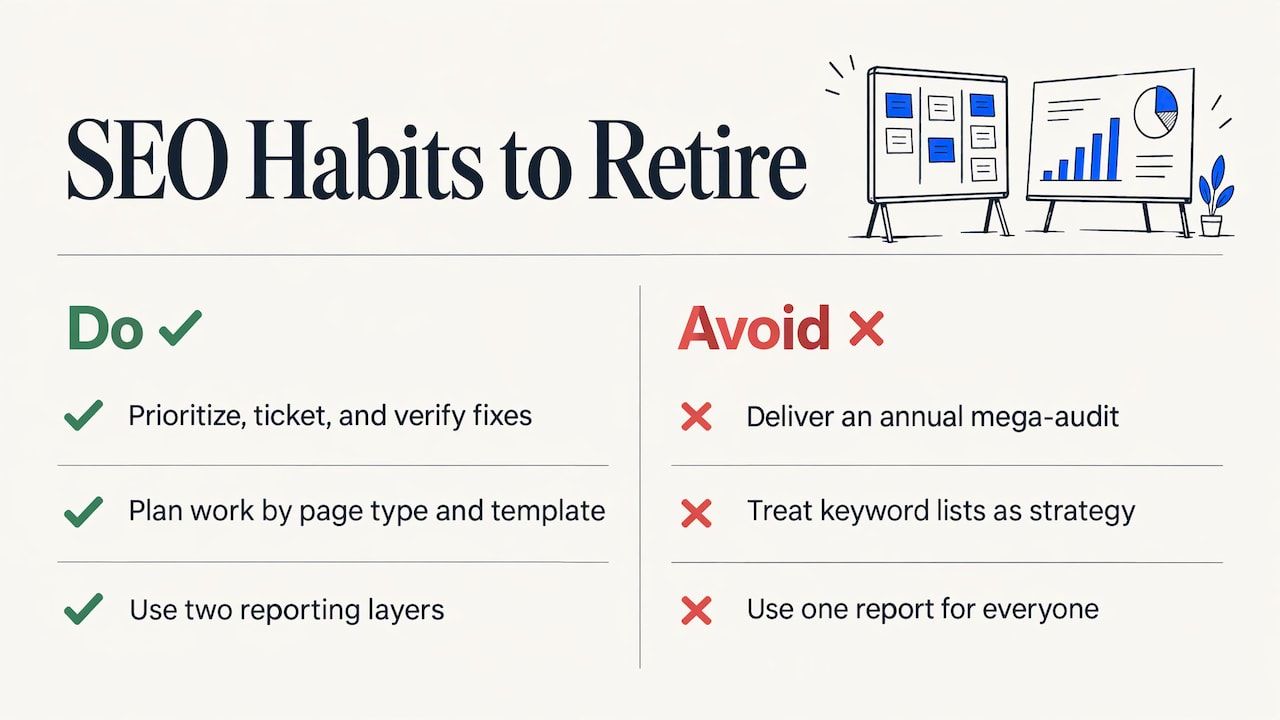
Our analysis, not measured fact: three common practices cost enterprise teams more than they return.
**The annual mega-audit.** A 200-page PDF delivered once a year is a snapshot of a site that changes weekly. It is a very expensive way to produce a document nobody can deploy. A short list of prioritized, ticketed fixes with verification beats it.
**Keyword lists as strategy.** At scale, the unit of work is the page type and the template, not the keyword. Deciding how category pages, product pages, guides and regional variants should be built does more than a spreadsheet of ten thousand terms.
**One report for everyone.** Engineers need diagnostic detail and executives need business terms. A single dashboard usually serves neither, which is why we favor two reporting layers from the start.
For ecommerce teams the same logic applies to category and product templates, where one fix can repair thousands of pages at once, and where change freezes during sale periods set the calendar for everything else.
## Where Pharelia fits
Pharelia is a managed service for B2B organizations, with ecommerce where relevant. Our scope can include [content and SEO/GEO strategy](https://pharelia.com/en/seo-geo-support#strategie), [technical and international SEO](https://pharelia.com/en/seo-geo-support#seo-technique), production, optimization and [measurement](https://pharelia.com/en/seo-geo-support#mesure), depending on the engagement. Pricing is on request after scoping; you can start from the [managed SEO and GEO services page](https://pharelia.com/en/seo-geo-support). Ecommerce teams can look at our [ecommerce SEO audit and content work](https://pharelia.com/en/solutions/e-commerce).
## A short checklist before you sign
1. Write down your three biggest blockers and who owns each.
2. Decide which markets, brands and page types are in scope.
3. Confirm which access the provider will have: CMS, analytics, search console, staging.
4. Agree the five reporting layers and the attribution rule in advance.
5. Ask what a deployed-but-broken fix triggers in their process.
6. Get the budget tied to a written scope, with a review point rather than an open-ended commitment.
## FAQ
### What are enterprise SEO services?
They are managed search optimization programs for large, complex organizations, covering strategy, technical and international SEO, content, measurement and the coordination needed to ship changes across teams. The principles match regular SEO. The difference is scale and approvals.
### How much do enterprise SEO services cost?
One 2026 survey reports enterprise retainers of $5,000 to $15,000+ per month in US dollars, as a global benchmark ([Goodfirms](https://www.goodfirms.co/resources/seo-pricing-plans)). Real prices depend on sites, markets, content volume, implementation responsibility and reporting depth. Expect a quote to follow a written scope.
### Do enterprise SEO services cover AI search?
Often, but not always, so check the scope. AI answer visibility is a distinct workstream with its own measures: mentions and citations should be tracked separately from clicks. No provider can guarantee citations.
### Should we hire an agency or buy a platform?
It depends on the bottleneck. Platforms help a capable in-house team diagnose and track; a managed service helps when strategy exists but delivery, content and measurement are stuck. Many large organizations use both.
### How long before results show?
It depends on the site, the backlog and how fast fixes ship. We do not promise a timeline or an outcome. Ask any provider which leading indicators, such as fixes verified in production, you will see before traffic and revenue move.
### Discuss Your Enterprise SEO Scope
Email Pharelia to discuss your organisation’s search visibility needs and the SEO or GEO work that may fit your remit.
[Email Pharelia](mailto:contact@pharelia.com)
## Sources
- [Enterprise SEO: What it is & how to build a winning strategy (Semrush)](https://www.semrush.com/blog/enterprise-seo/)
- [Enterprise SEO Guide: Strategies for Scalable Search Success (Search Engine Land)](https://searchengineland.com/guide/enterprise-seo)
- [Enterprise SEO Strategy: Scale SEO for 10,000+ Pages (Seology.ai)](https://seology.ai/blog/enterprise-seo-strategy-guide)
- [Enterprise SEO project management: a practical guide (Phloz)](https://phloz.com/blog/enterprise-seo-project-management)
- [How To Define & Report SEO KPIs That Actually Move The C-Suite (Search Engine Journal)](https://www.searchenginejournal.com/how-to-define-report-seo-kpis-that-actually-move-the-c-suite/576233/)
- [SEO Pricing Plans: How Much Does SEO Cost in 2026? (Goodfirms)](https://www.goodfirms.co/resources/seo-pricing-plans)
## Recommended
- [B2B SEO agency for the French market](https://pharelia.com/en/solutions/b2b)
- [E-commerce SEO agency: audit and content](https://pharelia.com/en/solutions/e-commerce)