# Content Governance: A Practical Model for Teams at Scale
Content governance explained with a clear position: five decisions, three models, a RACI example, metrics and AI rules for teams running many pages or sites.
Author: Louis Choquet · Founder, Pharelia
Author profile: https://pharelia.com/en/authors/louis-choquet
Published on 2026-11-12
Source: https://pharelia.com/en/blog/content-governance
## Introduction

Content governance is the set of decisions that tells everyone in an organization what content belongs on your sites, who can request, approve and publish it, what it must meet before it goes live, how long it stays, and when it is retired. Our position: most teams do not need a thick governance manual. They need those five decisions written down, one accountable owner per content area, and a few metrics that show whether the rules change anything. This guide shows how to get there, which model fits which organization, and where AI-assisted production changes the rules.
## TL;DR
- Content governance is five decisions, not a document: scope, roles, quality gates, lifecycle and retirement. If a rule does not change a decision, cut it.
- Pick the model by how many teams publish and how much risk their content carries. In our analysis, a hybrid model fits most multi-brand or multi-site organizations, a centralized one fits small or heavily regulated teams.
- Name one accountable person per content area. ‘Everyone is responsible’ is not an owner.
- Measure outcomes (defects, time to fix, freshness), not activity (pages reviewed). Keep AI mentions, citations, clicks, visits, enquiries and revenue as separate lines.
- Govern AI-assisted content through approved sources, risk-based review and human accountability. Do not rely on volume alone.
### Make Content Rules Work at Scale
Pharelia helps teams shape content and SEO/GEO strategy, produce articles and pages, and optimise existing content around a tailored remit.
[Explore SEO and GEO support](https://pharelia.com/en/seo-geo-support)
## What content governance is, and what it is not
Vendors define it in slightly different words, but the core is stable. One enterprise CMS vendor describes it as [the rules, processes and protocols that define how an organization identifies, creates, publishes, maintains and archives content](https://blog.blackbaud.com/content-governance-overview/). Another says it [aligns content operations with brand and business needs, regulatory standards and quality expectations](https://www.contentful.com/blog/what-is-content-governance/). These are vendor definitions, and they are consistent with each other. We use them as the working definition.
What it is not matters just as much:
- **It is not content strategy.** Strategy decides what content should exist to reach which audience and business goal. Governance decides how that content is controlled once many people touch it. You can have a strong strategy and chaotic governance, and the reverse.
- **It is not a style guide.** A style guide is one standard inside governance. Governance also says who enforces it and what happens when someone ignores it.
- **It is not a tool.** A CMS can enforce permissions and workflows, but it cannot decide who is accountable. Teams that buy the tool first usually encode their confusion in software.
- **It is not control of every word.** The goal is consistent decisions, not a bottleneck with a legal department’s face.
The case for doing it is mostly about waste and risk. A Templafy survey of 2,000 global workers, published by the vendor, reports that [94% of employees regularly find errors in documents marked final, and 62% waste time recreating content that already exists](https://www.templafy.com/content-governance/). Treat that as a vendor claim from a survey in the document-management space, not a benchmark for web content. It still matches what we see described everywhere: duplicated pages, outdated claims, and no one sure who can approve a change.
## The five decisions every governance setup must make
Stripped down, a governance framework answers five questions. This is a framing we share with [practitioner Ellen Harvey](https://www.ellenharvey.com.au/articles/how-to-build-a-content-governance-framework), who frames governance as consistent decisions on scope, roles, quality gates, lifecycle and retirement. Here is how we apply it.
1. **Scope.** What content belongs on the site, and what does not? Without a scope, every department adds a page and nobody removes one. Write a one-paragraph scope per site and per content type (product pages, guides, news, documentation).
2. **Roles.** Who can request, create, approve and publish? Section below.
3. **Quality gates.** What must be true before publishing: factual check, brand and tone, legal or compliance review when the claim requires it, SEO and accessibility checks.
4. **Lifecycle.** How long does a page live before it must be reviewed? A pricing page and an evergreen guide do not need the same cycle.
5. **Retirement.** What happens when a page no longer serves users: update, merge, redirect, archive or delete, and who decides.
Most frameworks published by vendors list more components, such as [ownership, standards, approval gates, compliance rules, lifecycle policies and measurement](https://wpengine.com/blog/content-governance/). They are all variations on these five. If your framework has twelve sections and none of them says who can delete a page, it is decorative.
## Choosing a governance model: centralized, distributed or hybrid
The three models differ in who publishes. The Nielsen Norman Group, writing about intranets but with logic that applies to any large site, describes [a centralized model where a central team approves and publishes, a distributed model where content administrators publish independently, and a hybrid where a central team handles some content while others publish under shared guidelines](https://www.nngroup.com/articles/intranet-content-management/). Their view is that hybrid balances contributor freedom with a framework in which central administrators protect navigation, relevance, writing style and presentation.
On large enterprises, one CMS vendor says the [hybrid hub-and-spoke model is common](https://kontent.ai/blog/enterprise-content-governance-model-for-decision-making/), because accountability and production sit in business units while a central team coordinates shared standards and specialized work. That is a vendor observation, not a measured prevalence, so we treat it as plausible rather than proven.
### A decision matrix you can reuse
The matrix below is our analysis, not measured fact. Score your organization honestly against each row.
| Situation | Centralized | Distributed | Hybrid |
| --- | --- | --- | --- |
| One brand, one site, a small team | Fits well | Unnecessary | Overbuilt |
| Heavy regulatory or legal exposure on most pages | Fits well | High risk | Fits if central owns the claims |
| Several brands or country sites with local expertise | Slow, local knowledge lost | Inconsistent, duplicated | Fits well |
| Technical or product content written by engineers or subject experts | Bottleneck | Quality varies | Fits well with editorial support |
| Ecommerce catalog with thousands of product pages | Impossible without automation | Data inconsistencies | Fits when product data has a single source |
| No one has time to run a central team | Fails | Drifts | Fails unless a hub is staffed |
How to read it: the winner depends on the use case. For a single-site B2B company with a small marketing team, centralized is the right answer, and adding committees is the mistake. For a group with several brands, hybrid is our pick: shared standards, one hub that owns them, and local owners who publish.
Who should avoid hybrid: organizations that cannot staff the hub. A hybrid model with a hub that is one overworked person becomes a centralized model with extra meetings. In that case, start centralized for the highest-risk content and delegate gradually.
Where hybrid fails: it breaks when the line between central and local content is vague. Decide explicitly which things the hub owns (navigation, templates, brand claims, legal text) and which things locals own (topic selection, examples, local detail).
## Roles and the RACI matrix
The role list is rarely the problem. The usual set is [author, editor, content owner, subject-matter expert, legal or compliance reviewer, brand or marketing manager and publisher](https://easycontent.io/resources/roles-and-responsibilities-in-content-governance/). The problem is that several people hold a role and nobody holds accountability.
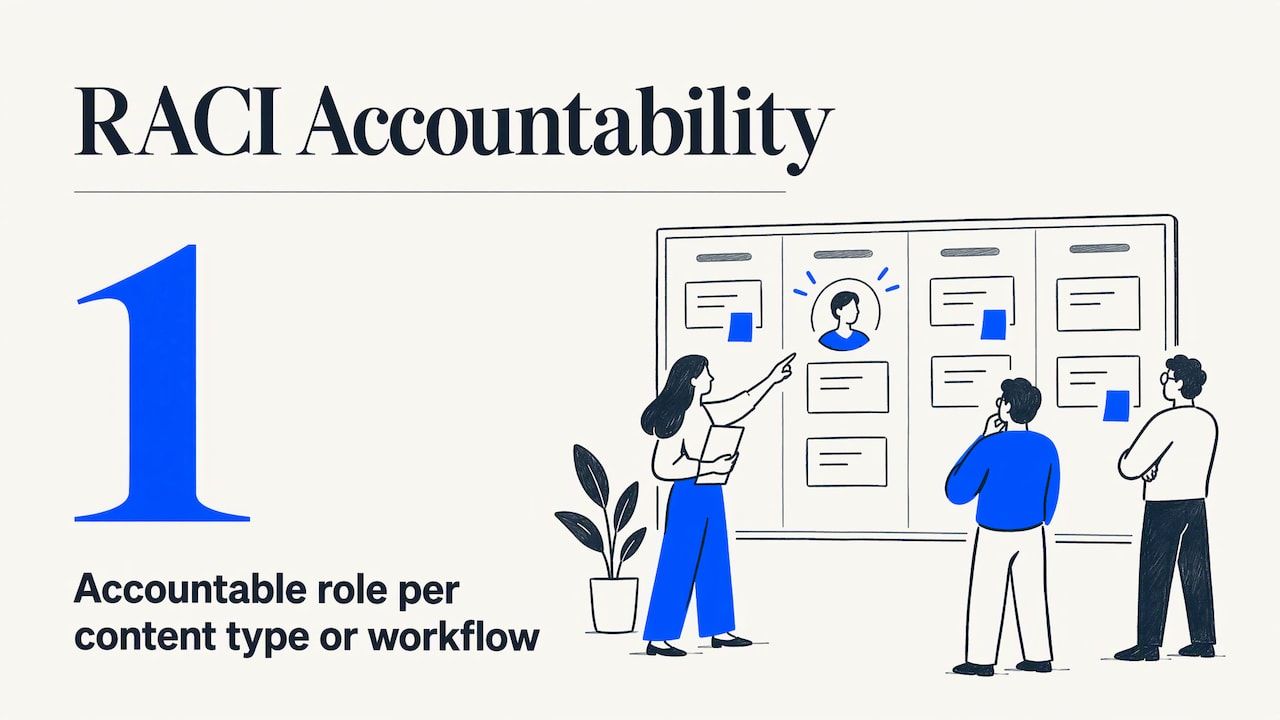
A RACI matrix (responsible, accountable, consulted, informed) fixes that if you apply one rule: [one clearly accountable role per content type or workflow, with explicit escalation rules for exceptions](https://wpengine.com/blog/content-governance/). Practitioner Ellen Harvey makes the same point more bluntly, noting that statements like everyone is responsible [tend to create ambiguity and slow decisions](https://www.ellenharvey.com.au/articles/how-to-build-a-content-governance-framework). We agree: if the accountable column has two names, you have zero.
### Illustrative RACI for a B2B software company
This example is illustrative. It is not a client case, and the roles are placeholders.
| Activity | Content lead | Product expert | Legal | SEO lead | Web publisher |
| --- | --- | --- | --- | --- | --- |
| Decide the topic and scope | A | C | I | R | I |
| Draft the page | A | R | I | C | I |
| Verify technical claims | I | A/R | I | I | I |
| Review regulated or comparative claims | C | C | A/R | I | I |
| Check metadata, structure, internal links | C | I | I | A/R | R |
| Publish | A | I | I | C | R |
| Review at renewal date | A | R | C | R | I |
| Retire, merge or redirect | A | C | C | R | R |
Notice that the content lead is accountable for most rows, and that legal is accountable only where legal exposure exists. Giving legal accountability for everything is a common way to create a six-week approval cycle.
## The process: three workflows, not one
The U.S. Department of Labor publishes lightweight governance guidance for its modernization work that is worth reading because it refuses to over-engineer. It recommends [mapping three workflows: planning, publication, and retirement or sunsetting](https://www.dol.gov/agencies/eta/ui-modernization/use-plain-language/content-governance). This is U.S. federal guidance for government web teams, so adapt it rather than copying it, but the structure holds for private organizations.
- **Planning workflow:** the steps before drafting. Who can request content, how requests are prioritized, and what brief the writer receives.
- **Publication workflow:** drafting, revision, accuracy checks, who must review, when review is considered complete, and how the content is updated afterwards.
- **Retirement workflow:** when content is removed or archived, and who decides.
Map each workflow by drawing the real process, not the intended one. Mark every point where content waits. In most organizations that is where the problem lives: a single reviewer’s inbox, a legal queue, a CMS permission that only two people hold.
The same guidance separates two things teams often merge. A quarterly roadmap covers higher-level governance work such as [implementing policies, launching a style guide, introducing workstreams and auditing existing content](https://www.dol.gov/agencies/eta/ui-modernization/use-plain-language/content-governance), and it is distinct from an editorial calendar of publication dates. If your governance work lives only on the editorial calendar, it will lose to every deadline.
## Policies, standards and procedures: keep the three apart
HubSpot offers a useful distinction: [policies express organizational values and goals, standards are measurable targets, and procedures are step-by-step instructions](https://blog.hubspot.com/marketing/content-governance-model). Teams often write a policy and call it a standard.
| Layer | Weak version | Usable version |
| --- | --- | --- |
| Policy | Our content must be high quality | Every page that makes a product claim is traceable to an approved source |
| Standard | Write clearly | Pages carry an owner and a review date; headings answer the page’s main question |
| Procedure | Check with legal | Claims tagged as comparative or regulated go to legal before the publish step |
The test for a standard is whether a reviewer could say pass or fail without arguing. If not, it is still a policy.
## Governance and search visibility
Governance and SEO meet in the same places: duplicated pages, outdated pages, inconsistent claims and unclear ownership. A governance setup that bans redundant, obsolete and trivial content, usually shortened to ROT, [keeps website content fresher and reduces rewrites after publication](https://www.techtarget.com/news/How-to-build-a-content-governance-model/850144/), according to TechTarget’s guidance.
For search and AI answer engines, our analysis is this: both reward pages that are consistent, current and clearly owned, but no governance model guarantees rankings, citations or traffic. Governance reduces self-inflicted problems such as two pages competing for the same query, or a stale claim repeated across three sites. It does not replace strategy, original content or technical SEO. If you manage multiple sites, the shared structure matters; our [Groupe Squadra project](https://pharelia.com/en/client-work/groupe-squadra) on giving a group website a shared structure is an example of the kind of problem governance addresses.
## Measuring governance without fooling yourself
The most common measurement mistake is counting activity. Morrison’s guide makes the distinction clearly: [pages reviewed is an activity metric, while defect density trends, time to remediate and incidents prevented are outcome metrics](https://morrison.app/blog/complete-guide-to-content-governance). It proposes [five core metrics: coverage rate, defect density, time to remediate, freshness compliance and exception volume](https://morrison.app/blog/complete-guide-to-content-governance). WP Engine lists a related, workflow-oriented set: [compliance rate, exception rate, first-pass approval rate, time in approval, publish-to-review time, overdue-content rate and rework rate](https://wpengine.com/blog/content-governance/). Both are vendor-published lists, not validated benchmarks, and neither gives target values. Set your own targets from your baseline.
### A starter scorecard
Pick five or six. More than that and no one reads them.
| Metric | What it tells you | How to calculate |
| --- | --- | --- |
| Freshness compliance | Whether lifecycle rules are followed | Pages reviewed by their due date / pages due |
| First-pass approval rate | Whether briefs and standards are clear | Drafts approved without rework / drafts submitted |
| Time in approval | Where the bottleneck is | Median days from submit to approve |
| Defect density | Whether quality gates catch errors | Confirmed errors found after publication / pages published |
| Exception volume | Whether rules fit reality | Publications that skipped a gate |
| Ownership coverage | Whether accountability exists | Pages with a named owner / total pages |
### Illustrative calculation
This is an invented example with illustrative figures. Suppose a team has 400 pages and 120 are due for review this quarter. If 90 are reviewed on time, freshness compliance is 75%. If 36 of 60 drafts clear approval without rework, first-pass approval is 60%. The numbers matter less than the trend over two or three quarters, and than the question: which gate is producing the rework?
### Keep downstream results separate
Governance is an operating improvement. Its link to revenue is indirect. When you report on the effect on visibility, separate AI mentions, AI citations, clicks, visits, enquiries and revenue. They are different events, with different data sources, and they do not move together. Claiming that a governance project produced revenue because mentions rose is the measurement error we see most often.
## Governing AI-assisted content
AI changes the volume problem. A 2025 survey by Markup AI, a vendor of content guardrails, of 266 C-suite, marketing and brand leaders at technology-forward organizations reports that [92% use much more AI for content creation than a year earlier, while only 33% see their guardrails as strong and consistently applied](https://markup.ai/wp-content/uploads/2025/11/Markup-AI-Survey-Report.pdf). The sample is small and self-selected, and the publisher sells the remedy, so read it as a signal of the problem, not a measure of the market.
The practical response is not to ban AI, nor to review everything by hand forever. Gradial’s guide for enterprise teams suggests governing [approved sources, brand rules, permissions and tools, assigning human accountability and recording decisions, stop conditions and recovery paths](https://www.gradial.com/guides/ai-content-operations). We would turn that into four rules:
1. **Approved inputs only.** AI drafts from your documents, product data and expert notes, not from whatever the model guesses.
2. **Risk-based review.** For ecommerce content, Brandfuel recommends that [low-risk items may auto-publish, while claims-heavy copy, major launches and high-revenue categories get human review](https://www.brandfuel.ai/blog/brandfuel-blog/ai-content-governance-strategy) . Define your own risk tiers in writing.
3. **One source of product truth.** Brandfuel also recommends [a single source such as PIM data, verified feeds, approved legal claims and pricing](https://www.brandfuel.ai/blog/brandfuel-blog/ai-content-governance-strategy) before scaling AI-assisted product content.
4. **A named human is accountable.** The tool is never the owner of a published claim.
One caution from the same Markup AI survey: it reports that [97% of organizations believe AI models can check themselves, yet 80% still do manual reviews or spot checks](https://markup.ai/wp-content/uploads/2025/11/Markup-AI-Survey-Report.pdf). Both statements can be true in a company, and that gap is a governance gap. Self-checking by a model is a useful extra gate, not a substitute for the accountable human on risky content.
## Worked example: three brands, one hub
This example is fictional and its figures are illustrative.
A company with three brands, each with its own site, finds the same product spec stated differently on all three, and 30% of blog posts are more than two years old. The team has four marketers per brand and no central role.
What a hybrid setup would look like in our analysis:
- **Hub (two people):** owns the scope statement, standards, brand claims library, templates and the scorecard.
- **Brand owners (one per site):** own topic choice, drafting and review dates for their site.
- **Tiers:** claims about specs, pricing, comparisons and compliance go to the hub or legal. Everything else publishes with a brand owner’s approval.
- **Quarterly roadmap:** audit the oldest 20% of pages, merge duplicates, then redirect or retire.
- **Scorecard:** freshness compliance, first-pass approval, ownership coverage, reviewed every quarter.
The point of the example is the sequence: scope and ownership first, workflows second, tools and automation third. Reversing it is how teams end up with an expensive workflow engine and the same arguments.
## Common mistakes in content governance
- **Writing the manual before assigning owners.** A forty-page governance document with no named owner is a very elaborate way to say nothing.
- **Governing everything equally.** A footer link and a regulated product claim do not deserve the same gate.
- **Making legal the default approver.** Legal should own the claims that need it. The rest slows down and gets bypassed.
- **Treating the audit as a one-off.** A one-time cleanup decays. Put retirement and review dates in the process.
- **Buying a tool to create discipline.** Tools enforce rules you already agreed. They do not agree them for you.
- **Measuring effort.** Pages reviewed tell you the team was busy.
## Our perspective on content governance
> We think governance gets sold as a compliance exercise when it is really a production decision. If your content engine makes more pages than anyone can own, the question is not how to review faster. It is which pages should exist, who stands behind them, and when they stop. That is why we treat governance as part of the content system rather than a separate document. Strategy defines what to build. Production and AI content operations define how it is made. Optimization keeps existing pages worth keeping. Measurement shows whether the rules are working. If any of the four is missing, the others carry the cost. For organizations with several brands or sites, our view is that the shared standards and ownership model should be settled before scaling production, not after. We do not promise rankings or citations from that work. We argue that it removes avoidable problems, so that the visibility work you invest in is not undermined by contradictions and stale pages. *Louis Choquet*
## Where we can help
Pharelia offers a tailored, managed service that connects [content and SEO/GEO strategy](https://pharelia.com/en/seo-geo-support#strategie), production, optimization and [measurement](https://pharelia.com/en/seo-geo-support#mesure), including AI content operations. Scope, deliverables and responsibilities are defined per engagement, and pricing is available on request. See [our work for multi-site and multi-brand organizations](https://pharelia.com/en) to judge whether it fits your setup.
## FAQ
### What is the difference between content governance and content strategy?
Strategy decides what content should exist and why, based on audience and business goals. Governance decides how content is created, approved, maintained and retired once many people are involved. You need both: strategy without governance drifts, and governance without strategy controls the wrong content efficiently.
### What should a content governance framework include?
At minimum, a scope statement, defined roles with one accountable owner per content area, quality gates, review cycles and a retirement rule. Add compliance rules and metrics when your content carries legal exposure or runs at volume. Vendors list more components, but they usually reduce to these.
### Which governance model is best: centralized, decentralized or hybrid?
It depends on how many teams publish and how risky the content is. In our analysis, centralized suits small or heavily regulated teams, and hybrid suits organizations with several brands or sites, provided the central hub is staffed. Decentralized works only with strong shared standards.
### How do you measure whether governance works?
Use outcome metrics such as freshness compliance, first-pass approval rate, time in approval, defect density and ownership coverage, and watch the trend over several quarters. Do not count pages reviewed as success. Report visibility and revenue effects separately, and do not attribute them to governance alone.
### Does AI-generated content need different governance?
It needs the same five decisions plus rules on approved sources, risk tiers and human accountability. Low-risk content can follow a lighter path, while claims-heavy or high-revenue content should keep human review. Record who approved what, so a published claim always has an owner.
### Discuss Your Content Governance
Email Pharelia to discuss your content governance priorities and explore a tailored remit for improving content operations and search visibility.
[Email Pharelia](mailto:contact@pharelia.com)
## Sources
- [Blackbaud: What Is Content Governance and Why Does It Matter?](https://blog.blackbaud.com/content-governance-overview/)
- [Contentful: What is content governance?](https://www.contentful.com/blog/what-is-content-governance/)
- [Templafy: What is content governance](https://www.templafy.com/content-governance/)
- [Ellen Harvey: How to build a content governance framework](https://www.ellenharvey.com.au/articles/how-to-build-a-content-governance-framework)
- [WP Engine: Content Governance, A Framework for Consistency](https://wpengine.com/blog/content-governance/)
- [Nielsen Norman Group: Content Management on Intranets](https://www.nngroup.com/articles/intranet-content-management/)
- [Kontent.ai: Enterprise content governance model](https://kontent.ai/blog/enterprise-content-governance-model-for-decision-making/)
- [EasyContent: Roles and Responsibilities in Content Governance](https://easycontent.io/resources/roles-and-responsibilities-in-content-governance/)
- [U.S. Department of Labor: Content governance, lightweight practices](https://www.dol.gov/agencies/eta/ui-modernization/use-plain-language/content-governance)
- [HubSpot: What is Content Governance?](https://blog.hubspot.com/marketing/content-governance-model)
- [TechTarget: How to build a content governance model](https://www.techtarget.com/news/How-to-build-a-content-governance-model/850144/)
- [Morrison: The Complete Guide to Content Governance](https://morrison.app/blog/complete-guide-to-content-governance)
- [Markup AI: The AI Trust Gap survey report](https://markup.ai/wp-content/uploads/2025/11/Markup-AI-Survey-Report.pdf)
- [Gradial: AI Content Operations Guide for Enterprise Teams](https://www.gradial.com/guides/ai-content-operations)
- [Brandfuel: AI Content Governance Strategy for Ecommerce Brands](https://www.brandfuel.ai/blog/brandfuel-blog/ai-content-governance-strategy)
## Recommended
- [Campus Consulting : Connect content with business needs.](https://pharelia.com/en/client-work/campus-consulting)
- [Groupe Squadra : Give a group website a shared structure.](https://pharelia.com/en/client-work/groupe-squadra)
- [M2A : Structure the visibility of a merchandising offer.](https://pharelia.com/en/client-work/m2a)